
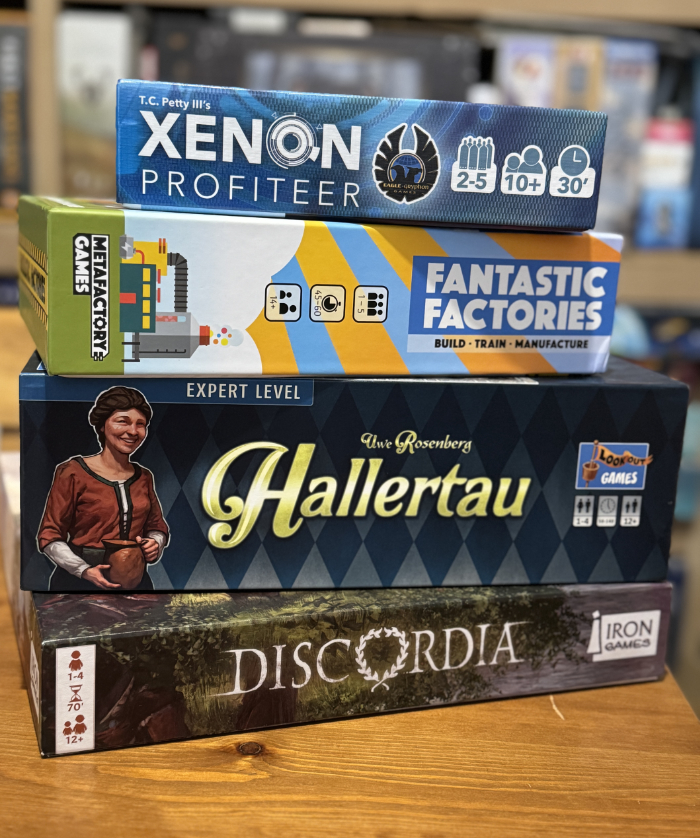
Today is a friend’s birthday, and we’re going to play some games together. We’ve played lots of different games, but some we return to again and again. It’s the same with any group of people I play with and have played with over the years. Whichever club I’ve gone to or friend group I’ve played among, there were always those games we returned to more than others, and which felt different. Why? I don’t think it’s just that you like that game more. There are plenty of games that I like well enough and seldom play. No, here I’m thinking of something more akin to pulling on that familiar old sweatshirt or the heavily worn slippers that really should go, but which have moulded themselves to you perfectly and cannot be replaced, no matter how many objectively newer and shinier alternatives your in-laws buy you for Christmas. They’re like a comfort blanket, so I call them comfort games.
As I pondered what we might play today, I started wondering whether you could deliberately design a game to fill that comfortable niche, and while (spoiler alert) I don’t think you really can, you can probably design something with more chance of getting there.
First, let’s take a step back. What do I mean by a comfort game? It’s a tricky thing to define closely, though I suspect you already have an image in your head. After having rewritten this paragraph half a dozen times, I still think that the best analogy is the favourite jumper, slippers, or chair. It’s familiar, friendly, and safe. It’s smooth edges and a warm hug. It’s an emotional comfort as well as an intellectual pleasure.
That’s a bit fuzzy as definitions go, and I wanted something more specific, so I tried a slightly different tack. If I was going to interrogate the idea of whether you could design specifically for it, which design elements would I need to include? After some pondering, I came up with a few common criteria that I think are important in the games I reflexively include in this category.
Collective Happy Memories
This isn’t quite the same as nostalgia, though it bleeds into it. I think it’s important that it’s not just me: the whole group needs the vibe to be just right. If you can manage this a couple of times with the same game, then you’re onto a winner. This is easier with fewer people, and it applies to solo games too. Starting a game with the knowledge that you had a great time last time helps massage your expectations the right way for this time. A very tricky thing to design for specifically, and probably something you’d expect to be working towards anyway.
Familiarity
I don’t think games can get into this comfort game category on a single play. You might see the potential, but they’re going to have to earn their position over time. This suggests that games need to be easy to get to the table, with simple set up. You need repeated plays to ease yourself into the comfortable embrace of the familiar. Another hard thing to design for. The following point can perhaps proxy for this.
Simplicity
This is a trend more than a hard requirement. I reckon that you could have incredibly complex comfort games if everything else aligned. However, I also think that there’s a sweet spot of complexity that’s not trivially simple, and not baroque in its complexity.
Comfortable Game Loop
A clean game loop is something you’ll be working on as you design a game, and a slick process is usually better than a cluttered one. Here though, I think that it’s essential to have a loop whose rhythm feels natural to the players as well as being clean and polished. Like musical taste, there’s a variety of options and matching the rhythm of the game to a specific player isn’t something you can do in the design stage (unless it really is a game that’s made for a specific individual).
Rewards Clever Play
All games do this to a degree. What I’m thinking of here is the kind of game where you pull off a neat combo and feel clever for having done so. Not all games promote this sort of combo loop, and different folk are probably attuned to different periodicities of it. For me, it’s not something I expect to do every turn; I want to earn it by plotting over a few turns to build into a clever combo, when I’ve set it up and the cards or dice or game state align to reward my play. I do think that this feeling of self-congratulatory pride is part of the puzzle, as unflattering as that sounds. Games with flatter loops and only regular, smaller achievements don’t seem to make my list.
I appreciate that this is all a bit fluffy and soft-edged, and also that it may well be entirely subjective, but it feels like a thing. Obviously, I’ve derived these ideas by reverse engineering the games I put In this category. You may end up with a different set of criteria if you tried this process with your comfort games. I’d be interested to hear what you find.
If I was organised enough to track my plays, I’m sure you’d see some of these near the top of my list, but not all. Discordia, for example, doesn’t come out often, though it’ll have a season now and again. However, when it does appear it always feels like slipping into warm slippers round a cosy fire. It’s very much a comfort game. So, frequency of play doesn’t seem to be a requirement once the initial familiarity has been built up.
Not sure where I’m really going with this. I just had the thought and wanted to share. To finish off, let me ask you a few questions. Do you have comfort games? I’ve ploughed on with the assumption that my neurodivergent brain is not off on a weird tangent (this time) and that the feeling is widespread if not universal.
What comfort games do you have?
Do you think they conform to these criteria?
Do you think it’s possible to deliberately design a comfort game?


 Quirkworthy
For me, King of Tokyo is the closest to a comfort game. It’s simple to understand but can be complex to play, and everyone enjoys it, young and old, neophyte or expert. I almost never make specific plans to play it, but almost always someone will say “fancy a quick game of King of Tokyo?” (and because everyone loves it, I’ve seeded copies everywhere) and off we go!
Seeding copies everywhere is a cunning plan.
Hi James
I think it is possible but there are other factors which would make it more cosy. Theme helps, without being too schmaltzy. But I think the key is how the game is played. Teamwork, where you work together to play the game, whether it’s a team goal full stop or you work together but there are private points to win, (Sagas of the Northlands). This avoids the ‘yeah whatever, you always win’. Exit games and others like the Sherlock Holmes Consulting Detective games or even Hogwarts Battles feels like, ‘come on gang let’s take this mother down!’ And the win is all the more sweeter.
Themes wise, another cosy feeling I get is when you are playing a game that feels older than it actually is, for instance Tsuro, Skullduggery (dice game), Sankes of Wrath.
The setting often helps, Ticket to Ride, Takenoko perhaps, Tang Garden (perhaps getting a bit complex on the mechanics but a proper zen feel to the game).
A recent one we’ve found is quite a good balance of playability and conjour up some childhood coziness,(uh oh, nostalgia), is Paint the Roses. Teamwork, problem solving, working out clues whilst avoiding the impending and acceleration Red Queen and a sense of satisfaction when each clue is narrowed down, definitely a warm fuzzy feeling.
Who’s James? I’m Jake 🙂
I think you’re conflating comfort with cosy, and for me they’re different things. I’ve not thought hard about cosy games, though your points seem reasonable on the face of it. Co-op, low complexity, theme, and so on. All important for that cosy vibe.
Comfort, on the other hand, doesn’t need to be cosy at all, or co-op (none of mine are), or low complexity. Anything could be a comfort game, as some of the other examples in the comments show.
My comfort game is chess. It really is. And it meets all your criteria.
I don’t doubt it. I think anything could be a comfort game.
Even chess 😉
Hmm, never thought about that until now. I don’t have a regular gaming group, but the closest I can think of as far as games go is “Monokratoras”, a greek bootleg copy of Dungeonquest I got as a kid but I got most of the playthroughs as an adult. Which also means that I don’t have happy memories of playing it as a kid as I played it very little (unlike a close friend of mine who destroyed his copy while playing with other kids!).
I do however feel that comfort games are pretty much like the people who play the same TTRPG in the same way over and over again; same characters more or less, same stories, same rules. And I feel for these people, it’s just the familiarity as you put it combined with the group vibes, and honestly they could be playing pretty much anything that’s not too convoluted (let’s face it, half of those people play D&D 3.5, and that’s pretty unnecessarily complicated…).
So I’m not sure you can design a comfort game mechanics-wise, though your tips definitely would be useful to do so. I feel it’s more of a social experiment than an experiment in game design, though.
Good point about the RPGers treating D&D as their comfort game. The principle applies outside games too. Everyone has a comfort activity of some sort, and I’m just applying it to gaming because I do that with everything. Obsessive? Moi?
Definitely something of the social experiment, or perhaps social engineering involved in intentionally designing comfort games.
It’s not obsession if there’s logical arguments to explain it, LOL.
I feel that to intentionally design a comfort game, you need to focus on the zeitgeist when it comes to mechanics, cherrypicking what people are already *very* used to in order to make it feel familiar (Which lots of designers are doing anyway, for marketing reasons…). Anything that breaks the mould makes it even harder.
And of course you can’t compete with the social inertia of existing “family games” like Monopoly or Catan. I honestly don’t know what it woudl take to make a game that level of popular. I mean, 7 Wonders is brilliant and extremely popular, and I wouldn’t put it anywhere near that level of recognition, familiarity and “comfort”.
For RPGs, though, the answer is simple- 5e. But I feel that was more because of the huge marketing campaign, the meme explosion and the meme culture that pervades the community, and the mass introduction of casuals which solidified it into the eyes of the majority as “THE RPG”.
5E is so big that it’s hard to imagine that it would ever be toppled from the top spot, but these things do happen. Catan is a relatively young game in that tier of familiarity and market penetration, so changes happen there too. Hard to measure though. I tend to use the measure of what Target or Waterstones stock as a proxy for which games have got to that stage.
Azul, Machi Koro, Glory to Rome are such games though the last one needs some getting comfortable with the way it is different from other games.
It’s a personal thing. More than most categories you could break games into, I think it’s unlikely to more than overlap with even close friends (if they have un-shared gaming experience. And even then… )