I’ve been a combination of wordsmith and game designer for decades, and you’d be forgiven for thinking that word games would be the perfect fit for me. And yet, while I’ve played many of them, it’s just not something I tend to reach for. So, when I tell you that I think a recent word game is elegantly designed and that I wish I’d thought of it, you should consider that high praise indeed.
The game in question is called Word Dungeon and is designed by a friend of mine, Joe Shimwell. Joe’s already run one successful Kickstarter with it, testing the waters of the print and play approach that I’ve been preaching to anyone who’ll listen, and some who’d rather not. His over 500 backers tell me I’m not the only one who thinks he’s onto something.
So what makes it good? Firstly, it’s simplicity. In Word Dungeon, you have a gridded map of rooms and corridors of the sort you’d expect from a classic RPG catacomb. Here and there are gems and treasure chests to collect, and a boss to fight. You progress by building a path through the dungeon with letters, in a similar way to constructing words in Scrabble, or a crossword. Once your path reaches the exit or slays the boss you’re finished and you can tot up your score. Like I said, (deceptively) simple.
Of course, some of the dungeons (and there are many) have an extra rule to give a twist, and these make you approach the puzzle a new way. And it is a puzzle.
If I put aside the simplicity of the rules, the bit I like most is that unlike both the Scrabble and crosswords I mentioned earlier, you aren’t handed the letters and left to construct a word from what looks like the name of a particularly unpronounceable Welsh village. No. You can use any word you like that will fit the space. Like a crossword, wherever letters touch they have to form proper words, both across and down. Other than that, you choose what you enter, and therein lies the real brain burn.
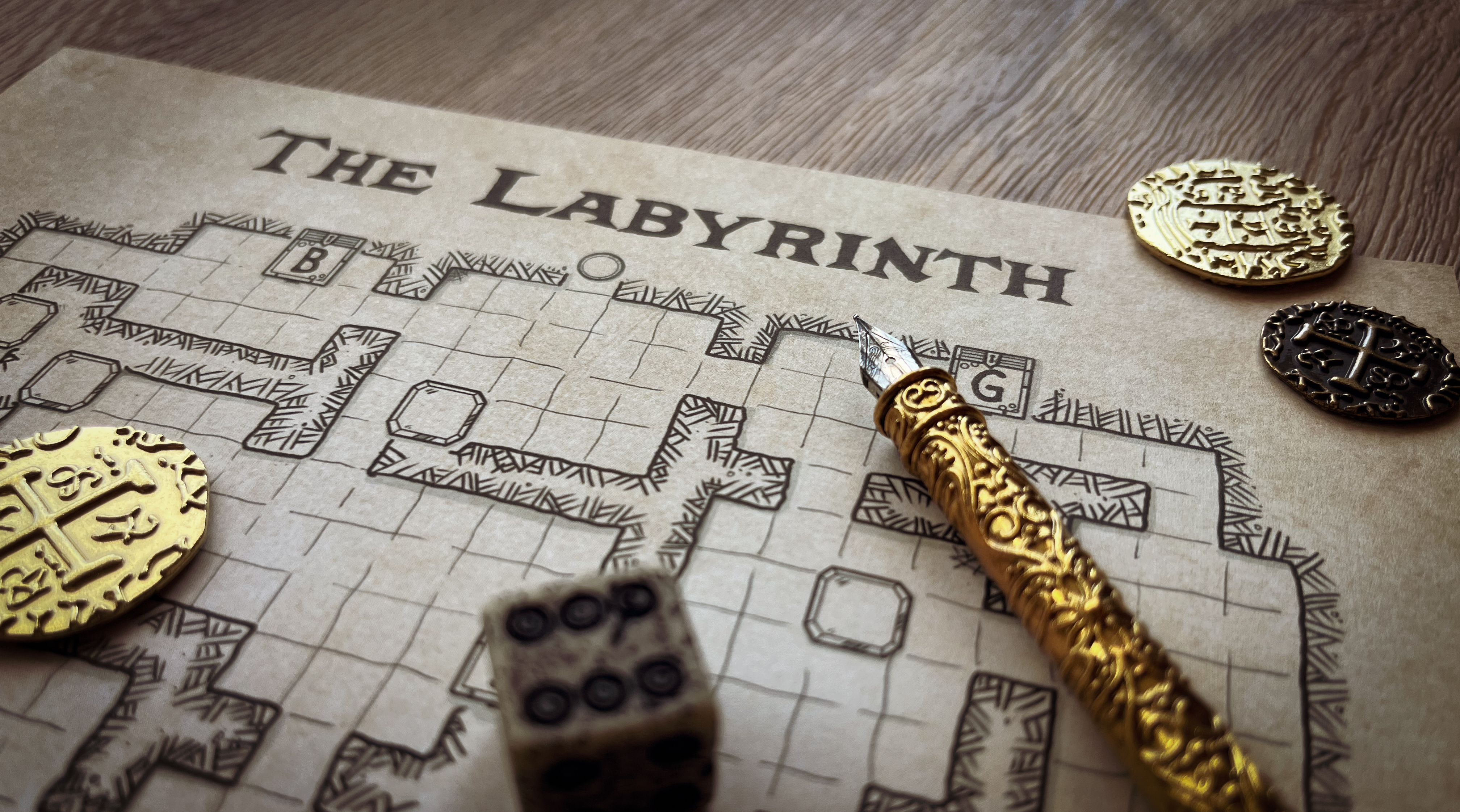
In order to collect bonus goodies, you have to incorporate their square into one of your words. Naturally, they’re in awkward places that drag you from the optimal route. For other treasures, there’s already a letter on the map which you must also incorporate to count them as looted (and therefore worth VPs at the end). But most of the time you’re making your own problems. Get too clever in one room, and you might struggle to continue your path in the next. You need to be thinking several words ahead while juggling whatever wrinkle this dungeon has to offer. All of which gives you a lot of puzzling to do, and occasionally leaves you with really awkward situations. Situations that you put yourself into. And that feels very different to Scrabble, for example.
What ends in J anyway?
The rules are so simple that they can be internalised in a couple of minutes, twists and all. The game then gets out of the way. You’re left to spend your time wrestling vocabulary into a convincing spaghetti of interlocking words so that you not only traverse the tunnels and get to the boss, but do so with maximum points along the way.
If you’re interested, you can still get the original set of dungeons. In addition, a couple of hours ago (as I write this) Joe launched a second campaign, this time on Backerkit. It’s already funded, and this time it’s for a hundred slightly smaller dungeons. A hundred. That’s a touch bonkers, but in a good way, and I’ve backed it to add to the first collection.
Turns out that I just needed the right word game, and it wasn’t Scrabble.