Deadzone Beta – New Turn Sequence

Part of the job of the Beta is to draw out the elements of the rules which cause the most confusion so that we can clarify the relevant parts. Whilst it would be nice to have examples and tactical hints and tips for every single section it’s not really practical (it would triple the size of the book). So, the Beta focusses on the rules bit of the rules and when folks find something tricky I know to expand on that in the final version.

So, the first candidate for expanded explanations seems to be the new turn sequence. I’ll not worry about exactly what the models can do when they get a chance to act – we can look at that later. For now I’ll just focus on the sequence of play as a whole.

I’ll assume that you’ve looked briefly at the Beta and find it less than clear. See if this helps.


Rounds & Turns

Deadzone is played in Rounds. During a Round all the models on both sides get to move, shoot and generally do stuff.

Within a Round, players take Turns doing some stuff with some of their models until all of the models have had their chance to act.

For example, if I have models A, B , C and D in my force, and you have models 1, 2, 3, 4, 5 and 6 in yours, then a Round might go like this. 

  • Turn 1: I do stuff with A and B.
  • Turn 2: You do stuff with 1, 2 and 3. 
  • Turn 3: I do stuff with C.
  • Turn 4: You do stuff with 4.
  • Turn 5: I do stuff with D.
  • Turn 6: You do stuff with 5 and 6. 

At this point all the models on both sides have had a chance to do something and the Round ends. 

Note that the number of Turns within a Round is not fixed and doesn’t really matter. It’s as many as it needs to be and could vary from one Round to another if the players changed their tactics.


A Single Turn

When it comes to your Turn you must normally do stuff with some of your models. You must use at least one model and can choose to use more. The maximum you can use in a single Turn is equal to the Command Total of your Leader model. The Command Total is the two numbers of your Leader’s Command Value added together.

For example, an Enforcer Sergeant has a Command value of 2/2 and therefore has a Command Total of 4 (2 + 2).


Passing Your Turn

As it says above, when it comes to your Turn you must normally do stuff with some of your models. However, sometimes you can Pass the Turn right back to your opponent without doing anything.

Count the number of models on both sides that have not done anything yet this Round.

If you have fewer models than your opponent left to do stuff with this Round then you may choose to Pass.

If you have the same number or more models than your opponent left to do stuff with this Round then you may not Pass.

In the first example above, the red Turn 5 shows a point at which the army of letters could choose to Pass because when it comes to their Turn the only model they have left to do stuff with is D while the army of numbers has two models (5 and 6) left. 


And…

That’s it. What is really interesting is the implications.

Firstly, it allows your models to work as teams and support each other when you want them to. However, when you just want to bide your time you can hold back and just take Turns with a single model at a time.

Secondly, it gives more control to better commanders. By more control I mean that they can do stuff with more models at a time if they want to and can therefore do more to control the ebb and flow of the Round. Given the number of models you usually have relative to your Command Total you can choose when to surge forward only a few times in a Round before you run out. When you choose to do so, or if you choose to move as small teams or individuals for the whole time, is all part of the tactics.

Thirdly, because the ability to act within a Round is based on the Command Value of the current Leader it reacts to the changing situation on the battlefield. If a Leader is killed then their loss is immediately reflected in a reduced ability to control the ebb and flow of the battle.

Fourthly, it helps to give character to individual factions as the command structure of each is different. Some have Leaders who are well armoured and dangerous fighters who are happy leading from the front. Others have less combat-oriented models who are happier leading from the safety of an armoured bunker.

Fifthly, it adds another consideration to army building. Now you have to decide which type of leader you want. Adding a captain rather than a sergeant isn’t just about their fighting skill any more – it’s actually about their command ability too.

Posted in Deadzone | 32 Comments

Deadzone Beta Rules

The Beta rules for Deadzone will be available in a few hours so I’m putting this post up to collect any feedback and comments you may have.

There are a number of changes from the Alpha and a distance yet to go till we’re finished. However, this is a significant step forwards, with many small refinements to the core system, a new Command system and an altered turn mechanic that integrates with it.

I’ll be attempting to get some of the remaining goodies up before the Kickstarter ends with more missions and expanded army lists high on the agenda. As ever, subscribe to Quirkworthy or check back regularly for the latest info 🙂


Posted in Deadzone | 224 Comments

Deadzone Beta Rules Nearly There

Well we’re almost done with the first iteration of the Beta rules. It’s currently being laid out and the cards redone with a lot more info on them. I’ll check through tomorrow first thing when I’ve got less tired eyes and we can make any final tweaks before they go out to you guys.

We’d been hoping to get them up today, but the best laid plans and all that…

So what can you look forward to?

I’ve made a number of small changes that have biggish impacts – I’ll not spoil the fun by telling you them all, but many were suggested on these forums.

The major differences are a revised turn sequence and the addition of Command Values (which drive the card system and also part of the turn sequence). I’ll talk a bit about their game impacts when you have the rules to refer to over the next few days.

The reason this is a Beta rather than an Alpha is because I think the core systems are all sufficiently robust now. They’ve been played a great deal by us and kicked about by you guys too. There are, as always, alternative ways to do every aspect and I’ve tried out the various suggestions that have been made here and elsewhere. Some have been adopted, others ransacked for details and a few abandoned in favour of other methods. Your feedback has been very useful and has helped move us along this far. What it tells me is that the core of the game is sound.

What is not yet in the Beta is a final expanded wording for all the rules. Many could do with additional explanations and diagrams and these will be added in due course, but at present I think it would be better shorter. I’m very conscious that I want people to  read and (even better) play them and get the feel of the game as a whole without worrying too much about every last detail. Changing the turn sequence and adding the CV makes far more difference in play than you might expect, and is an integral part of the way the factions fight and control the battlefield.

I was hoping to get the points values and full army selection into this version, but that’s going to have to wait a few more days. That’ll give you a few more stats and some examples at least from each of the different armies 🙂

Posted in Deadzone | 4 Comments

Quirkworthy’s Ramblings: New & Shiny

This article reprinted by kind permission of Ravage magazine.

Whether you play board games or miniature games, if the system you are using has a battlefield or board to fight over then it shares a common set of stages of learning. In broad terms there are three steps, though their edges are blurry and they blend into one another.

Step 1 – the Novice

When you first play a new game it is all you can do to follow the rules. You make mistakes and forget things, and work out afterwards what they were when you re-read the rulebook or talk with your friends. You need to work out the odds of each step carefully, and you worry more about getting the rules right than planning several moves ahead. Depending on the learning curve of the game this period may be one game or a dozen.

Step 2 – the Gamer

Assuming that you continue to play the same game then you will gradually learn the subtleties. After a while you won’t need to calculate the odds, you’ll just have a feeling for the balance of power in an area of the board. In reality, I think you are still calculating, it’s just that you’re now leaving it to your subconscious to do the maths. Of course, you will now be able to work out the rules very quickly if you want to, but what interests me is the feeling or intuition you have gained.

Step 3 – the Veteran

When you play a game for a long time you learn to read the battlefield/board instinctively. You can tell at a glance the balance of power in an area, and trust your sense of what is likely to happen to be right most of the time. You may count the hexes or squares and calculate the odds carefully when it is a close call, but a large part of your strategy is likely to be based on a feeling for where you are weak and where you are strong. This frees you up to think several moves ahead and to construct elaborate plans. You are now so familiar with the rules that you don’t really think about them as rules any more than you think about gravity when you throw a ball.


Use the Force

Oddly, I’ve found over the years that one simple trick can really help understand the game situation, but almost nobody does it. People go through these 3 steps and get really good at their chosen game(s), but then they stop. And for all its skill, it seems that for everyone I have met and discussed this with, there is one thing that the subconscious is rubbish at: turning things upside-down and seeing things from your opponent’s point of view.

For some reason, when you glance at the board, your instinctive judgement is based solely on what you see from where you sit. I suspect this is due to the fact that you spend the whole game sitting on one side, and your subconscious has learned this as the only viewpoint. But there is another.

Stand up, walk around the table and look at the game from the other player’s perspective. Imagine that their force belongs to you. How does your side look now? Again, it is a case of degrees, but far more often than not you will find that a position that you thought was weak may look impregnable (so you can stop worrying), and another that seemed strong may look sievelike and frail (so you can start worrying). Whatever the case it’s unlikely to seem the same.

Sceptical? I’m sure you are. Try it though, and see what happens. After all, it only takes a few moments and it can’t hurt. I’ve suggested this to many people over the years, and whether they were new to gaming or a seasoned veteran of the tournament circuit they almost invariably said they saw things about the game that they never noticed from their own side of the table.

Personally, I find this fascinating, and because it is a subconscious thing, it is somewhat magical to suddenly get a reappraisal of the game from someone (yourself) whose instinct you trust.

So your homework assignment today is to give this a try for yourself. Any tabletop figure game or board game with a positional or “battlefield” type of play area will work, eg Chess, 40K, Dust, Dwarf King’s Hold, Flames of War, etc. It will work better sometimes and worse in others, but it will work.

I look forward to hearing how you get on.


By the way…

Have you ever swapped sides in the middle of a game, just for fun? How did that feel? Was it strange playing against a side whose secret plans you already knew?

Do you listen to your subconscious (your intuition) when you play? Is it more often right or wrong?

Posted in Ravage | 13 Comments

Deadzone Interview

This afternoon I spent a couple of hours on an online interview/chat with a jolly group of Spanish gamers. It’s quite odd hearing my answers translated into fluent anything 😉

This was recorded for posterity and is available on YouTube as you might expect.

On the one hand it’s better live as you could have asked questions. On the other hand the recorded version allows you to fast forward through whichever language you don’t speak…

Posted in Deadzone | 4 Comments

Asterians And Forge Fathers Are In…

DZ_Asterians_Leader_final_x2Excellent! Thanks to all the pledgers who have made this possible. I think we’re going to have fun with these stubborn stunties and cautious elves 🙂


Posted in Deadzone | 5 Comments

Mars Attacks!

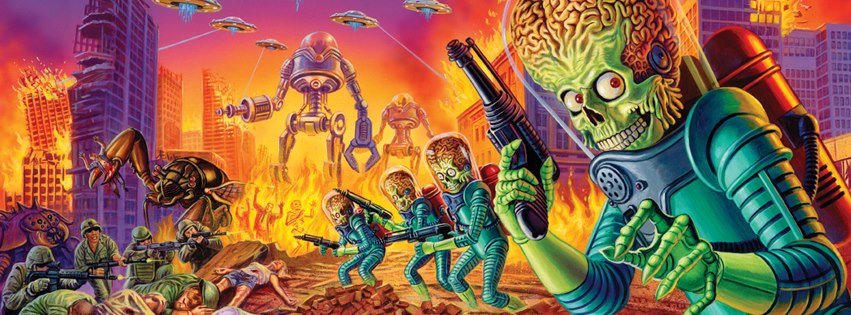
Mars Attacks banner artA few of you will have seen the press release, but probably not all, so here it is:

line

TOPPS & MANTIC ANNOUNCE MARS ATTACKS WARGAME

May 14, 2013 – NEW YORK.   Is your tabletop ready to be invaded?  The Topps Company and Mantic Games have joined forces to bring MARS ATTACKS to life as a miniature-based tabletop wargame!  Combining high quality sculpted figures with fast and fun tactical gameplay, Mantic will deliver an exciting new dimension to the resurgent sci-fi property.

Mantic Games, makers of the popular WARPATH and DREADBALL tabletop games, will make MARS ATTACKS their first license.  “MARS ATTACKS is a cult classic series that fans have been falling in love with generation after generation,” says Ronnie Renton, Mantic CEO. “Its oddball blend of retro sci-fi visuals, dark humor and over-the-top violence will make for a unique tabletop experience… our team can’t wait to bring the Martians to life in ways no one has ever seen before!”

Set against the backdrop of the new and expanding MARS ATTACKS universe, the game will feature all of the fun and thrill of the classic series, plus new characters and factions that will see action in upcoming comic books and toys.  It will also tie-in closely with Topps’ just-announced all-new trading card series, Mars Attacks: Invasion, releasing in October.

 “MARS ATTACKS is a world where giant robots, mutated insects and hordes of Martian soldiers face off against Earth’s military and innocent civilians— how could you not want to see a game out of that?” says Topps’ Adam Levine. “Mantic has quickly become one of the best in the business, and they’re the perfect team to adapt our outrageous visuals into this exciting new form.” 

Mantic plans an early 2014 release.

For more information on MARS ATTACKS, including regular updates on new products and cards, follow on Facebook.

line

So what’s all this mean then?

Most importantly for me is that I’m writing it 🙂

I’ve already had a couple of kickabouts with how I think it might work. Nothing to share yet by way of details though as they’ve all got to be approved by Topps before we go any further. That’s the thing about licenses – you’ve got to conform to a strict style bible. I can see how it might shape up though.

What I can say is that it will be a lighter game rather than a highly detailed geekfest as the whole idea is one that will appeal to less hardcore gamers. Having said that, it’s not going to be snakes & ladders – that would be dull. If you’ve played any of my games I’m sure you’ll know what I mean when I say that I’m burying interesting choices under simple mechanics. Simple, but not simplistic. Expect something that you could play with your family or with your gamer buddies for a lighter and sillier break.

Oh, and giant robots, flying saucers, mutant insects and martians out the wazoo. What’s not to like?

Posted in Mars Attacks! | 53 Comments

Updated Deadzone…

This will be along next week. I’m currently collating the results of my latest round of playtesting as well as all the feedback and comments I’ve read here and elsewhere. If you have any more comments from your Alpha games then please let me know and I’ll add them to the mix.

When the layout ninja gets back to the office first thing next week I’ll be ready to pounce with a new iteration of the rules. Once he’s made them all pretty then they’ll go up on the Kickstarter again. So, sometime middle of next week at a guess 🙂

Posted in Deadzone | 11 Comments

Deadzone – To Blaze Away Or Not?

One of the discussions around the Alpha rules has been about the term Blaze Away as the name for that action. In the game this refers to the model firing at an area in order to Pin or Suppress the target rather than kill it.

I chose the term Blaze Away because it was different from the effect names (Pinned & Suppressed) and because I was familiar in its use in larger than-life-action movies and stories – both having the sort of atmosphere I wanted to evoke for the game). However, it turns out that not everyone is equally familiar with it and so I’ve put up a poll on the Mantic forums for you to pitch in and say what you think works best.

Of course, mechanically this won’t make a jot of difference. In the game it does the same thing regardless of what we call it.

My concern with several of the suggestions is one of the inevitable confusion. Blaze Away doesn’t sound like any other game status, action or effect, whereas both Cover and Suppress are going to cause extra work explaining stuff and make it harder to write clearly and without sounding like a dictionary. It happens every time you have similar terms in rules.

Anyway, please vote and post up if you’ve got other suggestions for terms.

Posted in Deadzone | 25 Comments

Deadzone – Grenades in 3D

Grenades are a lot of fun in Deadzone, but the way they work in 3D is not very well explained in the Alpha. So, here I am to expand on that.

Firstly, a general note on 3D LOS. When attacking an square that is on a higher level with area fire you count as being able to see that square if you can see the edge or the corner of the floor.  Assuming, of course, that there isn’t a solid wall blocking that side.

In terms of grenades, the Alpha already explains how to resolve explosions in 2D. Let’s add the third dimension.

grenade scatter

This diagram is a side-on view of a grenade exploding on top of a single level block (B). Yes, it’s not a pretty sight, but them’s the dangers of dealing with Alphas 😉

The effect it has on adjacent squares (really cubes as we’re talking 3D) is as follows:

A: No effect. Grenades explode sideways and up, but not down. As the grenade will be lying on the floor, the blast will be blocked from damaging either square marked A.

B: No effect. If there was a hole in this square then there should be a chance of it falling through the hole (for the Alpha ignore this chance). If it does not then it can be assumed to be too far away for the blast to go down in much the same manner squares A are protected.

C: These adjacent squares on the same level as the explosion take the normal effect from the blast as adjacent squares.

D: If we assume that these squares are open on the side facing the explosion and that they are one level higher then they too are adjacent and subject to the normal rule for blast effecting adjacent squares. Remember though that as any potential targets will be higher than the source of the attack they will count as being in cover and so will get an extra dice.

Posted in Deadzone | 14 Comments