I’ve been rummaging in a lot of different games this week, and thought I’d ask you guys about a topic that I feel rather strongly about. It’s going back to an old hobby horse of mine: that the whole end-user’s experience needs (ideally) to be considered as a single piece and should be seamless. Often your client won’t let you do this, but it’s worth pushing for.
One thing that often gets ignored entirely is what the inside of the box looks like. Fitting stuff in is simply thought of as a matter of packing, not experience. In reality, the first impression is important. Sadly, there are few people who do this well. Awaken Realm stand out here as people who plainly think that experience through and put a deal of effort into making it a good one. Hats off to them.
For me, and I suspect many others, just looking at a game in its box is the start of the session, and it can set up a great time or cause your heart to sink a little. Judging by what I’ve read online, I’m not the only one who’s opened a box, looked inside, and just put it back on the shelf. Sometimes games are great in spite of this lack of care, other times it’s the only place care has been taken. The really great games are ones that consider the whole experience.
The following are three entirely not random games that have a different vibes for me.
What I’d like you to do in the comments is to tell me how each of these initial impressions makes you feel. Elated? Impressed? Disheartened?
Here are the games:
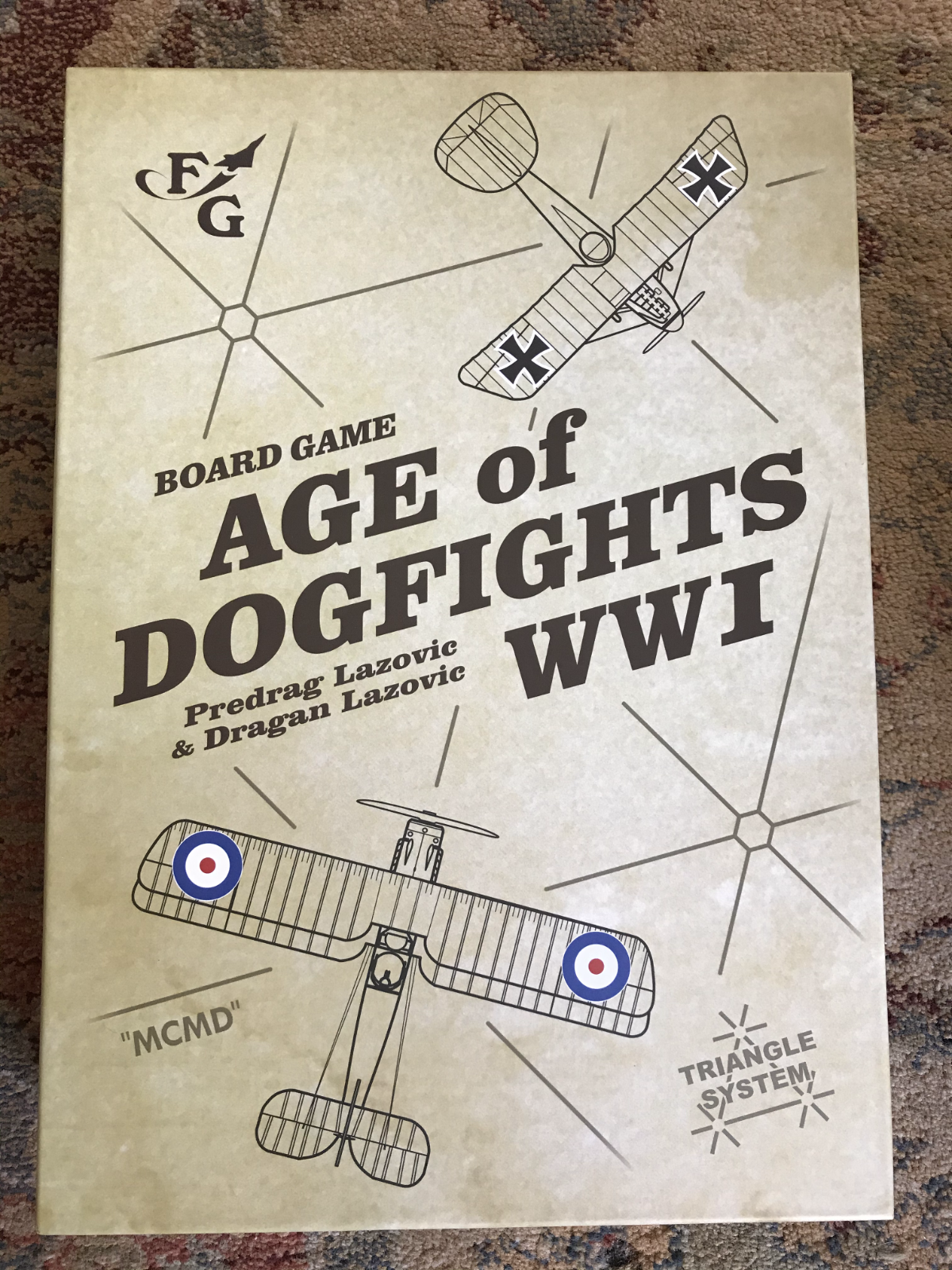
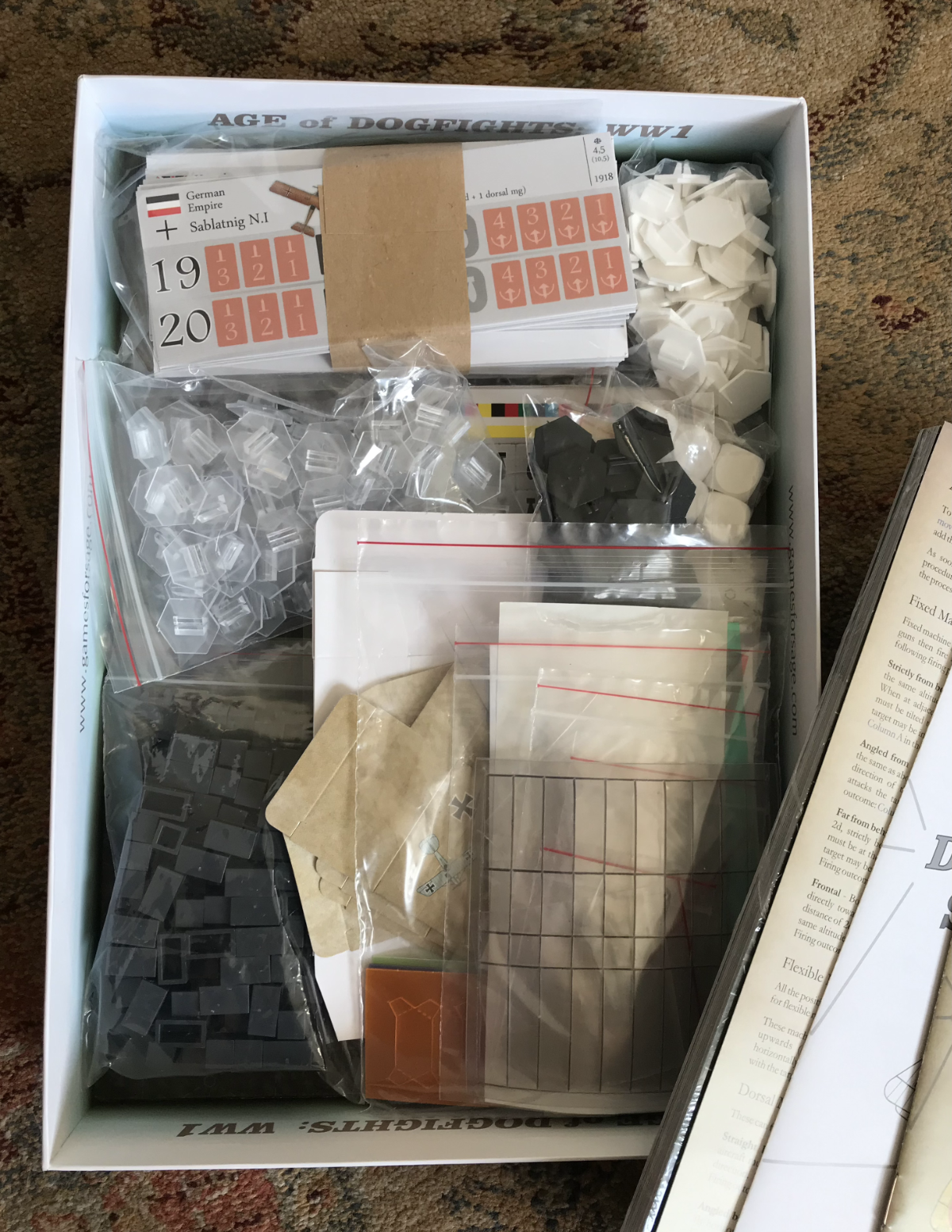
A: Age of Dogfights WWI.
A recent arrival from the wonderful world of Kickstarter. I was both hoping and fearing it would be like this 🙂
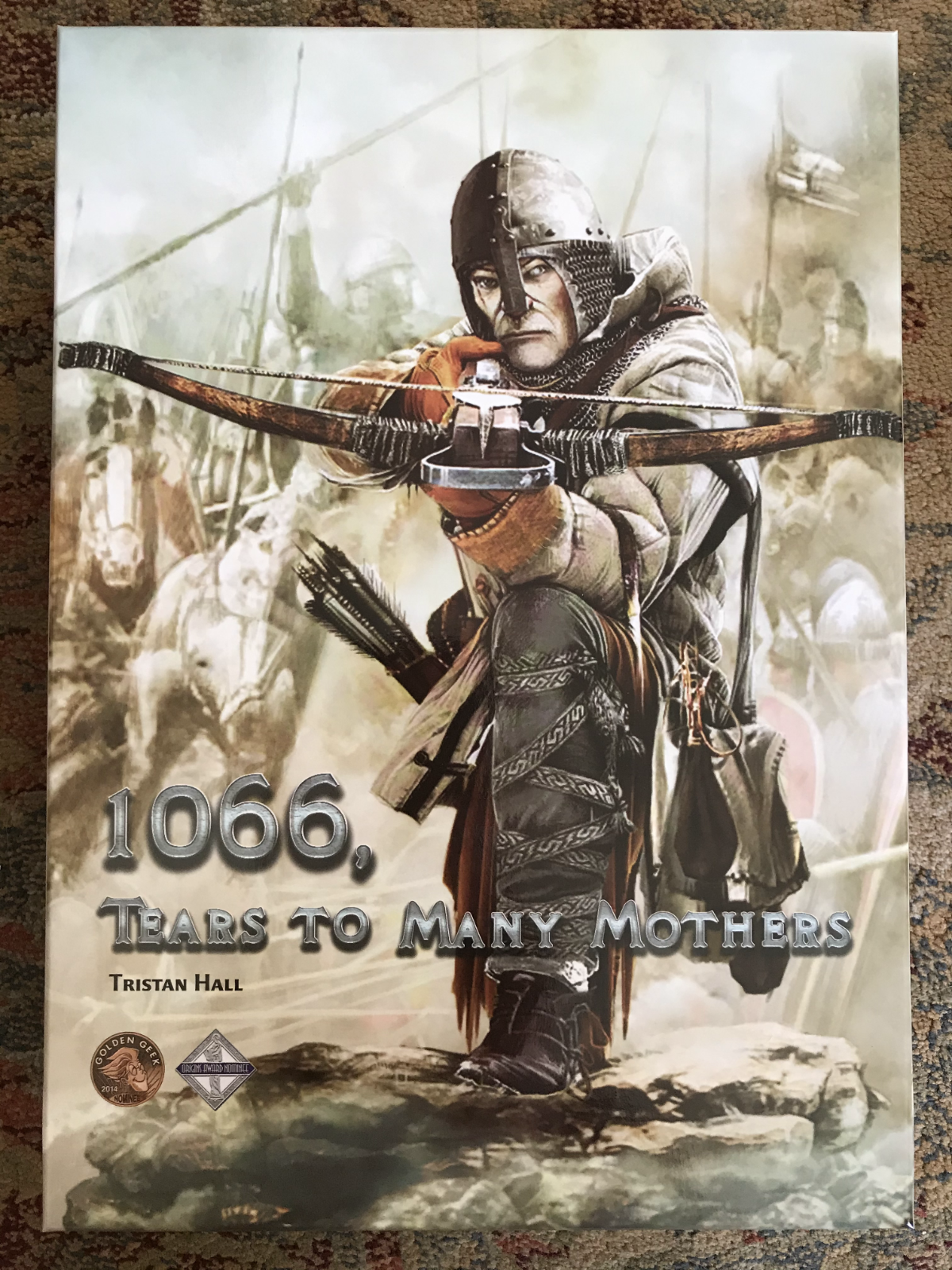
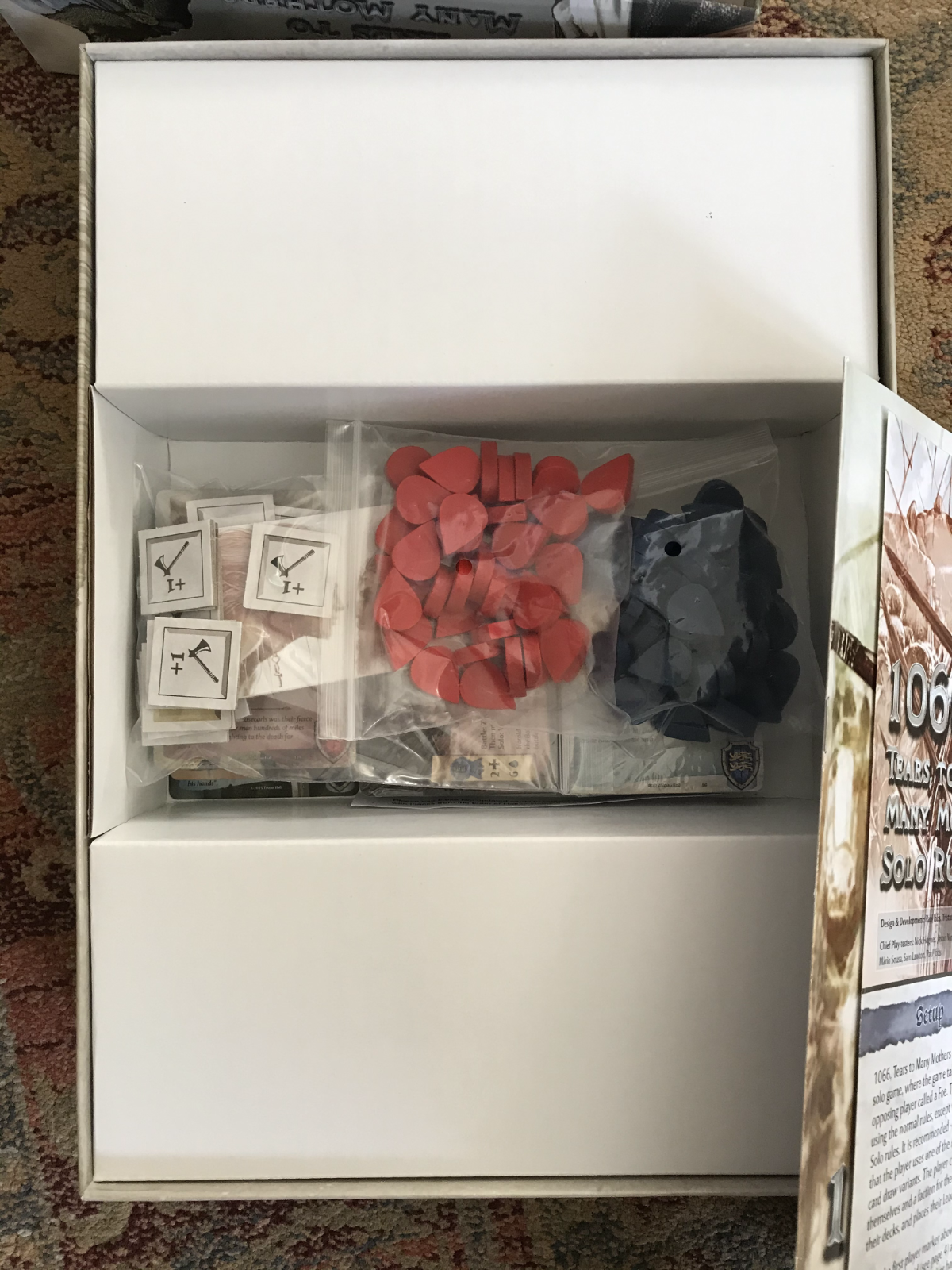
B: 1066, Tears to Many Mothers.
This is the first in a series from Tristan Hall. The third instalment is on Kickstarter now. Seriously?
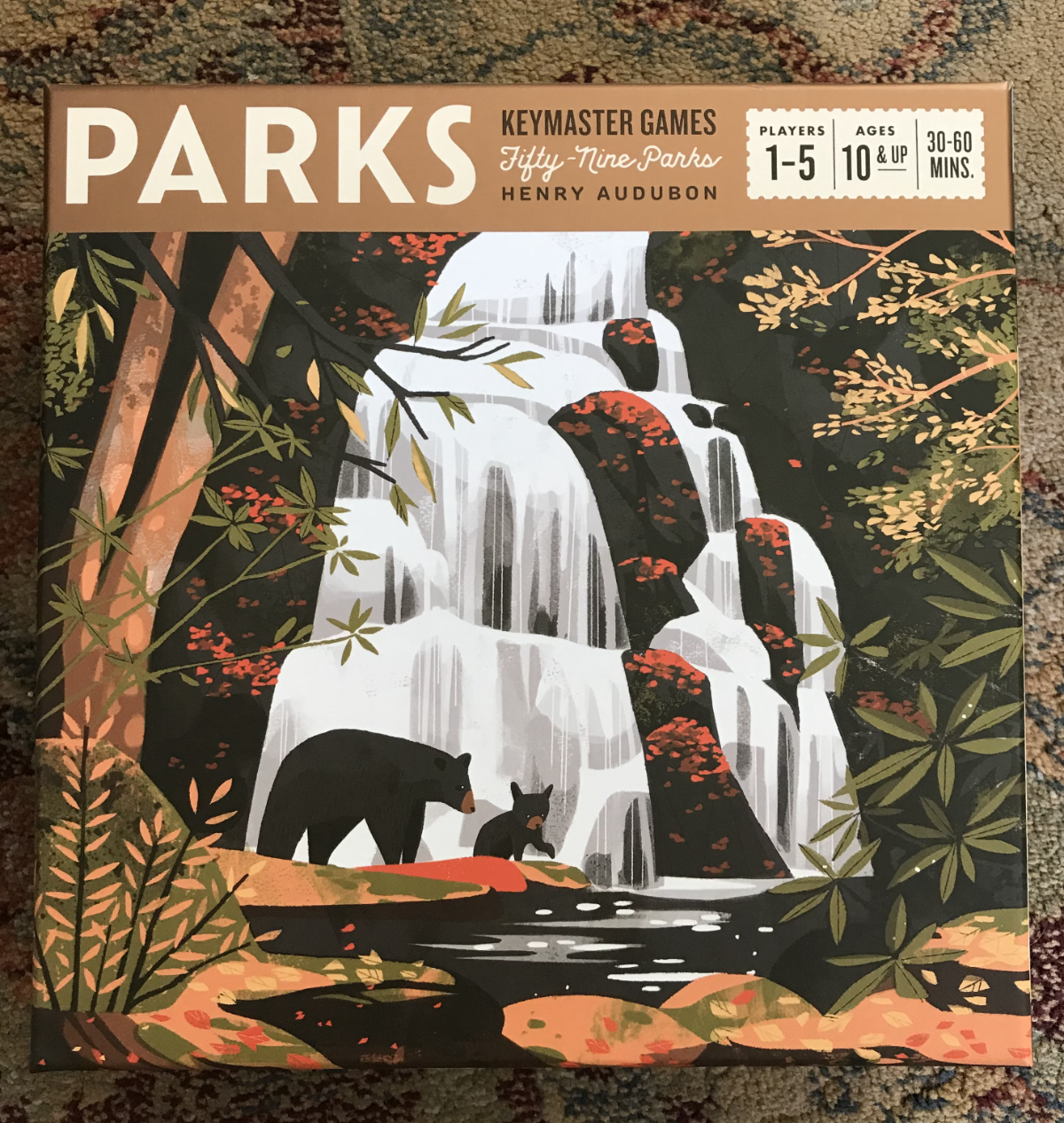
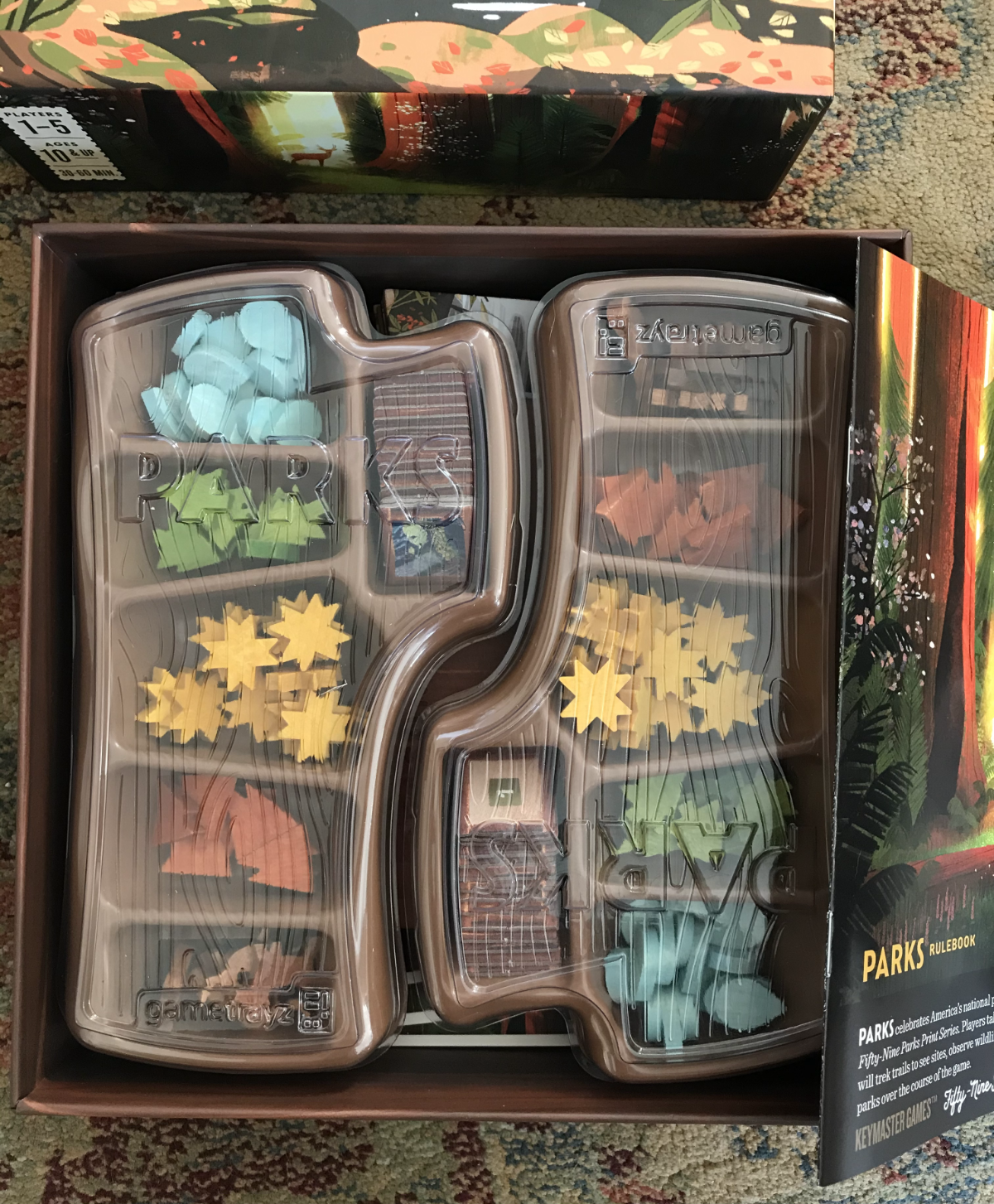
C: PARKS.
Half game, half art project. I’m guessing that the trays being in the shape of a log is not an accident.
Note that this isn’t about how the games play. It’s all about the shallow, yet vital, first impressions and how the image makes you feel.
So you don’t feel embarrassed, I’ll go first.
A: Gosh! That’s a box full of stuff. It’s not slickly presented, but it speaks of passion and reminds me of the kind of painful detail I’d put in my own games when I was 18 and knew for a certainty that more detail always meant better. Lots of different materials used. Clearly some (over)enthusiasm involved in the making of this. It’s a bit daunting and I’ll need to put aside some time to get to grips with this. It’ll be exciting when I do though.
B: Where’s the rest of the game? FFS. This box is at least three times as big as it needs to be and that’s just rude. People have shelf space to consider, you know. Reminds me of the bad old days of early “German games” (before they were called Euros) when paying for a game and getting a box of air was commonplace. Nobody liked it then either. Inconsiderate. Not a good start.
C: Classy. Custom inserts that you can take out and use as the supply on the table. Not only is it a full box, wasting no shelf space, but it’s useful in game too. They’ve made it easier for me to get the game on the table and quicker to set up and pack away, saving valuable gaming time. I like these people. Very positive start.
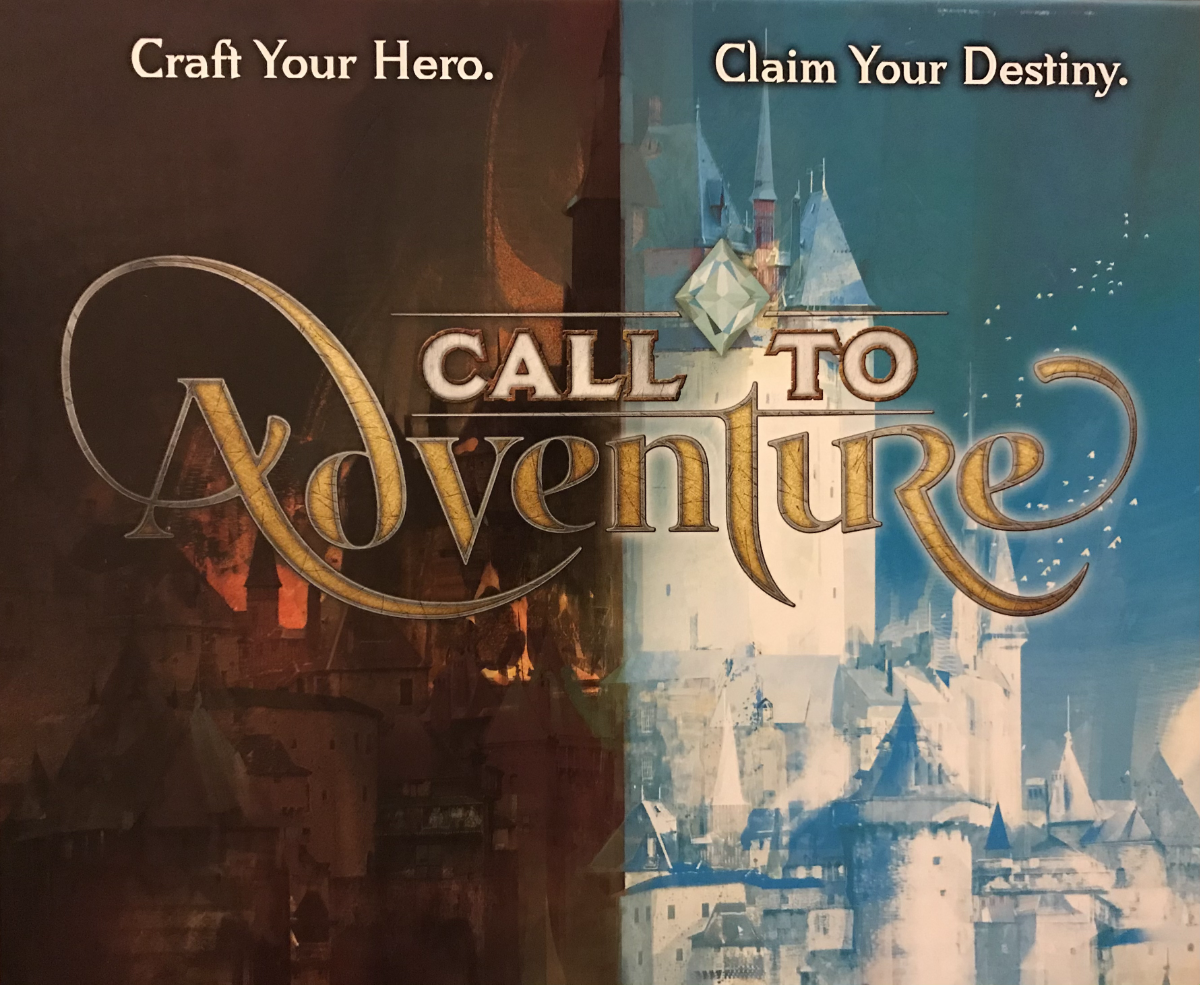
After my fun being Unbroken, I’ve heard the Call to Adventure, and have been off telling more tales of derring-do! Sadly, these did not go as well.
CtA has some very nice art and a generally attractive aesthetic.
My initial experience with Call to Adventure was a bit of a mess. The components list has wrong counts for some items, doesn’t show others, and the included FAQ also seems to be wrong in at least one regard (number of adversary quest cards). I’m still less than 100% sure my copy is complete. I think it is, but it’s just not clear.
If you start, as I did, trying to play the game solo without knowing the multiplayer game then you’re immediately confronted by the need for things which are not explained. Start by finding the Adversary cards (not listed among the components). When you’ve found them (they’re hiding within the level 2 and 3 decks) you can then start looking for your Hero marker. These are on the components list, but at less than 2mm in size I didn’t spot them at first. The layout guys like tiny icons: the skulls marking the adversary cards within the antihero deck are similarly small on the cards, and their placement among the other info is not shown in the rules so you have to find it yourself. None of this is particularly hard, it’s just unnecessary grit in the wheels of what should be a smooth process.
A poor first impression.
My first game included lots of looking through the pretty, but poorly laid out rules, and way too many WTF does that mean? moments. Far more than there should have been for a game this simple. In the end I just guessed a bunch of card interpretations as I could find little guidance. The game could really do with a reference of all the icons in one place. Currently it’s scattered across at least 3 pages, and I’m not sure that covers all of them. Nor do I especially want to be looking in the rules at all. Why can’t I have all this on a reference card?
The game is of a similar complexity level and play time to Unbroken, which is partly why I thought it might make a good comparison. But it’s no match. For solo play, Unbroken wins hands down. Easier to play, better explained, better referenced, and the things I dislike about the layout and graphics are no better done in CtA.
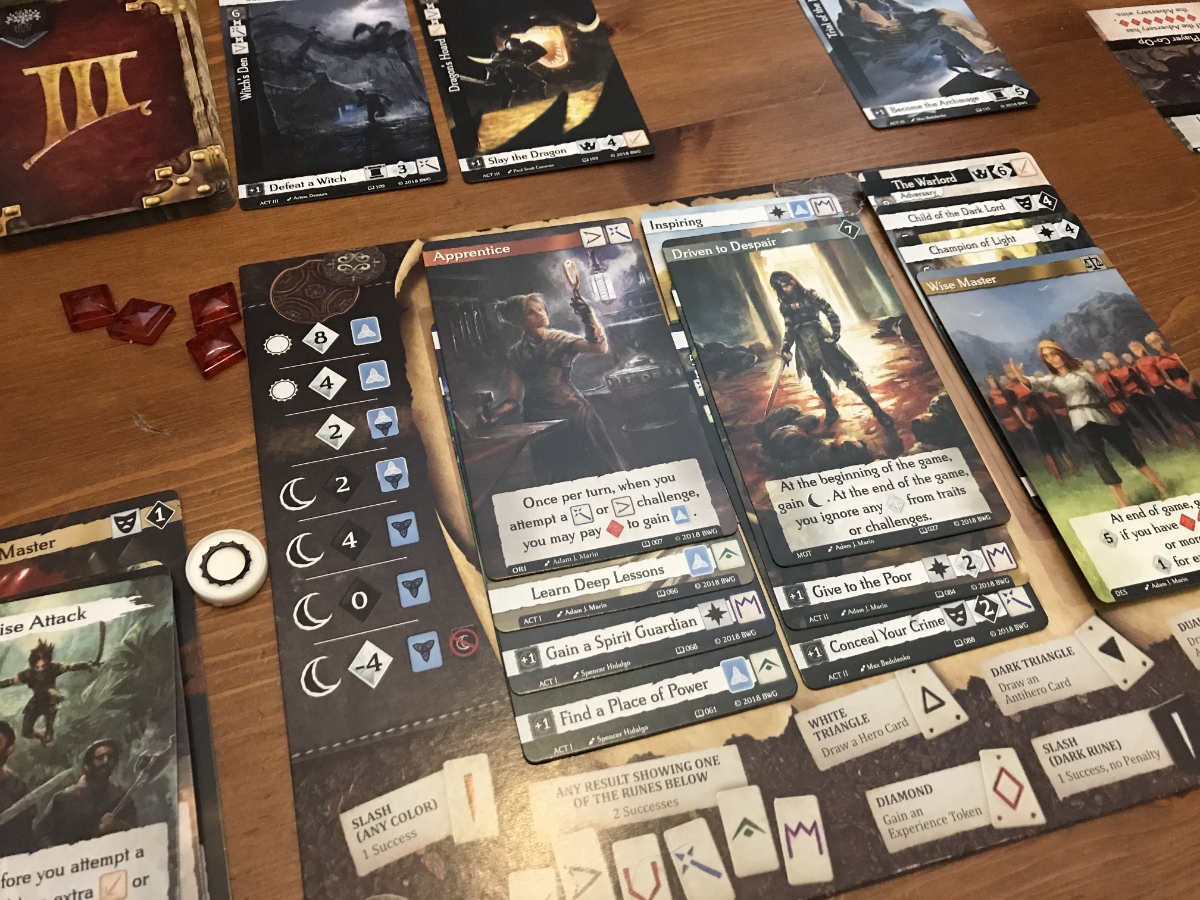
The end of my first game.
Despite all this, it’s not a complex game. So, after 3 games I knew the common icons by heart and knew where to look for the others, so I was fine. Unfortunately, by then I’d had enough. My third game was a bit of a slog and was not enjoyable. A big part of this was that I found the decisions less engaging than in Unbroken, and my objective far less clear. I could go for this or that, but it doesn’t matter a great deal and the randomness of the rune throw felt more powerful than my choices. The AI deck forcing redos and choosing different challenges on some results did not help me feel that my choices mattered.
So it was awful, right?
No, it wasn’t.
Call to Adventure is a pretty game – prettier than Unbroken, I’d say. Its problem is that it feels like it merely tolerates solo play rather than embraces it. Unbroken is solo only, so of course it’s optimised. In CtA it’s not even its own section – it’s blobbed in with the co-op rules (hence the lack of care in clarifying what the cards mean for solo play). There could be many reasons why the solo variant turned out half-hearted, but that’s what it is.
I think the truth of it is that CtA may be a great multiplayer game. While I won’t bother trying to solo this again, I will keep the game as I can see that it could be a lot of fun with the right group. It wants to tell stories, and so the banter around the table and the telling of your hero’s tale at the end (which they say you should do), are a major part of the experience. At least, that’s how it reads. And I can see how that might work, and be enjoyable.
I also think that the rules would be clearer if you started with a multiplayer game. That’s what it really wants you to be doing, and I assume how they were written.
When the Dark Times are over and I can get it on the table with a group, then I’ll revisit it and let you know how it goes.
In the coming weeks I’ll dig out some of the other dungeon games I’ve got to see how they compare. For now though, I’m still Unbroken.
You see that carnage in the distance? That’s the rest of your party being slaughtered.
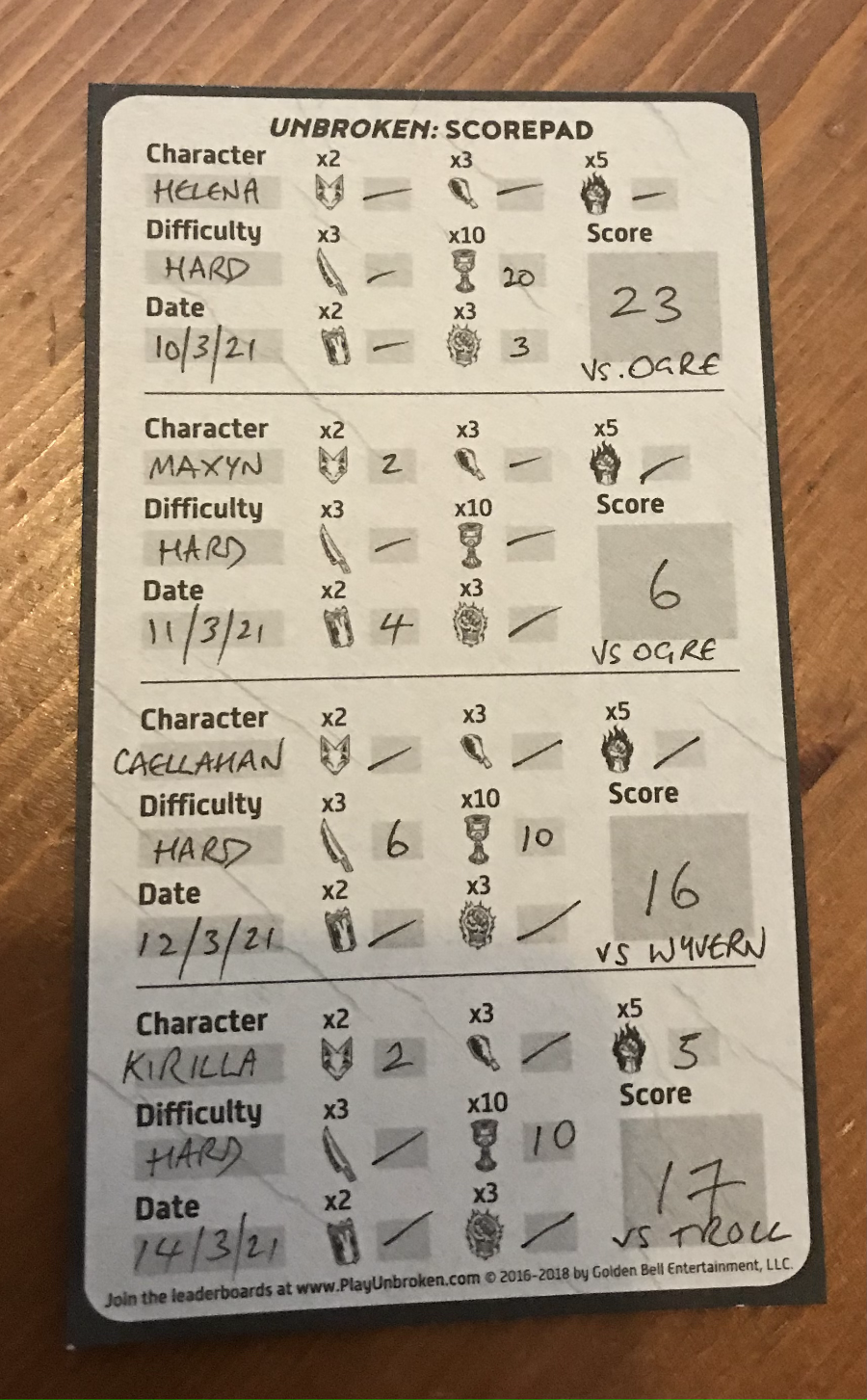
I’ve probably played over two dozen games so far, all bar one on hard mode. Of those I’ve won only five. But I have won.
Those wins have been with all four heroes, and against four of the six level four monsters (I’ve beaten the Ogre twice). I’ve fought all 24 monsters in the game at some point, and look forward to not meeting some of them very much more than others.
No great scores, but just getting out alive is a big win. I added the level 4 monster I beat as I thought that was interesting to track too. Still some who elude me.
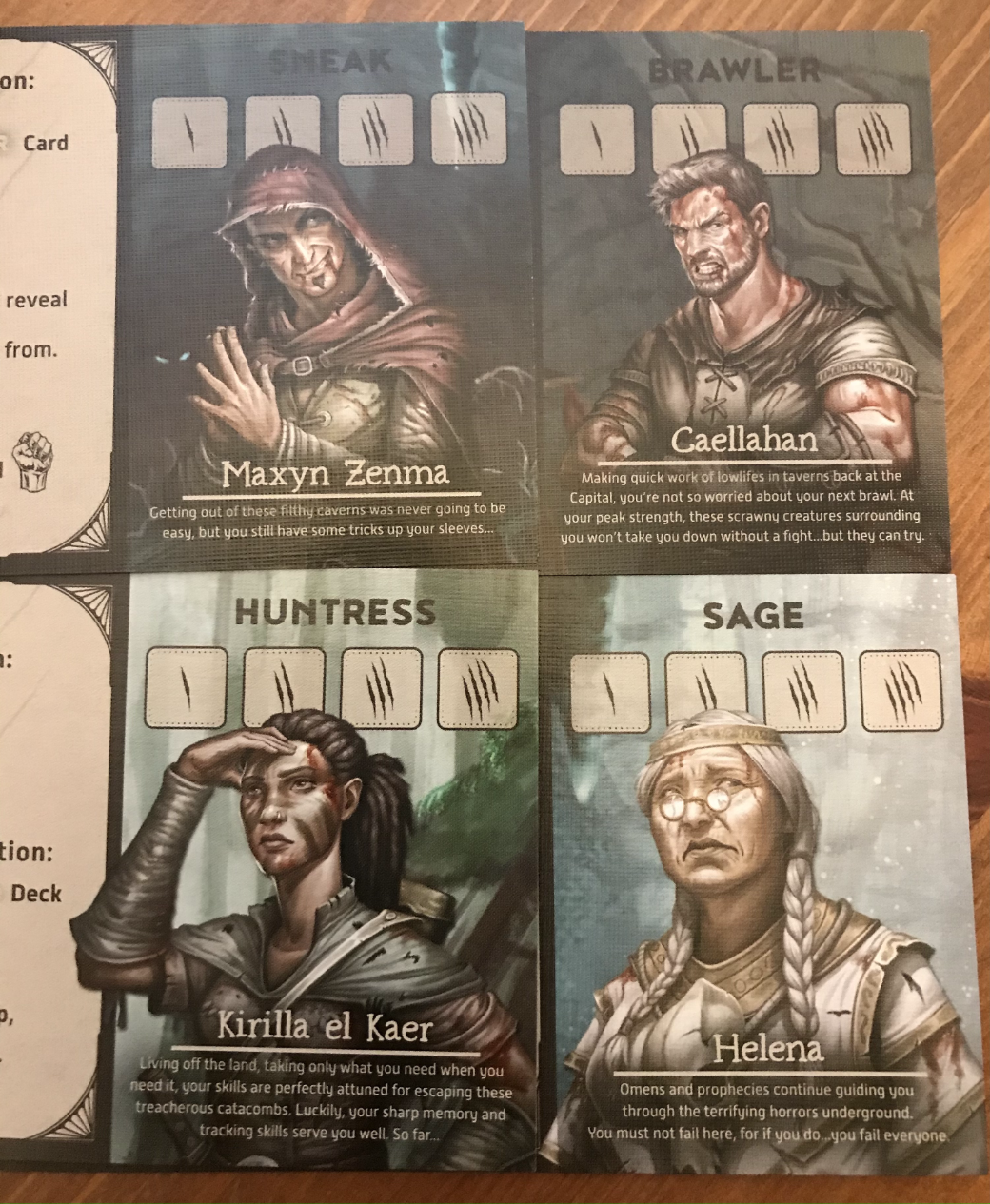
Am I still happy playing it? Yes, and I’ll be keeping it. Having experimented with the various heroes and different strategies, I’ve not yet solved it. I did work out how to use the huntress though, after thinking more carefully about how to get the best of her abilities. She’s pretty effective now I know what I’m doing with her.
Note that I say “her” when I refer to the Huntress. Each of the four hero cards has a male and a female side with identical rules, but I only ever use one side of each. I think it’s because that’s the side I prefer the art for. If you’re interested, for me it’s the male Brawler and Sneak, and female Huntress and Sage. I’m not sharing things out evenly – it’s just how it looks to me.
The heroes I use.
After all these games, what can I say apart from the game is great value for money and has a lot of legs? Well, like most games, it’s not without its faults. So where do I think it could be improved?
Combat is a combination of deterministic attacks (mostly the player), and random results (the monster). This means that you can sometimes see at the start of a fight that you aren’t going to win. This is a mild case of the problem I found hugely offputting with One Deck Dungeon. It feels much less of an issue here because it’s not always as cut and dried and you can almost always tell that you’re in that much trouble before you get to the fight. You can see what potential damage output you have, and if you’ve been collecting the wrong things then you could set yourself up for failure really easily. The resource economy has no wriggle room for wasting your time on random stuff. You need to stay focussed. And be a little lucky at times. In the end, I think that’s a good thing rather than a bad one. Here, if I end up in a fight that I can’t win, I can usually track that back to some poor decisions on my part rather than something the game randomly threw at me.
Sometimes though, these seemingly desperate or impossible battles can be the most engaging. I fought against the Abomination earlier today, and that scrap would have been my last were it not for the monster’s ability to harm itself. It certainly looked an unlikely win, but in the spirit of the game I fought on regardless. In the end, its bizarre nature allowed me to scrape a victory against it with only 2 “life” remaining. Hard to pull yourself up after that, but possible. In that case, I beat the next monster, and only failed at the final hurdle. Close though.
In general, I’m not a huge fan of deterministic games because of this predictability, but it works here most of the time. A minor con.
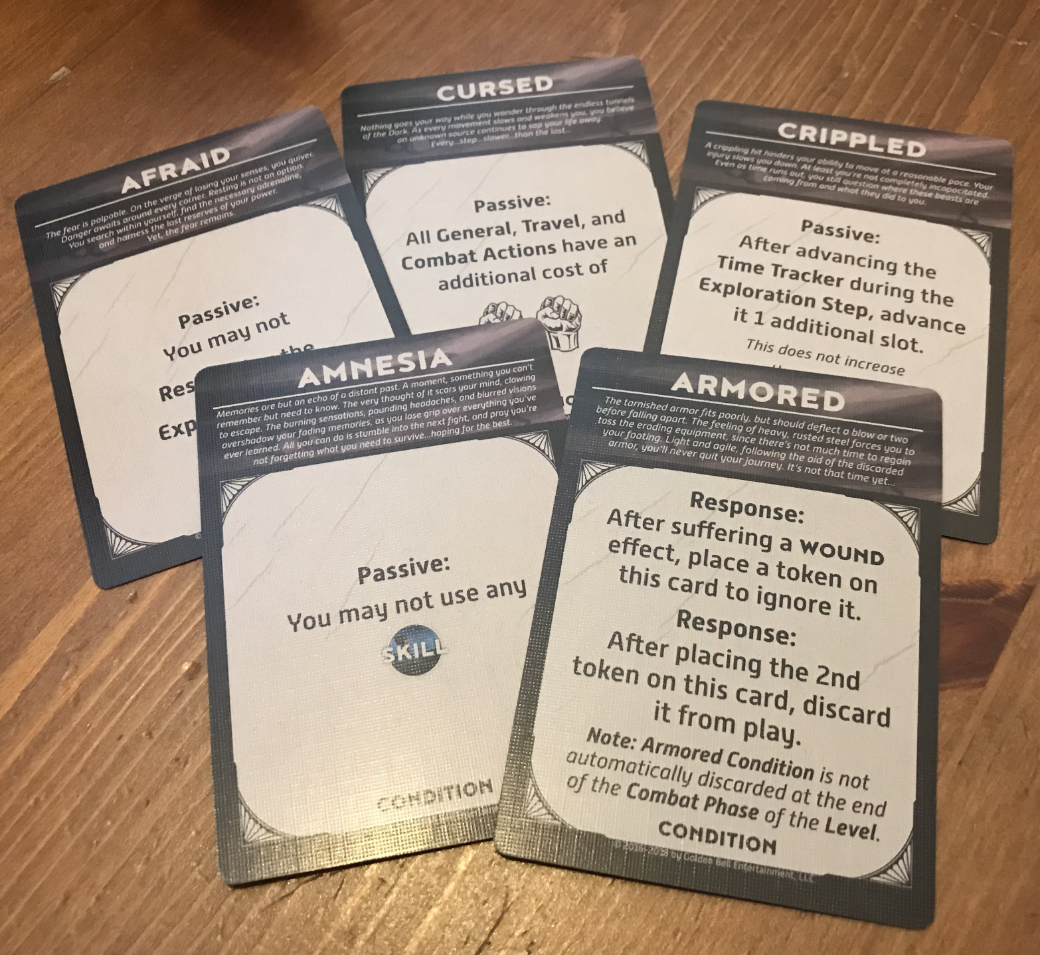
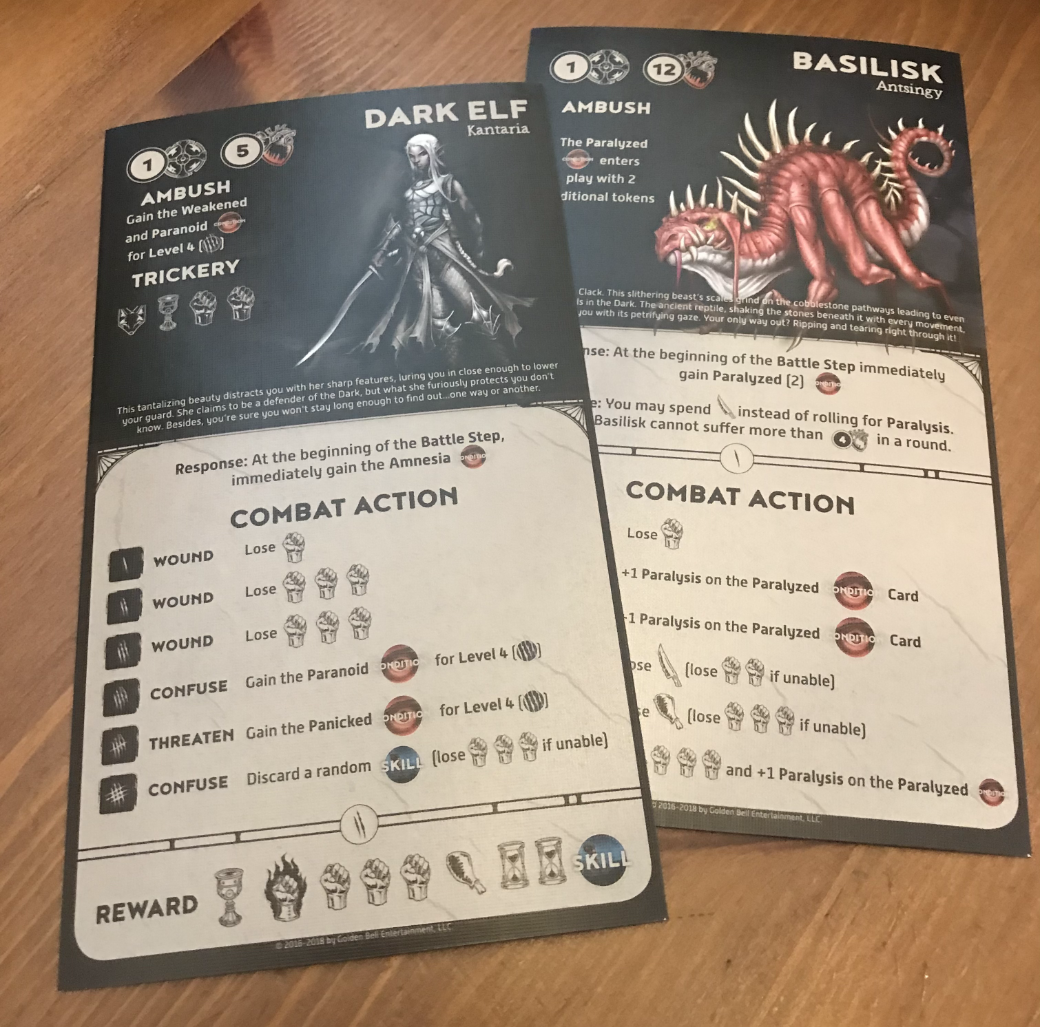
Some folk would consider the variation in lethality of the monsters to be a con. I’m not sure it is, and perhaps it’s worth engineering in as a concept just for the drama you get rolling for who you fight each level. Certainly, I’d rather not be fighting critters who dump loads of conditions on me to suffer through in the next level. And there are those who mess with you in the moment too. The Dark Elf’s infliction of Amnesia (you can’t use any skills against him) can be particularly crippling. I’d rather have an opponent who just had lots of wounds than someone who was easier to kill but crippled me for later. But you may see things differently.
Always nice to see Armoured. The rest are horribly familiar and I could wish them less so.
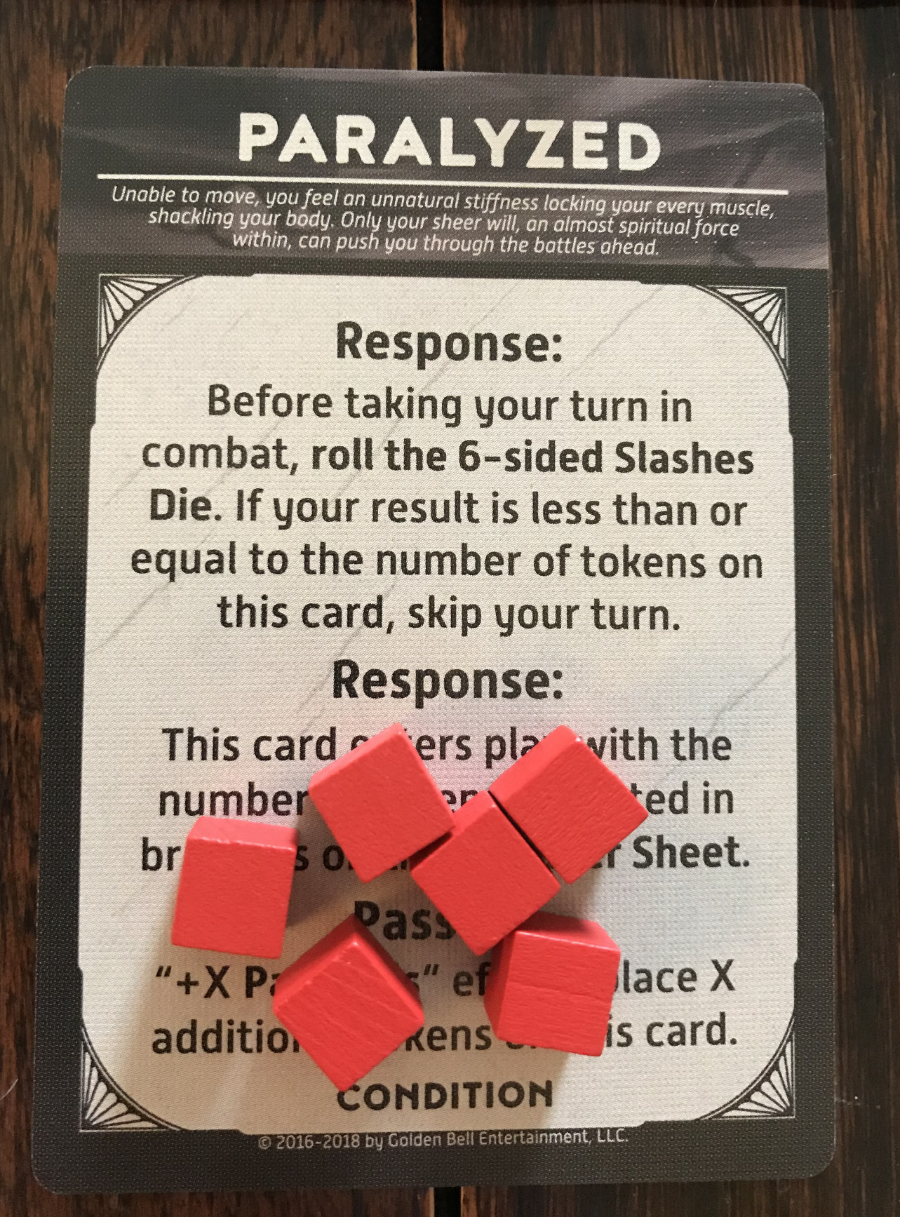
While I’m talking about conditions, I think that they’re one of the most impactful aspects of the game. Several times I’ve lost a game because of one or other of those lingering problems. Sure, it’s bad facing the immediate issues of the wyvern’s poison or basilisk’s petrifying stare (I have killed both of them though), but what’s more crippling in the long run is Weakened reducing all your damage, or Cursed making all your actions cost loads more. I’m not saying they’re broken, they’re not; just that you need to be really aware of what they can do and, if possible, avoid them. There is one beneficial condition: armoured. That’s awesome, and is possibly the only card I always choose over its alternative.
So this game has kept me amused for a couple of dozen plays so far and I’m going to be trying some other dungeon games next to compare. This is unlikely to be the last time I play Unbroken though. Apart from anything else, an expansion is in the works. I’ve not looked at what’s being added because it will be a fun surprise. What would be the obvious areas to expand though?
There’s endless room to add whole new sections to the game to expand the scope, but if we assume that they stick within the current framework there are some easy wins in adding more to some of the card decks.
The basilisk is hard to beat, but not impossibly so. You just have to ensure that he never, ever ambushes you. The Dark Elf is a swine and a half, and as a level 3 monster can cripple your chances of beating the following level 4. With no skills to use against him, you’ve got to have set yourself up to kick out some damage really fast from your main weapon.
A fifth level of monster would be an insanely hard option, but a fitting one. That would also entail giving you rewards for the existing level fours (which I felt like they should have done anyway), but that just means replacing those cards so would be simple in production terms.
I’d like to see some more heroes with new combinations of abilities. That’s probably the biggest bang for your buck in terms of adding extra game play with a card or two. It also allows you to expand the story and the world.
We probably don’t need more encounter cards as the deck is already huge, and the same goes for skills and conditions. That framework of core mechanics is already well fleshed out. So, they’ll probably add something entirely new, which will be interesting. In the end, Unbroken doesn’t really need expanding. It works fine as it is. But gamers are gamers, and the new and shiny has an undeniable attraction. So, when this expansion comes out, it’s pretty much guaranteed that I’ll be getting it.
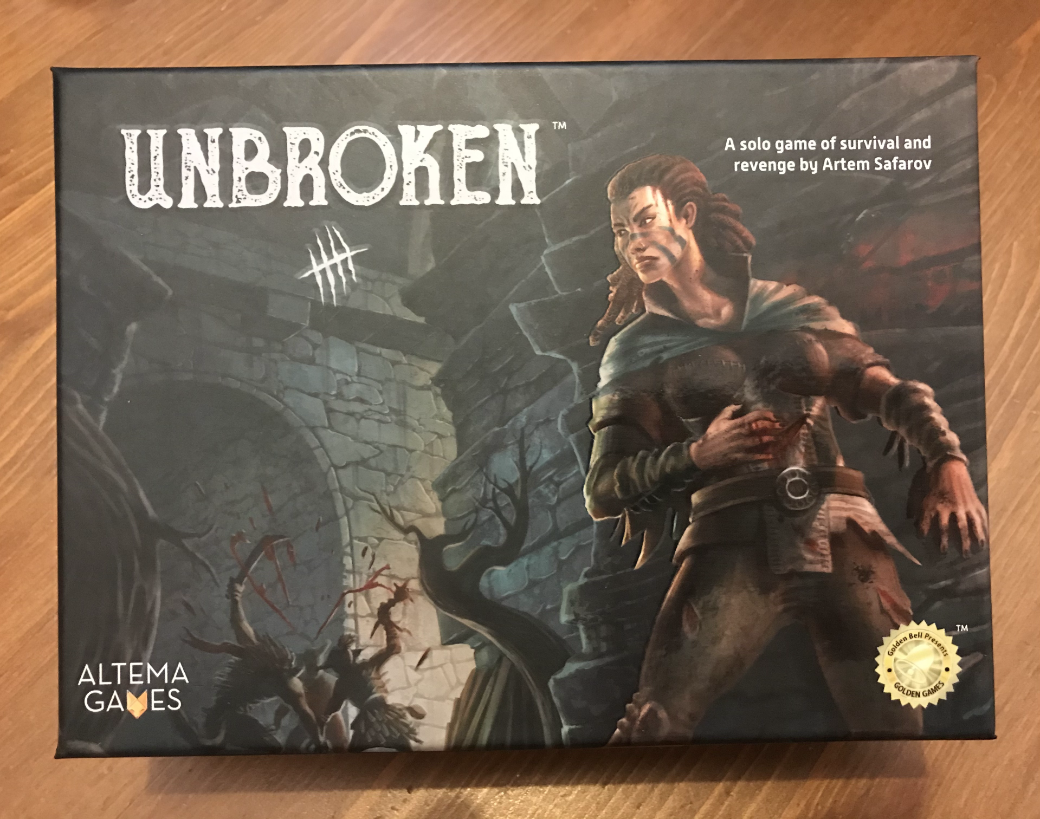
I’ve been playing Unbroken today. Yes, that Unbroken.
We hear a lot about Unbroken, and most of it’s to do with Golden Bell and their dubious antics. I wanted to step away from all that baggage for a moment and see what Unbroken was like as a game. I backed it on Kickstarter, and although I watched some of Golden Bell’s car crash of mishandling at the time, I wasn’t really paying enough attention to be very upset. The game was inexpensive, and I’ve had other Kickstarter creators fleece me for much larger amounts. However, all that shenanigans has had an undeniably bad impact on the way the game itself is perceived – you just have to look at the 5.9 rating on BGG to see that.
As a game designer, I understand very well the sometimes fraught nature of the relationship between creatives and money-men, and I really felt bad for Artem. It seemed to me that I’d be very wrong to dismiss his creation without giving it a fair chance. I’m very glad I did.
These comments are based on my first three plays of it, which I think is enough to get an initial feel. As usual, I’m not going to discuss the rules in detail as others have already done that. What I’m going to talk about is my experience and my impressions.
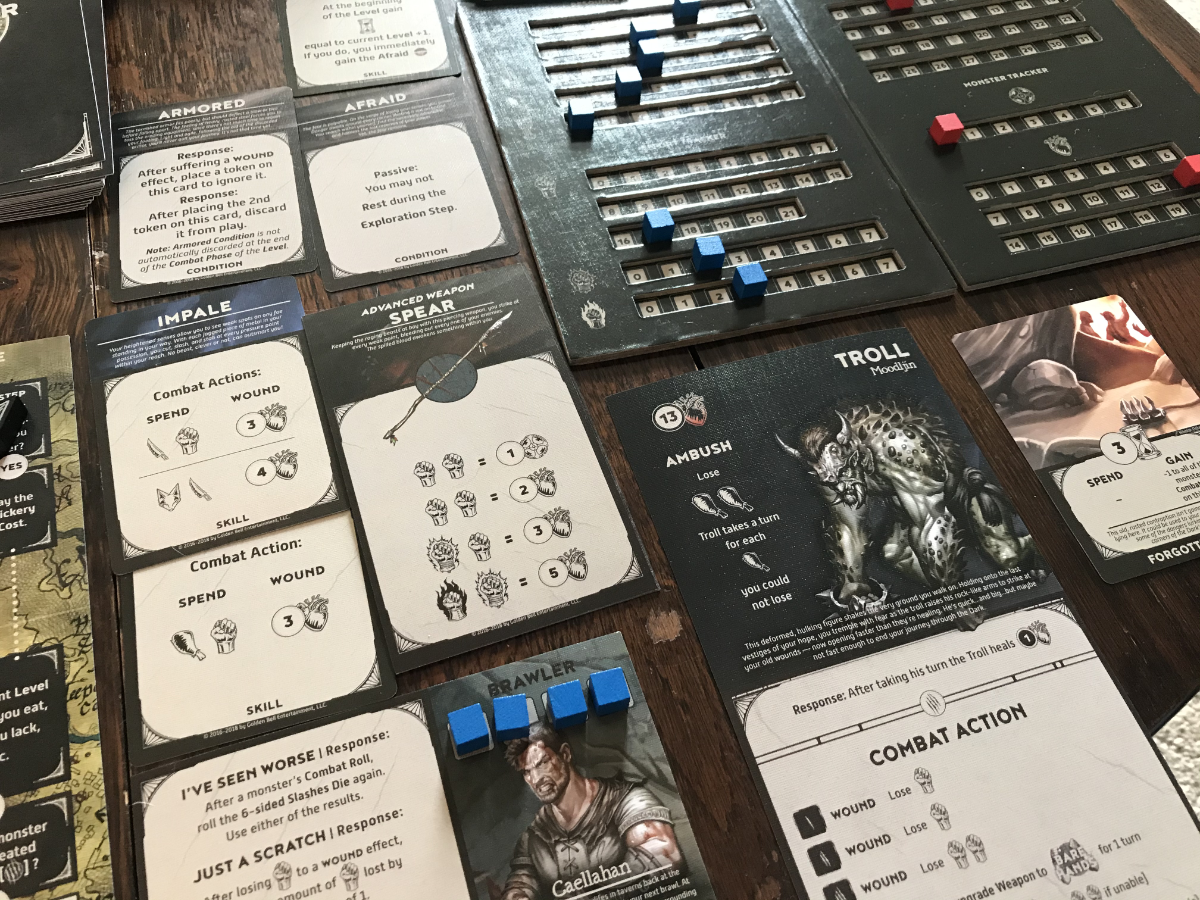
Troll? What troll?
Game 1 – Into the Dark
For my first adventure I took the most basic sort of hero: a brawler. I chose to play on normal difficulty as this combination seemed about as vanilla an experience as the game would offer. Vanilla is usually a good flavour to start with.
I’ve checked the rules and I’m pretty sure I was playing as intended. However, it all went deceptively smoothly. I quickly crafted myself new weapon after new weapon and ended up fighting all four monsters successfully. As a measure of how well I was doing, I beat the final level four troll without taking a single wound.
It had been fun, but a bit too easy. If this was as much of a challenge as I was going to get then it would be on the way to eBay pretty quickly.
You see that space at the top left? That’s where all the cool stuff you need to fight level 3 monsters is supposed to go.
Game 2 – A Touch of Overconfidence
After the first game, I changed characters and upped the difficulty to hard. In hindsight, I think my lack of trouble on my first run was mostly down to the hero I used, together with perhaps fortuitous combinations of other elements. I’ll try him on hard mode in a bit. First, I wanted to see what the other heroes offered. First up was the Huntress.
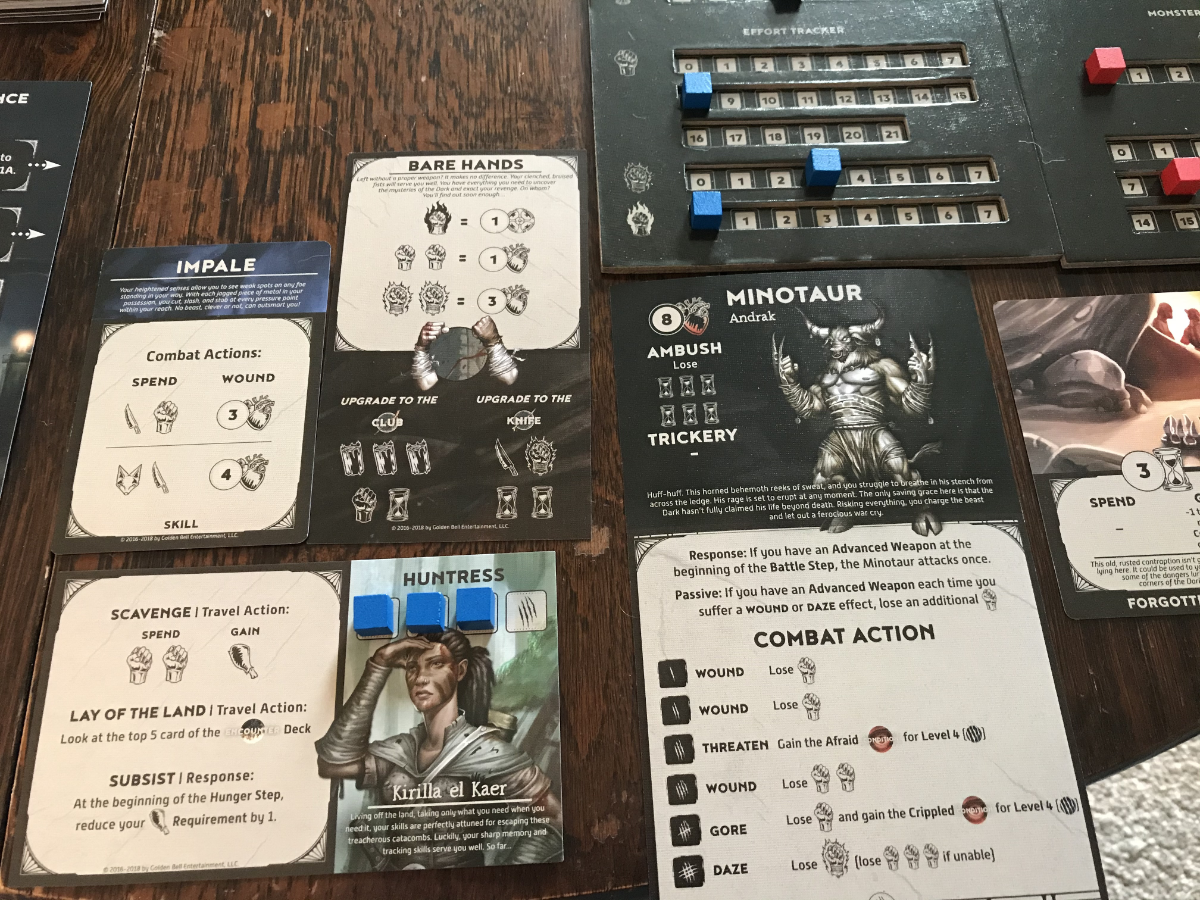
In the end, she didn’t fit my play style well and I ended up wasting her abilities much of the time. That was my fault; it’s down to playing style. As it stood, I struggled to make headway, and had to duck the second monster by sacrificing a weapon upgrade. I would never have beaten it. Then I couldn’t rest (Afraid condition), and by the point I’d run out of time and had to confront the third level monster I was in no place to fight it either.
In the end, I lost the game trying to kill a minotaur within my bare hands. Not entirely surprising.
This felt like a mismatch between me and the hero’s style rather than a problem with the game itself. It was still fun to play though, if a little frustrating, especially after using the very straightforward brawler in the previous game. You might even call him simple (just not to his face). For future games I’ve set myself the challenge of getting competent with all the different characters.
This is not a good look.
Game 3 – It Ain’t Over Till It’s Over
Not to be beaten, I set the game at hard mode again for my third outing. This went much better with the Sneak character proving much more of a natural fit for me. I thought I had it in the bag till I slipped up and got ambushed by a Basilik on level four. That ambush took a difficult opponent into the realms of a really, really dangerous one, and when I managed to fail my save vs being petrified every single time I sealed my own fate. Eventually it turned me completely to stone, which was bad. It was a tense fight though, and didn’t start out as a guaranteed loss. Average rolls would probably have been a loss too (once I’d been ambushed) but given the other toys I’d collected it felt like it would have been close.
It was one of those games where I was noticeably really lucky at the start and had noticeably terrible luck at the end. Overall it balanced out as these things always do; it was just strange to get it all sorted into sections like that. Even so, rolling dice and drawing cards, mean that these things happen occasionally, and it didn’t stop me enjoying the adventure.
Was it fun?
Absolutely.
Unbroken is pretty quick and straightforward to play. There are several small gaps in the rules where implementing specific powers and so on are a little unclear. However, I just took the least advantageous interpretation each time and carried on. It all worked out fine.
I’d compare Unbroken very favourably to One Deck Dungeon. Both fill a similar slot of light, fast dungeon game. Having played ODD half a dozen times I’ve put it in the pile to trade. I didn’t like it at all. Unbroken gives you way more agency, has more interesting and more meaningful choices, and tells a better tale. I’ll be keeping it.
Are there cons? Sure. But in my view the flaws are ones of layout and production (eg poor choice and use of icons, tiny font for colour text, some flimsy cards) rather than the rules, so I’m going to ignore them here.
Overall, my experience with Unbroken as a game has been very positive. The fact that I’m trying to slim my collection and yet I’m still keeping it should tell you enough.
It’s a real shame that Golden Bell messed up the management of it so badly as that’s detracted from what I think is a cracking little game. The BGG rating seems to be a reflection of GB’s poor handling rather than the game itself (though it’s also a black mark against BGG. Because their rating system is heavily exploited and generally not fit for purpose in other than the crudest sense. That’s a rant for another day though.)
Today, I just wanted to flag up the fact that Unbroken, as a game, deserves way more love than it gets. So now you know.
If you’d like a second weekly dose of all the game-related wisdom you didn’t ask for, this time focussing on the designs I’m working on myself, then you can find it over on my Patreon. Otherwise, I’ll see you back here next Tuesday for another exciting episode…
I’ve got a trapped nerve in one shoulder, and tennis elbow in the other arm, so it’s painful to type lots. But, rather than leave you waiting, I’ll pose a short question for you to ponder.
$100 games. These used to be the rarest of rare, but now we see them quite often on Kickstarter, and increasingly bleeding into retail. In fact, for the larger games, $100 is now looking like not enough. The costs of materials keep going up, and 2020 did a real number on shipping costs. Margins are tighter than ever, and so prices must rise, or the contents must shrink. So, which is it?
Do prices just keep going up till we’re looking at $150 or $200 core games, with extras on top? Or is the $100 price point so important that the contents shrink to fit under that for all but the biggest companies?
What do you think? Do you have an upper limit on spend per game
There’s always a handful for whom cost is no object, but production minima need a thousand or more to keep the costs sane. So, where is the upper limit for the mass market?
If you’d like a second weekly dose of all the game-related wisdom you didn’t ask for, this time focussing on the designs I’m working on myself, then you can find it over on my Patreon. Otherwise, I’ll see you back here next Tuesday for another exciting episode…
Today I’m thinking about small games and air in boxes.
I’m slowly playing my way through my game collection, culling the unworthy, and enshrining the blessed. As I play even more games than usual, back-to-back, I’m struck again by the wide variation in how games look once you get the box open, and how much each production team has thought, or cared, about this. And, importantly, how much that matters.
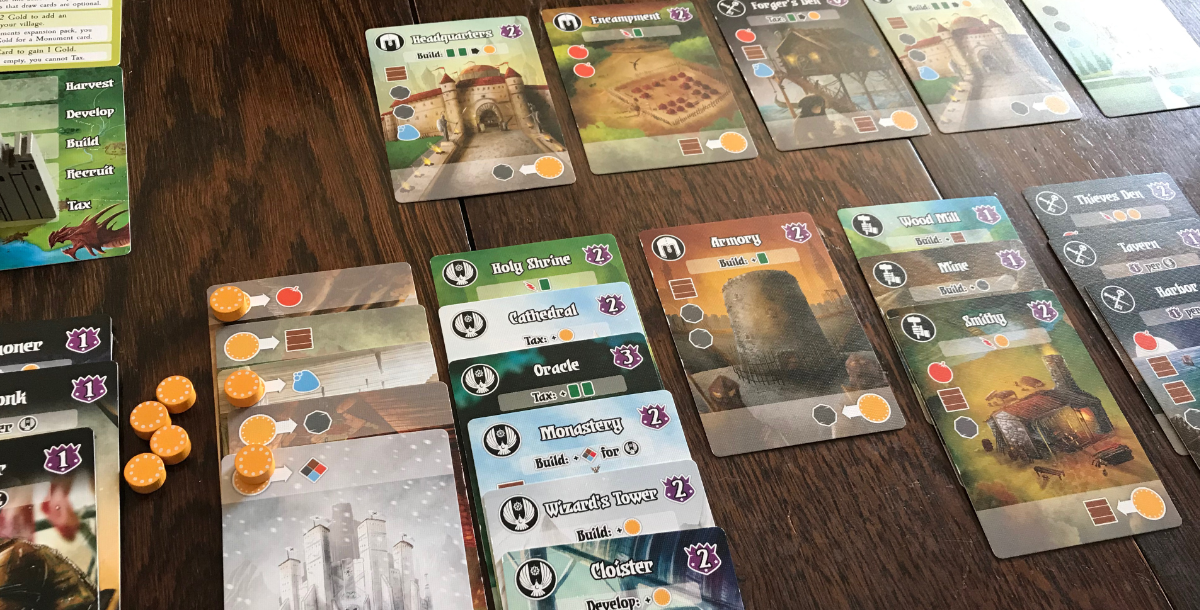
Final state of a recent solo game of Villages of Valeria. Only used 10 adventurers, as per the revised solo rules. Using all of them makes the points silly as I can almost always take them all. As it was, I scored 75, which is about normal for me.
When it comes to what stays and what goes, the calculation is baroque and, in detail, probably unexplainable. Not in every aspect though. One of the more quantifiable features of a game that comes into question is the amount of space it takes up on my shelf. I have perhaps five or six times as many games as I have shelves to comfortably put them on. If I cram them in Tetris style, maybe only four times. That’s still not good. Each game must therefore justify the amount of space it takes up, and the larger its volume, the harder it is to convince me to keep it (or buy in the first place – a different, but related discussion). Put simply, the physically bigger the game, the more it has to prove itself on the table. And games which take up only half their volume with actual game are just making life harder for themselves. Ain’t got room for boxes of air.
Speaking of these space hogs, the traditional excuse for a big box full of a lot of nothing and a little game has been that it needs to have shelf presence in the stores. It’s true that this problem seems to be less prevalent these days. I suspect this has more to do with shipping and the greater cost of getting stock from factory to distribution now that the bulk of games are printed in China rather than Europe or the US. However, I digress.
The reduction in the number of games being sold in retail, over the counter, during 2020 is for obvious reasons. In a broader sense, a large and increasing fraction of sales are now online, where you cannot rattle the box, or even tell how big it is from the image on the site. Without the context of the rest of the shelf, you could have a game in a matchbox or a coffin and the art would look the same in the thumbnail. This, I expect, has also played into why gamers end up buying less air these days: less need to impress in person till after the sale has been made. Spend the money on better art instead. But it still happens, and it’s a pain when it does.
Note that you can go too far the other way too. It’s rarer, but it still happens. The North, for example, is so tightly packed that it’s something of a challenge to get the cards out and back in. And then there is the question of whether the obviously planned or even simultaneously released expansion will fit in the core box or not. The fact that several publishers are now producing larger boxes to cover a whole game range, often with bespoke inserts to pack things in carefully, tells you that I’m not the only one after this sort of OCD form of storage. It’s not always easy to get this right when you don’t know how popular the game will be, and therefore how many expansions the income will encourage you to produce.
And there are plenty of other considerations that production teams need to consider. What size are their other games? That will matter when they need to ship mixed cases (the big outer brown card box they ship several games at once in). And speaking of cases, it’s always cheaper to be able to standardise and buy your cases in pre-printed bulk, in standard sizes. This sort of hidden cost is usually invisible to the end user, but someone pays for it. The brown card boxes you throw away don’t come free.
And if we’re getting into cases, there are questions of how high they can be stacked and how they’re palletised, impacting again how the games inside are stored and packed. How much packaging material of what sort do you want to use? For wholesale shipments and individual customers? Not always the same thing. There’s a lot to consider (and a lot which is often ignored or done at the last minute). You *can* do this all at the end, but it’s more efficient to at least consider things like how you will ship and deliver the end product while you’re deciding on the size and robustness of the retail box.
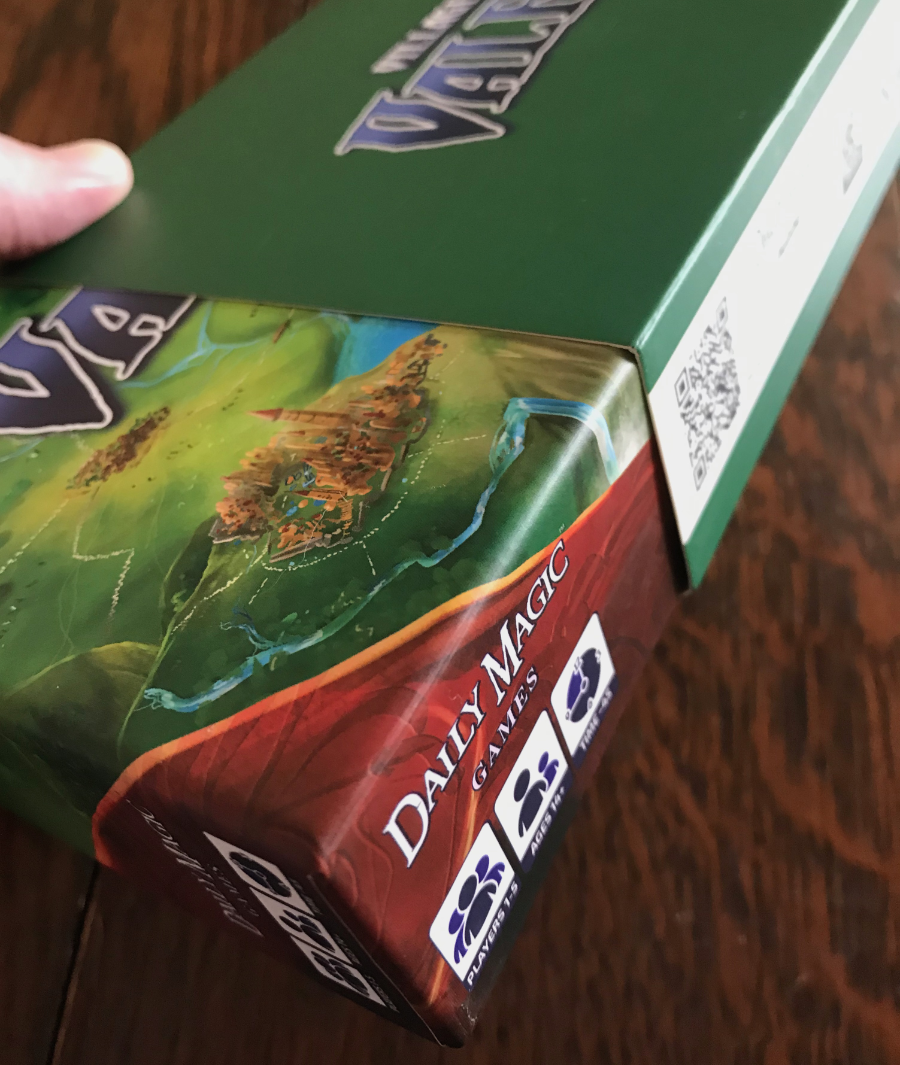
I wasn’t taken with sleeves round game boxes to start with. However, with smaller games especially they help to keep everything in the box when you cram it into a shelf at an odd angle because it just fits that gap…
The game on my table today is Villages of Valeria. If I look at it critically, without my usual side order of mercy, then it’s not the best game ever. It’s too light to retain my attention for more than a few plays at once. Nonetheless, in this case that’s fine, and it’s staying in my collection. Why? A few reasons. One is because although it’s a simple puzzle, and each play is much like the last, I enjoy it just as I do sudoku, or various forms of patience. It’s the answer to a particular frame of mind, when I want something not too taxing, with rules I can refresh myself on in 2 minutes, and which is up, done in a comfortable and familiar way, and back away in half an hour or less. So, it scratches a particular itch. That’s not enough to stay in my collection though. I need to be harsher than that to fit everything in the space I have. So what else?
It’s also an attractive game; a statement that’s a little odd for me to make because I’m not a fan of the artist’s style. Even so, for whatever reason, it works for me here. Maybe because the main cards are buildings and not people.
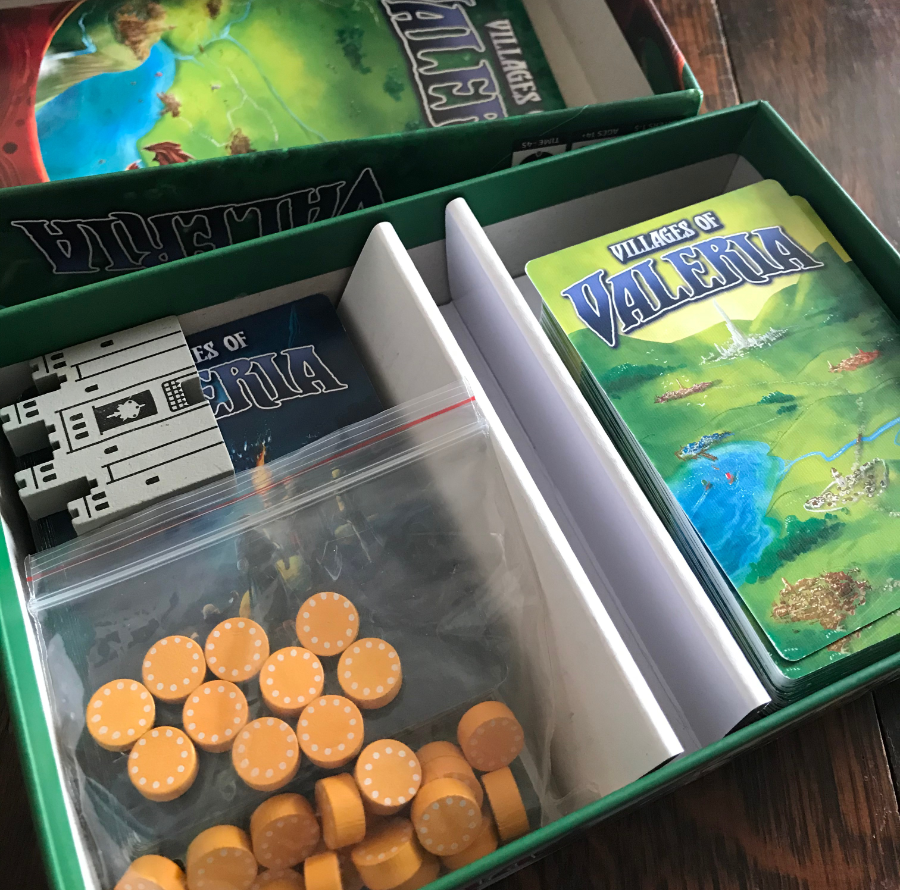
The inside of the box is neither overly crammed with components nor full of air. It’s got just enough room that if I wanted to sleeve the cards I could, and everything would still fit. It’s a good compromise size.
In the end though, the thing that excuses its lack of technical shine is its size. Had it been in a large box full of air it would probably have been traded away by now. As it stands, it takes up so little of my painfully limited shelf space and fits so well for that particular headspace, that it stays, lurking quietly till I need a quick fix of a familiar game I don’t need to think about too much. It comes down when more technically worthy games that I’d give higher marks to stay to gather a little more dust, waiting till my brain or mood (or both) can cope. And there is probably space for this sort of thing in your collection too.
Games shouldn’t really be measured against a single scale. They’re never 10/10 for every occasion. They need to fit different groups of friends, moods, and time slots.
And yes, they also need to fit on the damned shelves.
If you’d like a second weekly dose of all the game-related wisdom you didn’t ask for, this time focussing on the designs I’m working on myself, then you can find it over on my Patreon. Otherwise, I’ll see you back here next Tuesday for another exciting episode…
Kohaku has turned out to be one of my better choices on Kickstarter. It’s a charming little tile-laying game that looks lovely and has a light brain sizzle in both solo and multiplayer.
This is taken from the publisher’s website. Unfortunately all of my own pics (below) are a bit dark. It’s all the lowering thunderheads of our northern winter.
Now I’m not going to write a full how to play or a review here: there are plenty of those around already. For this and other Tuesday posts that follow, I simply want to pick out one or more aspects of something I’ve come across recently in my gaming, and share my thoughts on it with you.
For Kohaku, there are three things I’d like to discuss:
Components.
Simplicity.
Solo.
Components
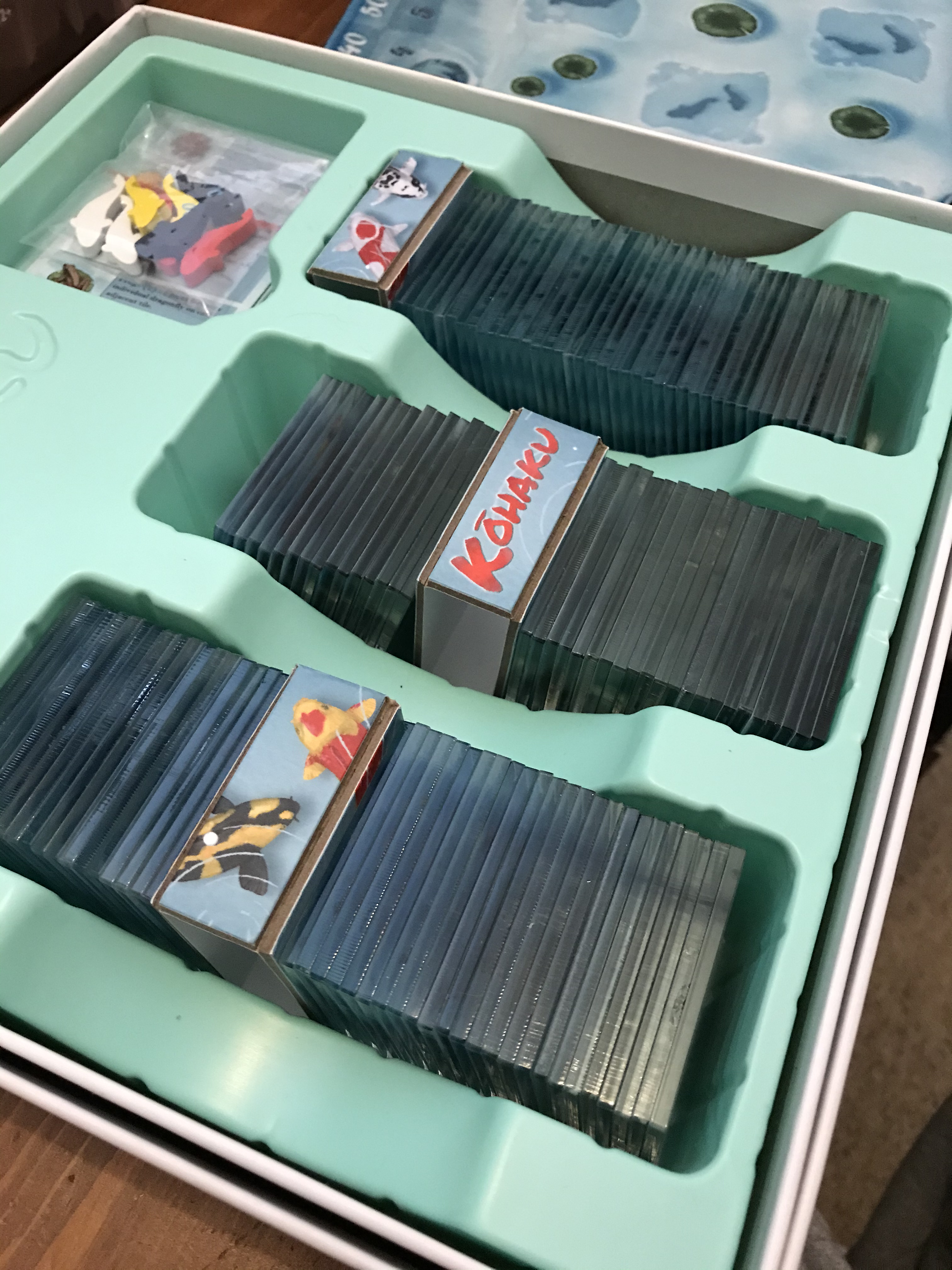
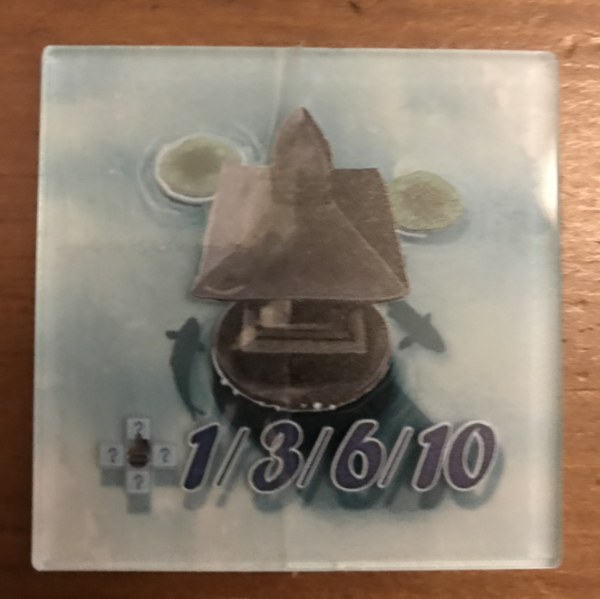
Kohaku is a handsome game, full of chunky pieces of brightly coloured acrylic. It comes in a solid box with an insert that actually holds all the components sensibly for once without acres of empty space. The central board is made of edge-stitched neoprene and feels like a quality thing. The shaped scoring tokens and reference cards are nicely made too. Nothing feels cheap. Of course, the main act is the acrylic tiles themselves.
The tiles snugly in their tray.
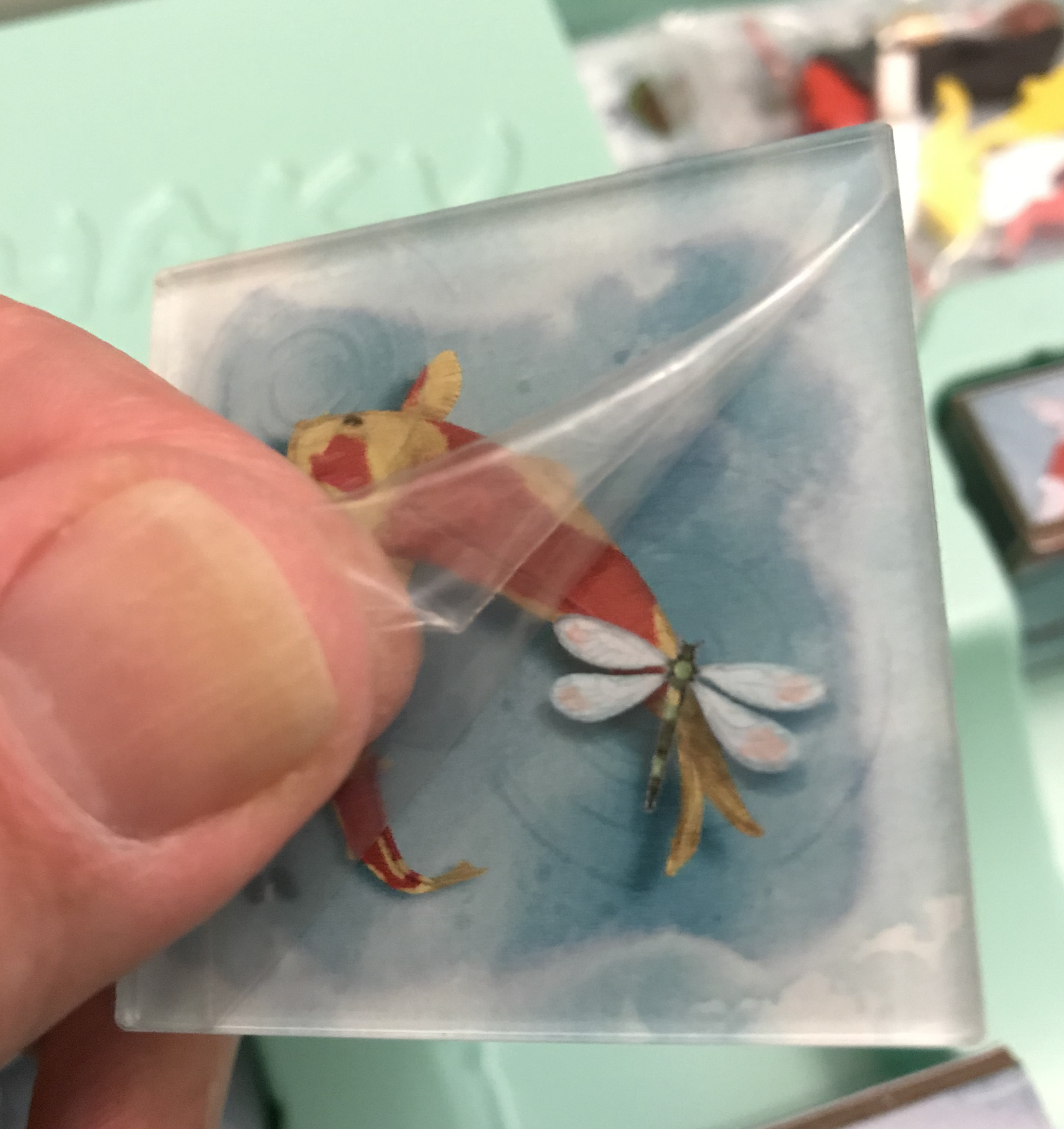
The tiles are shipped with a protective clear film on both sides. It can be removed easily enough. Fingernails will help. It’s not absolutely necessary to take it off, though it does make the tiles even more bright and shiny, so I’ve removed it from mine. There are layers of image printed on each tile, giving them some depth, which makes them look more striking than flat print on card. The fish are, naturally, on the bottom layer of a tile, with dragonflies, lilies, and ripples on top. Some creatures like turtles are partly in and partly out of the water, and the structure of the multi-layered printing shows this too. Overall, it’s a very nice job, a clever use of an unusual technique to mirror theme, and adds lots to the visual appeal.
On the left you can just about see that the film has been cut to reveal the right of the tile and not the left. On the right the protective film is being peeled off.
This is all visible from the front/top of the tile. The backs are painted with either a koi or lily pad silhouette to show which of the two tile types it is: koi or feature. That’s important for gameplay.
One question I’ve seen raised in comments online is about the robustness of the acrylic tiles. Without the film will they get scratched? Are they too delicate to use at all? Some of my tiles had damaged film, presumably doing its job of protecting the shiny acrylic surface below. Once removed, none of the tiles I’ve got show damage on the top surface. The back has a ding or two on some of the paint (which is applied differently to the top surface that looks to be heat sealed), and one has a scratch in the white base colour along one edge. They’re also not 100% uniform colour. To be honest, I don’t think it matters. Could I memorise which tile was which using the marks? Probably. Would it be of any real use? Not really. While I could technically give myself an edge by knowing this, it’s not how or why I play, and would be a complete waste of neurons to bother memorising which pattern of speckled dings or shade of grey marked which tile. Just not important. Far more interesting and likely to improve your final total is spending the effort working out what you can score with the combinations of what’s available now, and how that will set up future scoring opportunities.
So, could the face of the tiles get damaged? Sure. Will they? They seem pretty tough. I would be very surprised if they got any more damaged than card or paper components would when confronted with similar force. Plus, the acrylic tiles are waterproof, which card is not, so against sticky fingers and drinks they’re probably more robust than most games. Overall, I’m very happy with the robustness of the tiles and I think the contrarian comments are barking up the wrong pond. As far as I can see here, the difference between acrylic and cardboard is all win for the acrylic.
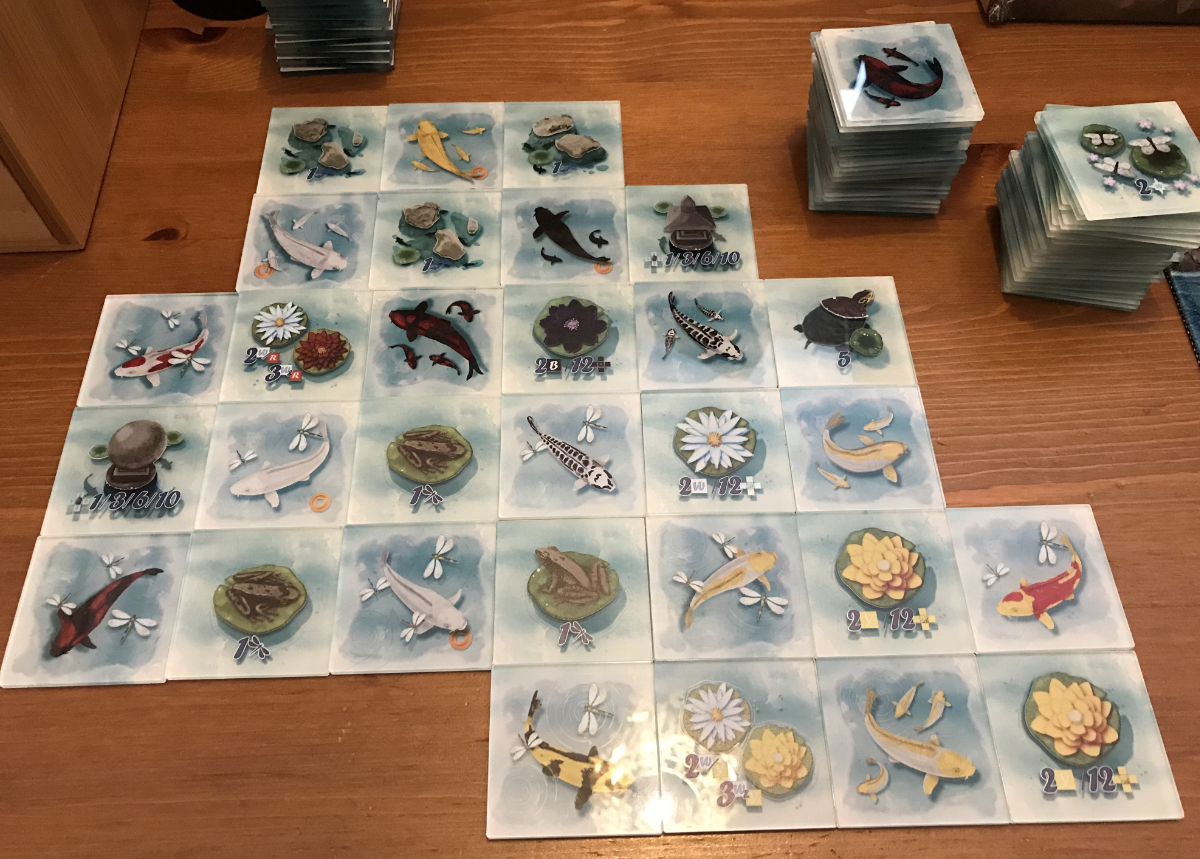
My player pond at the end of a solo game. As before, apologies for the crappy lighting. The game looks way brighter in real life.
Simplicity
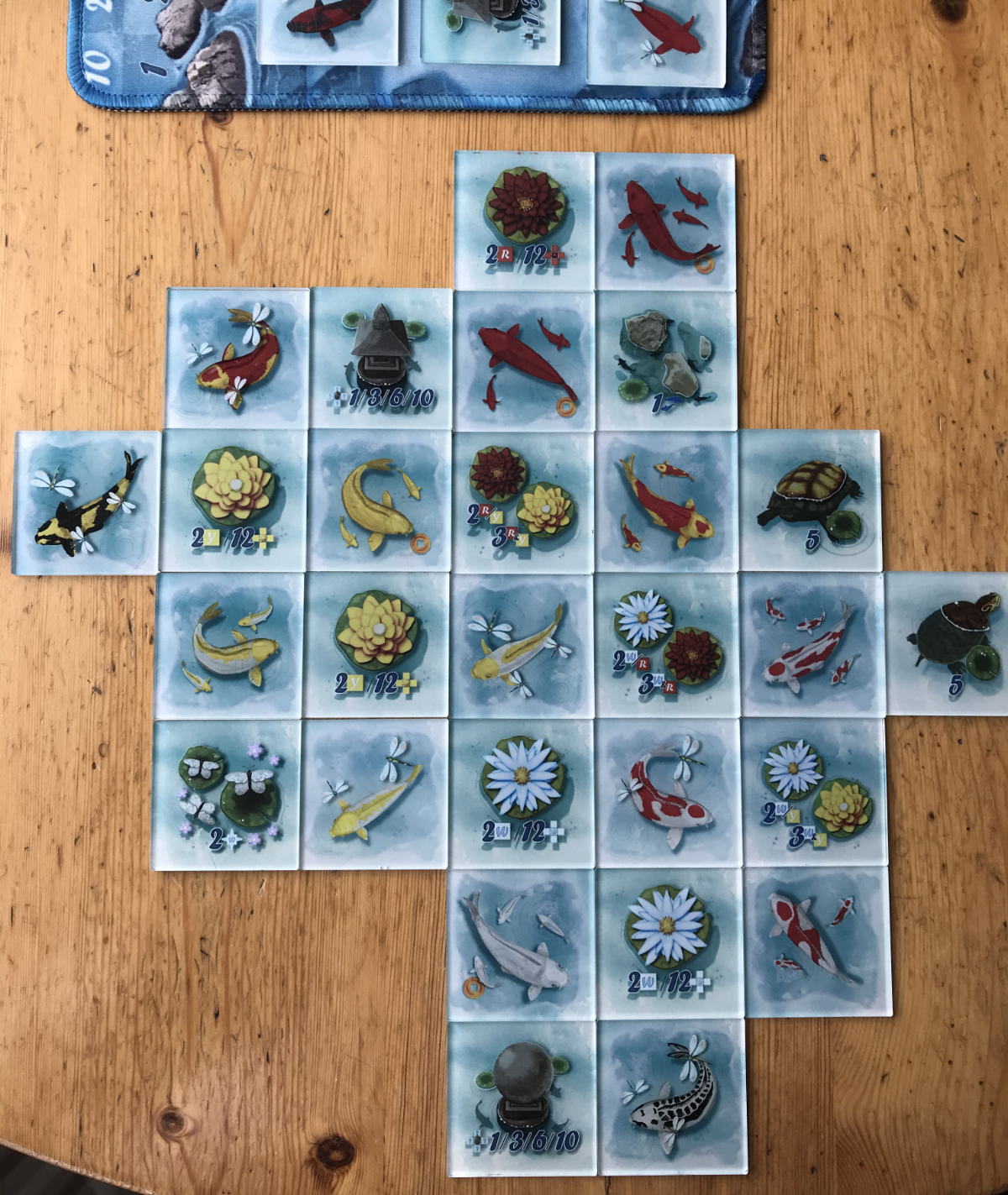
I like games that pose a lot of interesting challenges with few rules. When you’re designing a game it’s always worth asking yourself whether each new rule you add is pulling its weight in terms of adding something cool to offset the additional effort required in learning and remembering. Here, Kohaku does really well. The rules are brief and straightforward. In fact, the scoring takes up about three-quarters of the actual rules. How you play is simplicity itself. Once you have internalised a very simple process (take two adjacent tiles from the central pond, add them in your pond) all your thinking goes into working out not how to play, but how to maximise your score. And that’s great. They’re also clearly explained and the reference cards for each player list the different ways to score, which is all you need. Sure, it’s much easier to get rules and reference right when you’ve such a light mechanical footprint, but I still see it done badly all the time. So, well done here too.
Another final pond. This time from a two-player game.
Solo
I’ve played this solo, and also (despite the vile pestilence that washes over our blighted lands) managed to get a couple of two-player games in as well. The experience is very similar as interaction is minimal. Overall, I think I may just prefer solo play, though it’s a close run thing and a fun game in either context.
The scoring for the solo game is the most interesting bit. You play as normal, and the AI does its own thing, picking a random tile each turn from the supply and then snaffling any matching tiles of that type from the main pond. It’s unpredictable, lightning fast to resolve, and gets in the way of your cunning plans about the same as another player would. The really nice part comes at the end of the game when you score the AI three times, each time slightly differently, to give you three opponents of increasing score to beat instead of one. It’s a simple idea, and one that I’ve not seen before. It’s well worth borrowing though as it feels very different to come in second out of four rather than just beating or losing against a single opponent, or having to beat a static value. And second out of four is where all my solo games have been so far. I can beat two of them, but I haven’t yet managed to pip the hardest of the AIs at the post.
I’ll get him next time.
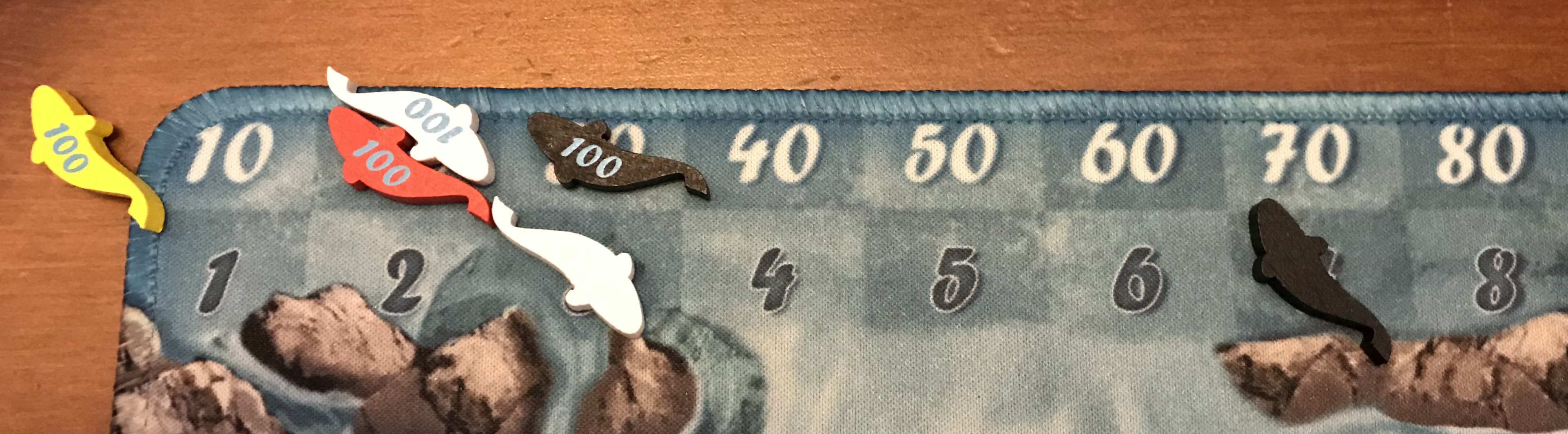
The four of us on one of my solo games. The AIs scored 100 (yellow), 120 (red), and 137 (black). I’m in white with 123.
As always, if you are interested in hearing more about my own design work, you may want to consider supporting me on Patreon where I discuss exactly that along with deeper dives into the inner workings of game design in theory and practice.
I’ve got a bit jaded with Kickstarter of late, hence my stopping talking about it. Maybe I’ll come back to it. Maybe not.
In the meantime, I thought that I’d use this space to talk a bit more about other people’s games that I’ve been playing, my thoughts on those, and any lessons I’ve learned or had reinforced.
Stuff about my own designs, WIP, beta rules and whatnot is mostly on my Patreon these days. Don’t all rush to join this week though – I’m in the middle of changing the tiers to. simplify things. More on that anon.
Also, I might want to discuss some miniatures that have caught my eye and wallet. And, at some point, I’m going to have a go at painting. Again. So that might happen. See if my crappy eyesight is still up to it.
Also, also, while I wasn’t looking, WordPress has changed its interface. That’s uglier than it used to be. So this post is partly an experiment to see if I can still post stuff and where all the necessary bells and whistles have been hidden this time…
I’m aiming for one post a week, on tuesdays. My intention is to pick one game a week to talk about in some depth rather than skimming through them all. We’ll see how that works.
We continue to have a good number of campaigns on Kickstarter’s tabletop section, and plenty of them are doing very nicely. However, for some reason I’m just not feeling very inspired by the last week’s crop.
It’s not that I think none of them would be fun to play, or that they aren’t nicely illustrated or presented. It’s not even that their campaigns are poorly run. At least, not all of them. In the end, it’s just that they lack that magical something which marks a project out as one for me. You know what I mean. It’s different for each of us, and it’s impossible to bottle.
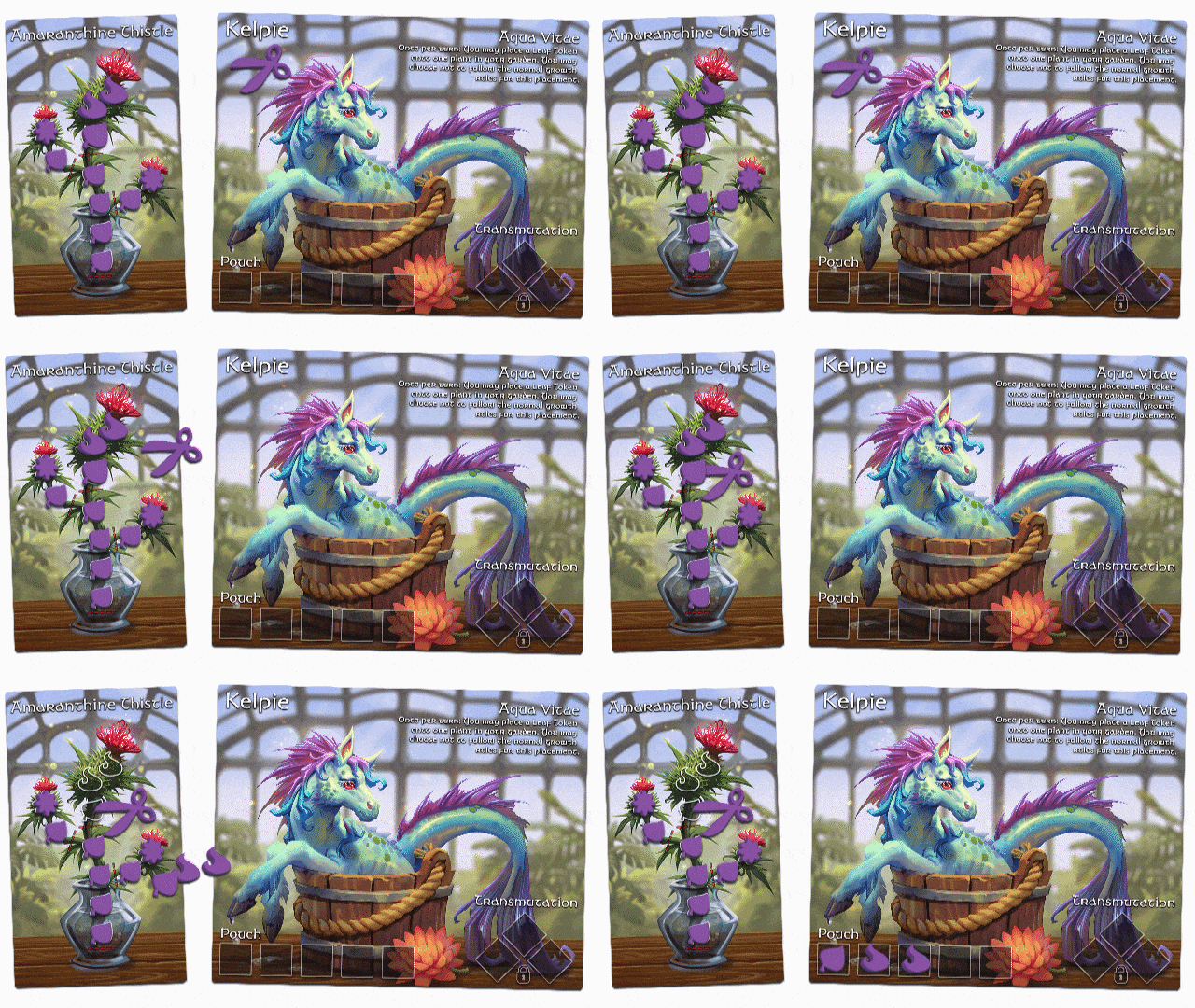
Familiar Alchemy may be the way to distil the essence of cool. As you can see, they’ve finished a sample piece of each type, and show the rest of the art as sketches.
There are a few things I’d like to point out as interesting though. As we’re talking about capturing magical essences, let’s start with Familiar Alchemy. it’s not really offering anything new in terms of the game itself, but you’d have thought that they’d do a bit better than they are. I’m hoping (and not believing) that it’s not related to their incomplete artwork. Asking for the crowd’s assistance in funding this sort of thing is, after all, why Kickstarter is here. Unfortunately, these days you’re not likely to soar very high if you aren’t doing a passing impersonation of being finished and ready to print before you start. Visually, at least.
This shows two finished pieces and gives you a better idea of what the end result might look like. In the game you grow plants and then trim off bits as ingredients for your potions.
I think their plan of showing a finished example and then sketches for the rest is not unreasonable and is a prudent use of resources. Why pay a lot for art you can’t use if the project fails to fund? And the finished art looks well done too. The game itself looks fine if not anything new, but competently done and if I hadn’t already got a dozen things that could fill this slot in a gaming night I’d be tempted. Anyway, just thought it was interesting for the art question. Does this mean that your campaign needs more finished art, or at least to hide any that isn’t? Sadly, I think it does.
You Get What?
Occasionally, people cram all manner of extra gubbins into a higher tier pledge. This is stuff like coasters, badges, T-shirts, and posters – none of which is part of the game and all of which tends to pass me by entirely. Give me the game play and keep the tat, thank you.
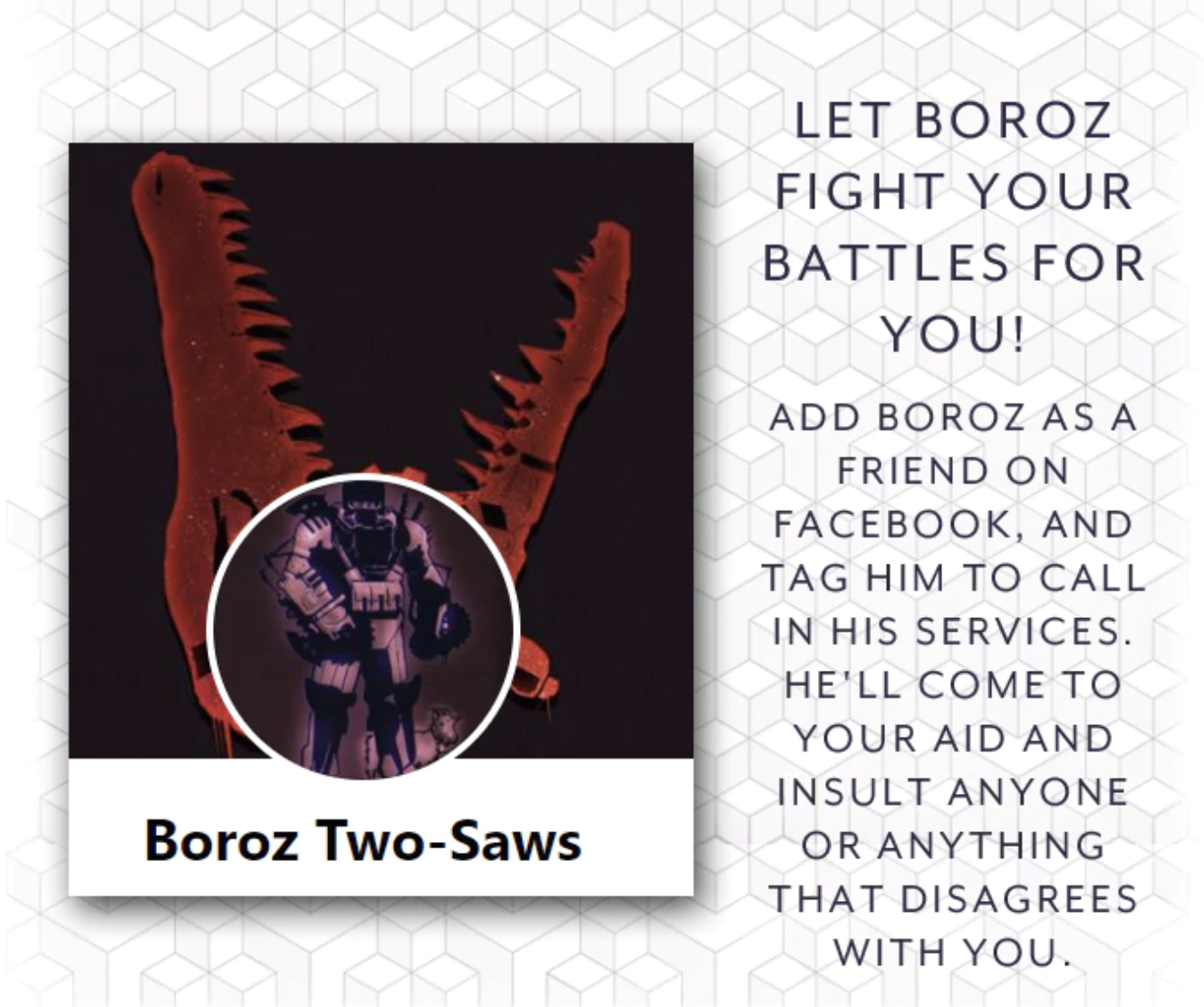
This week I saw something that’s a new one on me – at least bundled into a game tier: a robot bully to call on to help win your online arguments.
The text speaks for itself.
I don’t think this is bad per se; it’s just weird. The campaign it’s from is Antematter, which is otherwise moderately interesting and could be entertaining to play. I like the idea of planets moving. I’ve tinkered with that idea too, and it creates some interesting effects on the board, especially if several planets orbit at different rates and you therefore have to plan with their various future alignments in mind. In fact, I’m expecting the imminent arrival of another KS game that uses this idea, though with a very different game: Solar Dominion Fleet Commander.
Oddly Tempting
I’m always drawn to dungeon scenery, and this means that I’m also always needing to stop myself from buying sets I’ll never use. The latest in this line of tasty morsels to resist is Dungeons & Lasers.
This looks like a solid and practical set, and I can definitely feel the gravitational attraction between it and my wallet. Even so, I have resisted because I think it’s the 16-year-old me wanting it to tart up the D&D games he’s running, not the slightly older version who’s not likely to be doing so for some time, if ever. Skirmish, you say? Yeah, maybe. If I could get my solo skirmish rules to work the way I want them to, then maybe…
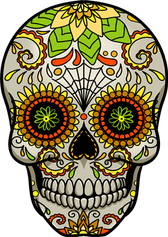
Dia de Muertos
I’ll finish with a very striking game called Die of the Dead.
This is boldly illustrated with the characteristic skulls and flower motifs of the Dia de Muertos, and the overall package is strongly themed. Unless I’m missing something, the game seems a bit random for my taste, and while I used to go to a gaming group that this would have fitted perfectly, that was many years ago. These days I don’t see it getting on the table. It’s a not-uncommon reason for me passing on games that I would have wanted years ago. Not so much that my tastes have changed or that I’m no longer willing to play X or Y, but that the opportunities to play them have changed as I moved to a new city, house, job, or whatever. The pandemic has pushed me towards solo play, true, though I’m still looking forward to (and buying things for) playing with friends. It’s just that you need the right group of friends for each game…
It’s nice to see that after a summer break, the numbers for Kickstarter campaigns are right back where they should be. That, plus the reported rise in overall funding total, says that KS is in a healthy place, despite the end of the world.
Or maybe because of it.
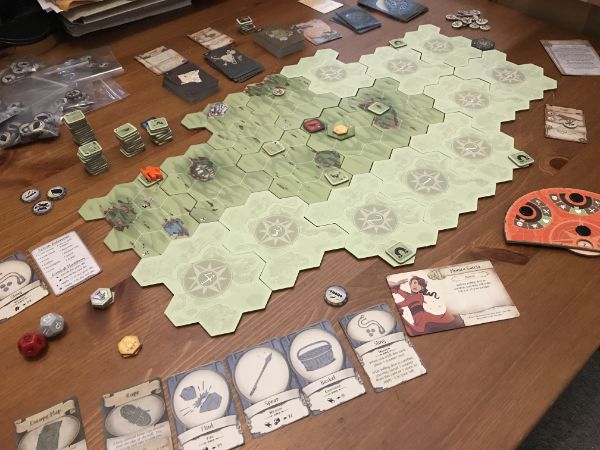
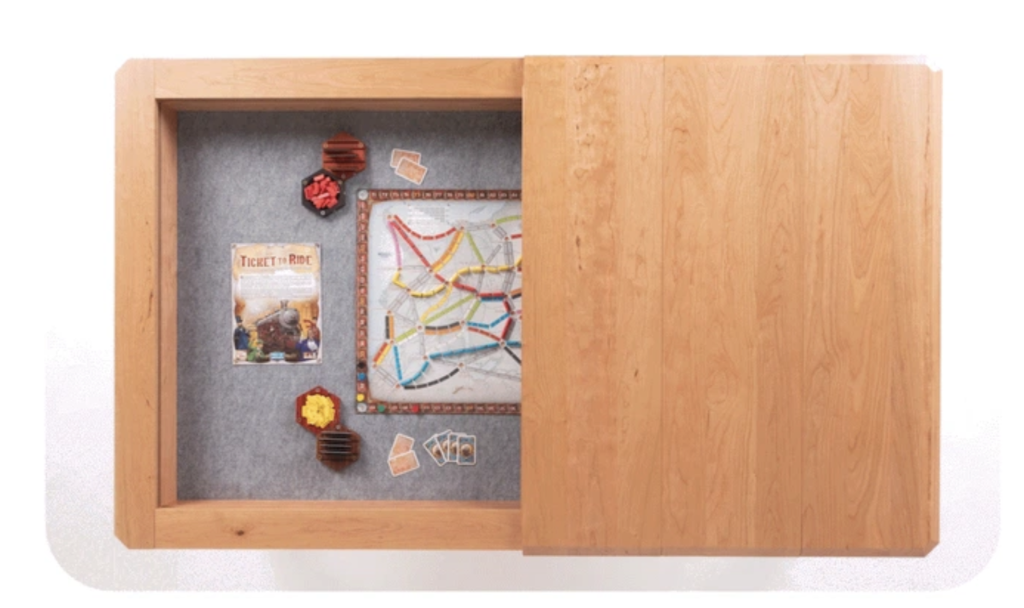
One of many modular tables from Wormwood.
Speaking of money, the Wymwood gaming tables are currently at over $7m, which I find a little bogglesome. This is vastly more than any of their previous campaigns, though their consistent slick productions over the years make this feel like it was all building towards where they are now. I have zero interest in their offerings, but hats off to them for a massively popular campaign. What is of interest to me is that they may be on track for taking the crown off Frosthaven within a few months of the coronation. It’s harder because they’re making handmade stuff and the amount this slows them down by is hard to gauge. Possible though. Watch this space.
All handmade from Moon and Stars.
Alongside this unstoppable juggernaut, it’s worth noting that there are tiny projects like Moon and Stars. This is ostensibly the sort of thing that Kickstarter was designed to support in the first place, and I do enjoy watching them. Sadly, it’s not a game I’m particularly taken by, though I should note that it’s the gameplay rather than the aesthetic that puts me off. Happily, he has found enough of an audience to fund it without me.
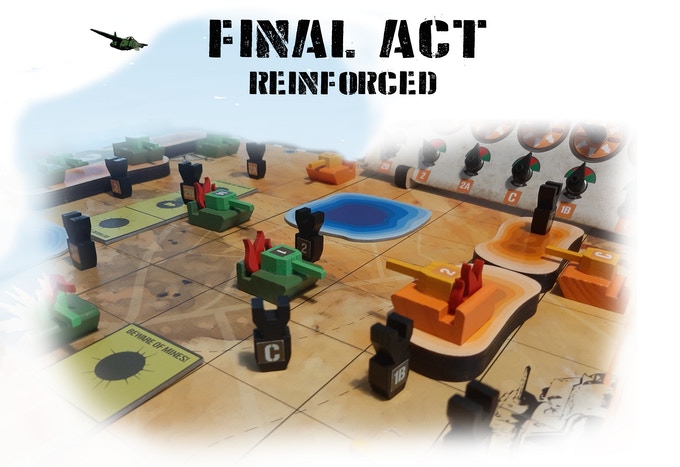
More of a Trojan Horse than a tank.
Another smaller project that has yet to find enough of an audience is one of two that I’m currently backing: Final Act II.
What I like about this is a couple of things. Firstly, I do rather like the handmade toy vibe to it. It looks like they’ve put a lot of care and thought into the presentation and it has a smidge of nostalgia for me even though I’ve never played it. Nicely done.
Secondly, having watched Marco’s excellent review of it, I can see a very clear audience and definitely imagine playing it. The toy-like quality of the pieces acts as a perfect Trojan Horse to sneak this one onto the table with people who would balk at accurately rendered tanks. And, once so snuck, you can play a game which masquerades as a trivial piece of family fun whilst actually having some serious tactics puzzle inside. Sure, it’s no Drang Nach Osten, but not every game can or needs to be. This offers me a chance to play a game with a friend who might not be up for playing something more obviously wargamey, and allows us both to enjoy a middle ground.
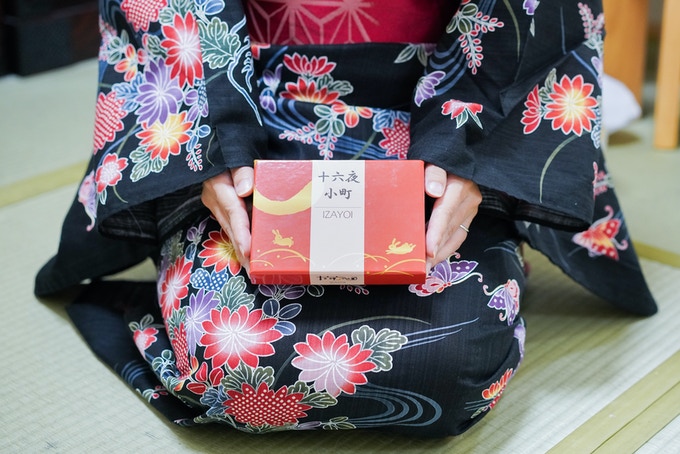
Finally, the mechanic that most caught my eye this week is in a Japanese game called Izayoi. The sweet touch to a simple game about influence is in having each player paired with a master, and then penalising players for embarrassing their masters by doing better than them. Very Japanese, and a lovely touch. I can see that making a very interesting game. That’s why it’s the second one I’m backing.