DreadBall Design Notes – Managing Your Actions


I want to take a step back from the detail of the dice and stats, and look today at a slightly bigger picture. You already know the overall picture of trying to win the game by scoring Strikes and you know the nitty-gritty of rolling dice, but what comes in-between?

Planning your team’s actions is the answer.


Team Action Tokens

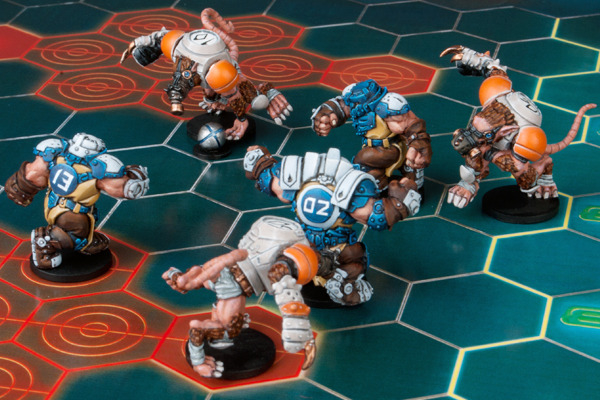
In each Rush, a Coach gets 5 Team Action Tokens. Each token allows a single player to perform a single action from a list that depends on both the situation and the player’s role. Actions are things like Run, Throw the ball, Slam an opponent, etc – many of which use the core dice mechanic to determine their level of success.

The Coach allocates a token to a player, selects the action to attempt and then resolves it. Once that has been completely resolved, the next token is allocated, and so on. This continues until all 5 are spent, he runs out of players, or loses the ball.

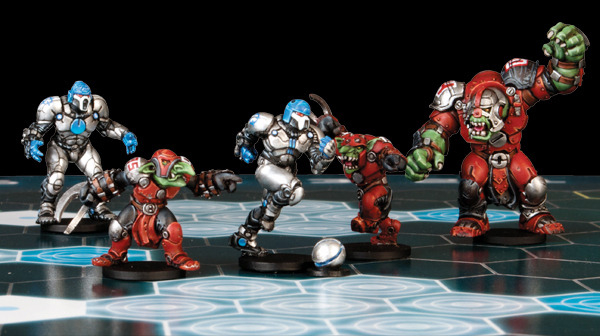
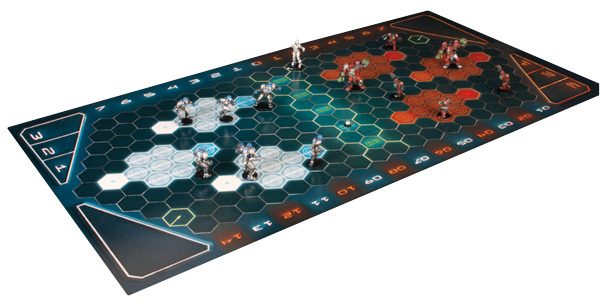
Here’s where it starts to get interesting. Each player can have 0, 1 or 2 tokens played on them in each Rush. As there are a (legal) maximum of 6 players on the pitch and only 5 Team Action Tokens per Rush, this will obviously mean that you will need to prioritise your allocation, and that some players will probably not act in each Rush (depending on your level of injuries).

You do not have to pre-allocate all your tokens, so you can adapt as things go right or wrong during your turn. If you want to spend 2 tokens on a player then they do not have to be consecutive (though they could be if you wanted). You could activate player A, then player B, then player C before activating player A or B again.

In practice, a Coach will generally work out a play involving several players and then try to execute it with his tokens. Ending your play with a Strike on the 5th token is ideal because this doesn’t waste any. You only have 7 Rushes in a game, and 5 Team Action Tokens in each, so they are a very limited resource. Spend them wisely.


Free Actions

So how do you get anything done with only 35 actions in a game? The answer is that you really end up with rather more than that. The first way you get extra actions is by doubling certain other actions. By doubling picking up the ball, for example, or doubling a catch, you earn a free action with that player. The circumstance list which type(s) of free action you can take, and a free action is exactly the same as one bought with a Team Action Token (apart from the limit to type and the fact that it’s free). This free action could, in turn, generate a subsequent free action, and so on. You can chain together as many as you can get – they do not count towards your 2 (or 3 – see below) action maximum in a Rush.

Obviously, working out how to engineer these free actions for your players is all part of a Coach’s skill.


Another Trick up my Sleeve

And this one’s a card trick.

DreadBall has a deck of cards as well as dice. These are used for a number of functions, and I’ll talk about them in more detail another time. For now, let’s focus on one type of card – the most common type – Special Moves.

Special Move cards are, in effect, extra Team Action Tokens, but ones that restrict who they can be spent on and what they can do. So, whilst you might be lucky enough to have an “Any Player, Any Action” card, you could also have a “Guard, Slam” card, or a “Striker, Throw”. These latter examples allow only that specific combination of player role and action. However, they are allowed in addition to the normal 2 action limit per player from Team Action Tokens – each individual player being allowed one more action from a Special Move card for a hard maximum of 3 (paid for) actions per rush. Remember that free actions are just that: free, and do not count towards this total.

Cards can be bought with Team Action Tokens, which means that (whilst they are not all Special Moves) you can effectively save an action for a later turn if you don’t need it now. By building these Special Moves into your cunning plan for a winning play, you can sometimes surprise your opponent who can calculate what you can do in 5 actions and defend against that, but can never be sure which cards you have up your sleeve.


Stir it All Together

This flexible combination of tokens and cards gives a very different game from one where every player gets to go once each in a turn, without fail. It puts a load more tactical options in the hands of the Coaches, and helps to keep the game balanced, fast-moving and exciting.

You could, for example:

  • Spread your actions among your players so that most of them did a little bit of something – a slow and steady approach.
  • Focus your actions on a few players to send them deep into the opposing half. They’d be unsupported, but what if they could score a Strike?
  • Focus your actions on a few players to reposition them against an opposing threat, perhaps scurrying back across the board to protect a Strike Hex when you’ve been wrong-footed.
  • Use all your actions to support a star Striker, using the minimum effort to make a hole and then sending him through with the ball for a Strike.
  • Spend your actions to break the opponents, ignoring the ball and closing down or hurting their best players.
  • And so on…

As always, you never have quite enough tokens and cards to do what you really want, and have to carefully manage your resources to make the best you can with a constantly evolving situation.  You plan your move, hoping perhaps for a double to give you the extra free action that the plan needs, but it’s never guaranteed. Even the best players fluff the odd dice roll, and it’s the job of the Coach – ie you – to keep the whole team rolling forward and scoring Strikes, no matter what.

Are you up to it?
 

Posted in DreadBall - The Futuristic Sports Game, Game Design Theory | 16 Comments

DreadBall Design Notes – Dice

So now you know what stats and roles do and how armour fits in. Now we get to the meat of the game: the core dice mechanic.

At the heart of the way actions are resolved is a single mechanic that covers the vast bulk of dice usage in DB. There are a couple of other things that dice are used for: launching the ball, scattering the ball, doing Ref checks and so on, but these are less common and are simple cases of form following function.

Core Dice Notation

The core mechanic is used for most action tests, and that means most of the game. A test is written in a standard format. This means that I can, should I ever need to, introduce other tests and they will slip neatly into the core of the game without a ripple. This notation is as follows:

3 dice Skill test (1)

This notation is made up of three parts.

3 dice Skill test (1)

The first part tells you how many dice you get to start with for your roll. This is usually 3, but can vary. Also, it can be modified by your player role and the situation. It is very important to understand that modifiers always apply to the number of dice you roll and never to the the number you are rolling against.

3 dice Skill test (1)

The second part is the stat you are rolling against. This can be Strength, Speed, Skill or Armour. They are all defined as X+, so 3+, 4+ and so on. This number never changes during a game. Each dice that rolls this number or better is called a success.

3 dice Skill test (1)

The final bit is the target number. This is the number of successes you need to roll in order for the action to succeed. There are 3 possible types of target number.

  • (1) A simple number.
  • (X) An opposed roll – you and your opponent roll and the one with more successes wins.
  • (123) An increasingly difficult target – each time you try that roll within the same action the target number gets one higher.

So, the example above (which is for picking up a loose ball, by the way) means that you roll 3 dice, and each one needs to be equal or better to your Skill stat in order to be a success. If you roll at least one success then you pick up the ball.

Modifiers

Most of the rolls have a small number of possible modifiers. A fair number of these are +1 for being a specific role. This helps make each role better at what it is supposed to be good at. The rest of the modifiers are situational and include things like standing in opposing player’s threat hexes. In general there are only a couple of these for each test and they are memorised fairly rapidly.

Rolling Up

So you roll a handful of dice, compare each to the appropriate stat and that’s your number of successes. Well, yes, but there’s more. Each dice that rolls a 6 counts as one success and you get another dice to roll. Leave the first one where it was as a reminder and roll another dice. If you get another 6, do it again, and so on. If you roll several 6s then roll each of them up. In this way a lucky player can beat someone with far better stats. It’s always fun to be able to turn the tables once in a while.

Doubling

Many (but not all) rolls have an enhanced effect which kicks in if you double the target number. For example, if your roll to pick up the ball gets double the target number of successes, ie 2 or more, then you not only pick up the ball, but get a free action to either Run or Throw as well.

Interactions

So, by combining the simple stats, roles and armour together with a pretty straightforward dice mechanic you have something altogether more subtle. The difference in stats is compounded by both the way the dice mechanic works, plus the role bonuses to makes apparently similar players from different teams work very differently on the pitch. Let’s look at an example.

I can never decide whether I prefer Orx or Veer-myn Guards. They are both Guards so they have the same armour and same bonuses for different actions. Their other stats (Strength, Speed, Skill) are:

Orx Guard: 3+, 4+, 5+

Veer-myn: 4+, 3+, 5+

Not a big difference, right? Wrong.

Start by ignoring the Skill. Guards can’t pick up the ball so it’s never used.

Strength is mostly used for Slam actions, which is the signature theme of the Guard. You run up to someone and thump them.

Speed for a Guard is mostly used for Dodge responses to opposing Slams. You see, when someone Slams you then you can choose to either Slamback or Dodge, ie you fight it out or you get out of the way. However, if you are looking the wrong way and they Slam you from behind then you don’t get to pick – you can only Dodge.

A Guard making a Slam will typically roll 5 dice (3 basic, +1 for being a Guard, +1 for taking a run up). Rolling against a 3+ gives an Orx Guard an average of 3.9 successes (including a likely roll up). A Veer-myn in the same position will have an average of 2.9.

Dodging looks rather different. If the Orx is Slammed from behind and needs to Dodge they will probably be rolling 3 dice and will get an average of 1.75 successes. The Veer-myn has an average Dodge of 2.3.

Slams and dodges are opposed rolls so your number of successes is compared to your opponent. On the pitch these numbers translate to the Veer-myn generally surviving better than Orx, especially against Strength 4 Guards (humans and other Veer-myn) who can’t knock them over easily when they sneak up behind. Orx against Strength 4 Guards are not enormously vulnerable, but it’s a world away from the lethality of attacking them from the front (3.1 Slamback vs 1.75 Dodge). And people you hit from behind don’t hit back if you lose.

The differences in these average numbers are not large, but the cumulative effect of all these slight variations, plus other considerations such as Veer-myn moving faster, plus the differing numbers of each role available to each team all mount up. It is this interaction that gives the character to the sides, and a point of stat here or there adds up to a noticeable difference.

Coaching Dice

Still not quite finished with the wrinkles.

Each team gets a number of Coaching Dice at the start of a game. These are usually blue so that they stand out from the white dice for the home team and the red ones for the visitors. The reason they need to stand out is that they are one-use per game dice that can be added to any of the above type of rolls at the Coach’s discretion.

As well as starting with some Coaching Dice, you can also earn more during a game by impressing the crowd. Your cool Strikes and brutal tackles get them going, and their cheers in turn inspire your team to greater efforts.

When you choose to use these dice is up to you, but you must decide before you roll any dice for that test. In the test they work just like any other dice, so an Orx will be more likely to get a success if he adds a Coaching Dice to a Strength roll than a Speed test, but he’d not need the help as much there either. It’s a balancing act.

What is particularly interesting is that Coaching Dice can be used to attempt something that would otherwise be modified to zero dice and therefore be impossible. So do you save it for then?

Either way, when they’re gone, they’re gone. You could always use more than you have.

Posted in DreadBall - The Futuristic Sports Game, Game Design Theory | 73 Comments

DreadBall Sites and News

Just thought I’d mention a few things in case you’d not noticed. 

DreadBall.com is now up with some more cool background bits. Think of it as Sports Illustrated for DB 🙂

The Kickstarter has added a load of cool variant boards and suchlike. I saw the prototypes of these and they looked very swish. I’m trying to get one so I can take lots of pictures and show you exactly what it’s like. Ditto for the other bits and bobs. It’s also got some concepts on that I’d not seen before either – things are going at such a pace. 

There are also DB posts on Frontlinegamer and JP’s War & Peace blog. 

If anyone has any more cool links of DB stuff they’d like to share please comment below.


Posted in DreadBall - The Futuristic Sports Game | 4 Comments

DreadBall Design Notes – Armour


Well I was going to talk about dice tonight, but I think I’ll do that tomorrow because I just remembered that I’d not really mentioned armour. I want to quickly describe this now as it works the same way as the 3 alliterative stats, and you need to know that when we talk about dice mechanics.

Armour is a role-defined value, so every Striker has the same protection, every Jack has the same, etc. Armour is defined like Speed or Strength as X+.

Striker armour should obviously be the lightest as they need to be agile, and it is indeed the weakest at 5+. Guard and Jack armours are both 4+, which may seem odd at first because Guards should clearly have heavier kit, right? Well, fret not. Guards get an extra dice whenever they roll an armour check, so they are likely to resist more damage even though the value they are rolling against is identical. Cunning, eh?

All this makes is extremely easy to remember what the value is you’re rolling against, which in turn makes the whole thing roll along very briskly.

Tomorrow I’ll talk about dice mechanics and it should become rather clearer how all these simple rules overlay to produce something more subtle and interesting.

Posted in DreadBall - The Futuristic Sports Game, Game Design Theory | 5 Comments

DreadBall Design Notes – Stats & Player Roles

Damn my intricate design!

I’ve come back to add this to the start so please excuse the dishevelled look. Explaining one thing without mentioning another is really fiddly because things are all rather interlinked. Or perhaps I’ve just been sitting on this for so long, not talking about it, and now I can I’m like a kid in a sweet shop – I don’t know where to begin.

Well I have to begin somewhere, and stats seemed like the place. Then, when I’d written the bit explaining those rules I really wanted to talk about them, but it didn’t make any sense without roles, so I added that bit too. As ever, I’m trying to explain some of the why as well as the what because I think that makes the whole thing easier to understand.

Bear with me, this won’t be short.


Stats 

Every game needs some game values, or stats, to define the pieces. DreadBall only uses a few stats, mainly because I wanted to keep things simple enough to memorise. I much prefer games where you can focus on the game itself and not on looking things up.

One of the other things that makes DB’s stats easy to remember is the fact that they are race specific. Each race has its own values, and they are the same for every member of that race*. This means that when you start out playing one-off games, all the model in your team have the same stat line, which makes things easy to remember.

So what stats do we have? Well to start with there is Move. This is how fast you scoot about the board. Move is defined as a simple number (4 or 5, for example). All the models in the DreadBall box have a Move of 5 (Trontek 29ers and Greenmoon Smackers). The two teams that are listed in the rules, but which are not included as models (Midguard Delvers and Skittersneak Stealers), have a Move stat of 4 and 6 respectively.

The other 3 core Stats are Strength, Speed and Skill. Nothing like alliteration to give a game designer a warm, fuzzy glow. These 3 stats are each defined as X+, so 3+, 4+, 5+, for example. This tells you exactly what you need to do to succeed, ie roll 3+, 4+ or 5+. These values are never modified in game*, which also helps make them easy to recall.

Strength is primarily used for hitting people.

Speed is used for Dodging attacks and Evading round people.

Skill is for Throwing, Catching or picking up the ball.

And we’re done.

Well, we are for “real” stats. The other values on the team roster are Armour (which is related to the role a player has rather than his race), Starting Team (how many of that player type you get in a starting team), Cost (how much another one of those players costs to hire in a league) and Notes (empty in a starting roster except for a single word in one player type).

“OK”, you say, “I can see it’s simple, but how can that be fun? Isn’t it boring and simplistic when every player is the same?”

Funny you should mention that. No, it’s not simplistic at all.

In common with many of my designs, what I’ve gone for is a few simple rules that interact in complex ways. Although each rule is easily memorable, they are layered in such a way as to give considerable variety and texture in play. I’ll explain what I mean in a minute, but first I need to tell you about Player Roles.


Player Roles

Every Player is trained in one of 3 roles: Guard, Jack or Striker.

The role defines a number of things and is central to the way the game works. A Player can never change their role.

Roles define what type of armour a Player has. All Strikers of any race wear Striker armour, all Guards wear Guard armour, etc.

Roles also define which Actions a player may take and whether they get a bonus for doing so.

Guards hit people and cannot pick up the ball.

Jacks do a bit of everything, but not as well as either of the specialists.

Strikers do the clever stuff with the ball and cannot hit people.

As you can see, the roles are archetypes of the big thumpy guy, the nimble agile one, with Jacks in the middle as the Jack of All Trades – able to turn their hand to anything (which is surprisingly useful). The layered rules approach allows me to again have very easily understandable rules (roles) when they need to be explained, but for them to be far more subtle in their variations when all the other factors are considered.


Put it Together and Stir

So each part of the stats and roles is simple enough. Added together you get something more interesting. A Veer-myn Striker, for example, wears the same armour as a human Striker and gets the same bonuses to rolls. However, he starts all his rolls from a different place because his stats are 4+, 3+, 5+ instead of 4+, 4+, 4+. This makes him distinctly better at ducking and weaving in and out of opposing players, and better at getting out of the way of attacks, but worse at actually making the Strike when he gets there. Couple this with the fact that Veer-myn teams are largely made up of Strikers (and humans only get 3 in a starting team) and this is what starts to give them their character. Veer-myn are great at making opportunities, but average to poor at adding the finishing touches. As was mentioned at the initial DreadBall playtest day, and many times since, Veer-myn teams are not for Coaches with nervous dispositions or delicate heart conditions.

In practice, because each of these rigid and simple rules is layered across the grain of the other, and because of the way the dice rolling works**, these minor differences are enough to have big impacts on the pitch and give character to the different players. Strikers may all share the same armour and bonuses, but each race of Striker is different. Same goes for Guards and Jacks.


*  In a league a player can get a single point bonus to a stat and so may end up with different values.

** Yeah, yeah, I’m getting to it…

Posted in DreadBall - The Futuristic Sports Game, Game Design Theory | 8 Comments

DreadBall Design Notes – A Glossary of Terms

What I’d like to do here is talk a bit about the game mechanics, how they work and why they work as they do. Rather than go on about everything all at once I’ll break this down into more manageable chunks and aim to post one chunk a day. That way you won’t get indigestion 🙂

I could start with a description of the board or why movement works as it does, but I think it might be simplest if we start with a few game terms. That way I don’t have to keep stopping in mid ramble to explain what I’m talking about. At least, no more than usual.

Like everything else, DreadBall has its own terminology. The terms are listed alphabetically as that will make it more useful as an ongoing resource, and as I expect that to be part of their use I will come back and add to this as I think of more that needs to be explained.

Words in Italics are defined in the list.

Action: A Rush comprises a number of Actions. Each Action allows a single Player to perform a discrete task such as Slam an opponent or Throw the ball.

Coach: the real world human playing the board game.

Doubling: when the total number of successes in a roll is equal to twice the Target Number or more. Often triggers an additional effect.

Free Action: an Action that does not cost a Team Action Token or a Special Move Card. usually earned by Doubling a Target Number.

Guard: a type of Player. Guards are heavily armoured are are the most survivable. Their job is to make a hole in the opponent’s line and to protect their own Strikers. They cannot pick up the ball.

Jack: a type of Player. Jacks can try their hands at anything.

Player: one of the imaginary individuals that make up a DreadBall team, represented by a model in the game. Players come in 3 types: Strikers, Jacks and Guards.

Rush: a turn. Within a Rush a Coach is able to make a number of Actions. The game lasts for 14 Rushes, 7 for each Coach.

Skill: a Stat. How good at throwing, catching and general ball handling skills a Player is.

Slam: A type of Action in which a Player tries to knock an opponent down.

Special Move Card: a type of DreadBall card. Each one defines a specific type of Action(s) that a specific type of Player(s) can perform by spending the card instead of a Team Action Token.

Speed: a Stat. How agile and dodgy a Player is.

Stat: short for statistic. This is one of the game values that defines a Player. There are 3 main stats: Strength, Speed and Skill.

Strength: a Stat. How strong and fighty a Player is.

Strike: the name for scoring in DreadBall. Used similarly to the term in bowling.

Strike Hex: one of the target hexes that you must hit in order to score.

Strike Zone: the area of the pitch in which you must be standing in order to make a legal Strike. In higher tech arenas the Strike Hex is often a holographic target and will only appear when a Player is in a position to legally score.

Striker: a type of Player. Strikers are lightly armoured and are the best at handling the ball. Their job is to make Strikes. They cannot Slam opponents.

Success: a result on a single dice that equals or exceeds the Stat against which the roll is being made.

Target Number: the number of Successes required in a dice roll to perform the Action.

Team Action Token: one of the 5 tokens that a Coach gets each Rush to activate his Players with.

Threat Hex: the three hexes immediately in front and adjacent to a Player. Opposing Players standing in a Threat Hex are penalised for some dice rolls.

Throw: a type of Action in which a Player attempts to launch the ball either to a teammate, at a Strike Hex in order to score a Strike, or at an opponent in order to injure them.

Posted in Uncategorized | 9 Comments

DreadBall Info


Just so you know, I’m going to try and keep up with the questions and such as people ask them. I’m not at my desk all the time, but I’ll be sifting through posts a few times a day so if I don’t get back immediately, don’t worry. I’ll not be long.

However, I can’t be everywhere at once. So, what I’ll do is focus on Quirkworthy, the Kickstarter comments and BoardGameGeek.

What you could do for me is simply point people here if you see them posting questions elsewhere without replies. I’d rather they got proper answers, but the internet is a big place and it’s just not practical otherwise.

Many thanks.

Posted in DreadBall - The Futuristic Sports Game | 3 Comments

DreadBall and the Elephant in the Room

The elephant in the room* is a colourful and evocative phrase that I rather like, but one which is rarely appropriate. Here, for once, I am happy to say that it is.

The elephant is, of course, Blood Bowl.

It was obvious from the outset that whatever DreadBall was or was not, it would be compared to GW’s Blood Bowl. Whether this was going to be favourable or not depended on the individual, but compared it would certainly be. This is exactly what is happening now, and so I would like to take a few moments to discuss the similarities and differences from my point of view as designer, and explain my decisions and talk a bit about where the concept for DB came from.

Firstly, let me say that DreadBall is very deliberately, NOT a Blood Bowl clone. I cannot stress that strongly enough.


Design Brief

Regular readers of my ramblings will know that I always start a design by writing a brief for myself. This helps crystallise the key points to bring out in a design, and gives you a reference point to return to if things need adding or trimming later to keep you on track.

The first point on my brief was that DB should not be like BB.

Now it’s unusual (and possibly bad form) to start with a negative, but I’ll tell you why this was critical, and why it’s really pushed us into a major set of positives. There are 4 main reasons:

1) Blood Bowl is a great game. I might even say it’s a classic. Certainly it has been around for 25 years and has a vast amount of nostalgic good feeling attached to it for many, many gamers. You cannot compete with nostalgia, so attempting to do a better version of BB (ie fantasy American football) was inevitably doomed to failure. Setting out to produce a failure is stupid, and as a I try not to be stupid** I wanted to avoid this.

2) Copying things is boring. Making stuff up is fun. Fun wins.

3) I have some pride. Or perhaps it’s arrogance, or ego or whatever. Whatever you want to call it, I like to think that I am quite good at this game design lark, and so I don’t need to copy someone else as a crutch for my inability. I can design something that is good in its own right as well as containing some unusual and inventive bits.

4) People deserve better. As a gamer, what would I want? Same again or something new and cool? What I think I really want is something that I didn’t know I wanted till I played it. If you see what I mean. A fun surprise. And in design terms that means sticking your neck out and trying something a little different.

So there are a lot of reasons not to try copying something as well known and as popular as Blood Bowl. Of course, the brief had lots of other things in too, and I’ll talk about that another time. For now, let’s get back to the elephant.

Similarities

There are some similarities between the two.

To start with, they are both board games that use dice and miniatures. They are also both about fictional sports (one fantasy, and one SF) that use balls. In other words they fall into a similar category. That doesn’t make them the same thing though. If it did then you could equally say that Snap was the same as Bridge because they are both card games, and that would clearly be silly.

There are a few detail similarities – reality modelling ones. For example, you can throw the ball in both games. It’s true that it’s harder to throw a ball a long way than a short one in both games too, but that’s just reality for you and would be odd any other way.

Both games have league rules (like real sports) and players can get better with experience (just like real people do).

In both game  you lose control of your Rush (turn) if you drop the ball. Again, this is generally what happens if you lose the ball in a real sport – the other guys get the initiative, which is what a game turn is effectively representing in almost any game.

What I’m trying to say here is simply that the things that are most similar are all a function of modelling a similar reality. It is harder to throw a ball accurately if the target is further away. People learn new skills with experience. And so on. That is therefore true in both games, but it doesn’t make the games the same.

Differences

I’ll just mention a few key ones here.

Mechanically they are totally different. See the thread here for more discussion of rule details in DB.

How you activate models and how much you can do with them in a turn is very different. A DreadBall turn is called a Rush. In a Rush a Coach gets 5 Team Action Tokens. These can be spent as he wishes, each one activating a single model of the 6 players on the pitch. There are a number of different actions to choose from, and different players have access to different ones and do some of the same ones differently. With this flexibility a single model may act up to two times with Action Tokens (and more if he wins Free Actions or plays cards) in a single turn. It is the choice of the Coach. Obviously with 5 Actions and 6 players, some of them will have to miss out. Who will that be? Decisions, decisions.

Compare this to Blood Bowl where each model acts once a turn. There is no tension or options. You always get to act with everyone (barring turnovers). In Blood Bowl there is a certainty that a given model can only move so far so you can plan exactly. In DreadBall it’s much harder to be sure because there are many more possibilities and you have to guess what your opponent is going to try to do, as well as whether he will succeed or not.

Scoring is very different. In Blood Bowl the pitch is like a Rugby pitch or American (or “real”) Football pitch with a single area at either end where you can score and nothing in the middle. This gives little tactical “texture” to the bulk of the playing surface, and I wanted to change that. Pinching an idea from pinball, I’ve given DreadBall multiple areas on each side of the pitch in which you can score, and they have different values (between 1 and 4) depending on how much risk you want to take. This lends texture and variability to the main body of the pitch and offers a Coach a number of options for scoring in most Rushes. Just so you know, scoring in DB is called a Strike (like bowling), hence the areas in which you can do it are called Strike Zones, the target is the Strike Hex, and the player type that is best at doing this is called a Striker.

Overall, DreadBall plays faster and smoother with no “resets” after Strikes. When someone scores in Blood Bowl play stops and all the models are reset on their own side. This allows for a certain amount of planning and positioning and a number of standard plays and set ups have grown up. In DreadBall I’ve gone for a very different model. DreadBall games don’t stop when a Strike is scored. Instead, the ball is immediately relaunched onto the pitch across the centre line. The Strike ends that Coach’s Rush, and so it is now the opposing player’s go, but none of the players are reset. This has a few interesting effects. Firstly it makes the game faster. Moving all the models and then deciding how to redeploy them inevitably takes a minute or two. Mostly this is thinking time for the players, so how long depends on the individuals, but it takes more than zero time. So, here DB saves some time.

Having no resets also introduces a new tactical problem to solve. If you run all of your players down the other end of the pitch to swamp the defence and score, as soon as you have done so the ball is behind you and the opposing player has a free run to your Strike Zones. This means that you have to think ahead to where the ball will go if you are successful as well as what might happen if you mess up. This tends to wrong foot new players the first time it happens because it is so different, but it very quickly makes for a smoother and faster game.

DreadBall deals with slower teams better. It is possibly a detail most people don’t care about, but I always felt that slower teams lost out in many BB leagues. Dwarfs, for example, can’t score as many  times as others ‘cos they’re just too slow. They can often close down the other team too, so overall scores are often low when they are involved. However, when scoring totals get used for tie breakers in league placement they inevitably lose out to fast teams like Wood Elves or Skaven. DreadBall uses a differential scoring system so it is the difference between the scores that dictates winning and losing. This means that even if one of the DB teams was as slow as BB Dwarfs (which none of them are) they would still be in with an equal chance in a league setting because winning by 1 is winning by 1 whether this is 13 points to you and 12 to your opponent or only 1 ever. What is tracked in game, and what matters at the end, is the difference.

Incidentally, in DreadBall there is a landslide instant victory if you ever get 7 more than your opponent at any point, and a Sudden Death tiebreak if the game gets to the end of normal play in a draw. There is always a result.

There’s a lot more, but you get the idea.


Will the Elephant Please Leave Now?

I understand why people make the comparison, and it is an excellent shorthand to say that DB is like BB if all you mean is that they are both fictional sports board games. Beyond that, however, they are completely different games.

DreadBall is not intended to make people abandon Blood Bowl. It is an alternative that many BB fans will also like, and hopefully will play as well, relishing each for their unique tactical challenges.

The DreadBall Kickstarter shows you some more photos of what’s in the box.


* In case you aren’t familiar with the term, it’s explained here.

** I try.

Posted in DreadBall - The Futuristic Sports Game, Game Design Theory, Metagame musings | 114 Comments

Back Again

A combination of wandering about Europe for a week and getting loads of gaming work done has kept me from posting for a bit, but I’ve cleared my desk now and will be rather more active over the coming days.

Big news is obviously the official unveiling of DreadBall on the Kickstarter. That’s quite exciting. Got come stuff to post on that.

I’ll also be going back through the site and making sure I’ve dealt with any outstanding questions or comments and generally try and have a bit of a tidy up. This site takes a lot of time to do, but makes no money, so tends to get bumped further down the list than I’d like. This is bound to be my fault, so I’m making an effort to be more consistent and post more because I enjoy our conversations. We’ll see how I do.

Posted in Random Thoughts | 12 Comments

Living FAQ: KOW Advanced Rules

Over on the Pandora FAQ lb asked if I was going to do a FAQ for the Siege rules that are part of the  Advanced Rules section I did for Kings of War.

Actually, no, I wasn’t going to. The reason is simply that it’s not my game, it’s Alessio’s, and he’s the expert. At least, that’s how I see it. I have enough trouble finding the time to keep up with the FAQs for my own stuff (as Lines will tell you).

However, it seems rude to just ignore it, so if you do have a question on the Advanced Rules then post away and I’ll see what I can do. Bear in mind that I’m not a real expert on the intricacies of the main game, so I may have to say I don’t know. I can, however, phone a friend if I get really stuck 😉

Posted in Kings of War | 13 Comments