
Over the years I’ve often been asked where I get my ideas from. It’s a standard question that is often posed to any writer or designer. There are several ways to reply.
The most honest answer is to admit that I’m not 100% sure 100% of the time, but that I can perhaps get you in the right ballpark so you can discover the rest for yourself.
I don’t usually say that.
My usual two answers are either the simple and short, or long and complex, depending on the circumstances. I’ll cover these standard replies later. I want to start today by giving you an alternative answer because it’s probably the most important one, and the one less often heard:
“You’re asking the wrong question.”
Now for this to be true, I’ve got to have jumped to some correct conclusions about what’s behind the question in the title, so I’ll cover that first.
This reply assumes that you really want to know more about the game design process because you want to design games yourself. You’ve probably had a go already. Not knowing a lot about the process, you perhaps think that getting the initial idea right will make the whole thing run smoothly. If only you had the right idea then it would be easy. As I’ve had the question and discussed it with the questioner several times, it seems to be a common fallacy. Well let’s stomp on that notion right now.
The initial idea is a tiny part of the whole process. Sure, there are better and worse ideas, and easier and harder ones to make into your chosen format of end product. However, in all cases, having the right idea won’t make the rest of the job trivial, and it often won’t even be a large part of the task. The truth of this is easily demonstrated by the many unfinished ideas for a project that every practising creative has: ideas are the easy bit. It’s the rest of the process you’ve got to worry about
So, like I said, the questioner has probably made this wrong assumption about the pre-eminence of ideas. Still, if you can’t come up with them then you’re going to struggle. So how do you?
Don’t get me wrong here; working off a rubbish idea isn’t a good thing. But every creative person I’ve ever spoken to about their work has always got way more cool things they want to do than time to do them. And they think of another half dozen during each one they complete. This is true of musicians, knitters, and sculptors as well as game designers and writers. Once you get into the right mindset you’ll be flooded with ideas.
So where do all these ideas come from? We’re back to my two standards answers.
The short answer is “anywhere and everywhere”. The long answer is the same as the short one with a bit more structured explanation added.
The short version is admittedly a bit glib, though it’s still probably a reasonable summary. Many creatives don’t really know where a lot of their ideas come from. At least, not so they could explain it in a coherent and step-by-step sort of process. In my view, this is because it’s largely to do with the subconscious, which is a closed room to your conscious brain. How it comes up with things is a bit of a mystery, so when asked for an explanation you’re left with trying to piece together a trail from the few breadcrumbs you can find. You can usually describe some of the genesis, but all of it? That’s uncommon. And the pieces that the idea is built from could genuinely come from anywhere. Could be something you watched (film, YouTube rant, discussion at a bus stop, cat falling off a table, snow falling) or read (book, instant noodle packet, side of a bus, tea leaves, divorce papers), or a taste, smell, or texture. Really could be anything. Keep your eyes open: there is potential inspiration everywhere.
Of course, you can always try to force ideas mechanistically, if you want. I don’t tend to find this necessary, though it can help on occasion. It is also a good way to get someone thinking in the right sort of way, and can help as a sort of training method. Maybe it will help you. Let’s look at some options.
The simplest way of having an idea for something is looking at what’s around and copying one you like. I’ll design a game about adventurers in a dungeon fighting monsters. Seen lots, played some, think I can do better. Copying the idea of a thing is easy, and not a terrible (or uncommon) starting point. By the time it’s gone through all the iterations it needs for a finished piece it won’t be the same anyway. At least, it won’t be if you let your own style come through.
The next level is to take the copy and deliberately add your own twist. You probably came to this idea one of two ways: either fed by your subconscious when it joins a couple of previously unrelated pieces, or by doing this by hand. For example, you watch The Abyss one night, and play Heroquest the next. The day after you’re putting something in the kitchen cupboard and you think “what if I had an adventuring game where the dungeon was underwater?
Alternatively, you can take things you like and mash them together: I like dungeon games and deck building so how about I combine them?
More involved mechanical approaches can be achieved by simply writing tables of each step and rolling dice. When you come up with a combination that sparks your creative juices you can build on that. Take odd combos and run with them: Gregorian Chant + Rap + Mountaineering…
However you approach it, at some point you’re going to have to enlist the aid of your subconscious. It’s way faster to make connections than your conscious brain, and it doesn’t work in series, which is what often causes dull and repetitive projects. The series process is usually obvious and many other folk will have trod that same path. Incidentally, this is also related to why two unconnected people can simultaneously have the same idea and the notion of an idea whose time has come. It’s to do with the cultural information which is fed into the random engine of the subconscious.
Anyway, I digress.
Where do ideas come from? If you’re not just copying, then ideas come from a making connections between previously unconnected possibilities.
What’s great about this is that it’s a learnable skill. I know some people who tell me that they can’t do it. However, I believe that it’s that conviction which is mostly responsible for holding them back. They can really. Same as drawing (anyone who can hold a pencil can learn); it’s culturally taught as some mystical ability. In reality it’s entirely learnable.
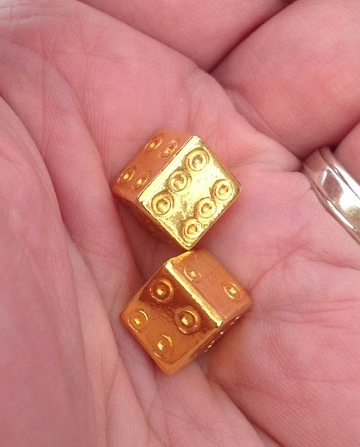
If you want to get better at coming up with interesting ideas, get a coin or a dice and try this as a starting point:
- First, relax. There’s no pressure, and no being wrong: you’re learning a process. You can do this as many times as you like. The more you do it, the less you’ll need the structure as a prompt and the more you’ll be able to do it freeform.
- Choose the sort of thing you’re going to do (board game, short story, or whatever you like. This process works with anything).
- Pick a broad theme or genre that you like and know about.
- Now, ask which of two options is going to be true. One should be very common, and the other rare. This question can be about any aspect of your project.
- Bearing in mind the answer to (4), ask another question with a common and rare answer to build on the previous answer.
- Ask another.
- Keep doing this till you either find a good idea or find yourself too far down the rabbit hole. Change tack as often as you like. Stop whenever you like. You can choose answers, or ignore them. It’s a very fluid process and you’re in charge. However, don’t shy away from difficult answers. That’s often where the really interesting ideas come from.
At each stage try to give yourself options quickly without overthinking. Remember that you’re doing this for your own amusement and nobody’s telling you it’s right or wrong. Relax. See what happens.
When you need to choose between a common and rare option, toss a coin or roll a dice. Give yourself a 50/50 chance of either happening.
Also, at any stage you may find yourself full of more ideas. This process is just here to jump-start stuff, so if you’ve got your own motor running take it from there. You can come back to the formality of this process if you want, or not. Up to you.
You could combine two or three simple choices to get a very strong idea from which you build later. Combining two or three apparently unconnected things is often gibberish, but occasionally genius. My favourite example of this working well is The Great Escape movie + Claymation + Chickens = Chicken Run. It’s a strong initial idea which is inherently original because it is so odd.
Before I go I’ll give you an example. This digs down through a lot more than 3 steps, which you can choose to do or not. I’ll also keep to the same topic for a few questions instead of flitting between them as one would have needed to do to get to the Chicken Run example. Both approaches are valid.
- Relax.
- I decide that I’ll search for a board game idea.
- My theme is a fantasy dungeon bash. D&D sort of thing.
- First question: are the players going take the role of the adventurers (common) or the monsters (rare)? I flip a coin and get tails: the rare answer. Monsters. So, a dungeon bash board game where the players are the monsters.
- Is it cooperative (seems the natural option for this), or competitive (less likely)? I get competitive. Yes, I really am flipping a coin for each step as I write this. I’ve no idea where it’s going. But each time I have to ponder where it could go, and the randomness is taking me where I might not have gone otherwise.
- Are the adventurers abstract (common because it would be easier) or played out in detail (tricky)? Naturally I flip and get detail. This could be an AI card deck, for example. I should ask. But first, let me check. Yup, this coin really does have a heads as well.
- Are the adventurers controlled by an AI (the obvious option) or something else (dunno what)? You’ve guessed it. I flipped tails the fourth time in a row. It’s the non-AI approach. Now I’ve got to think about what that means. How it can be done. My first thought is that it’s got to be the other players if it’s not an AI. It’s a little scary to flip on that topic, but let’s do it for that reason.
- Are the adventurers controlled by the other players (my first idea for this) or something else? Yet another tails, which means it’s not my first thought. Oh how we laughed. This is giving the old grey cells a workout. To recap: the adventurers are not abstract, they are controlled and their actions are detailed. This is neither done by an AI nor the other players. My first five ideas are all really just variant AI systems, so they’re out. I think the only thing left is scripted. This is still sort of an AI, but I can’t immediately think of how else it could work. Maybe asking questions on a new tack will shake something loose. Hmmm… wait a second. I know how to do it! The player controls the adventurers too. That’s interesting. I wonder how that works…
And so it goes.
Why not give it a try yourself and see what you come up with?
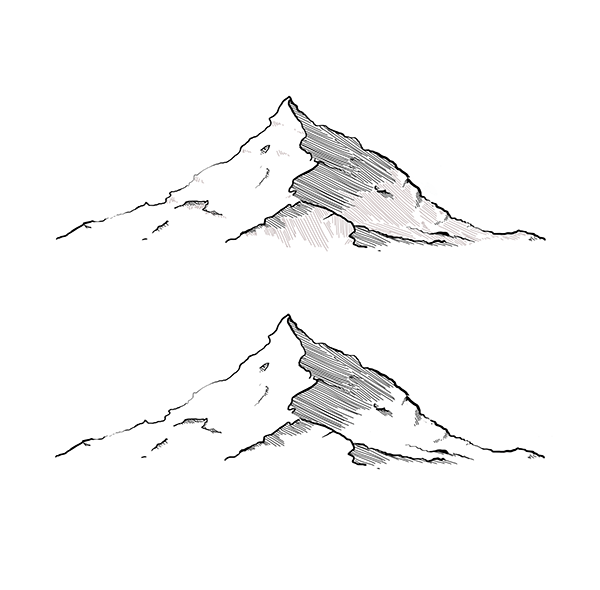
 I’ve got two bits of software to play with at the moment: Photoshop and Procreate.I’ll probably get Clip Studio Paint eventually too. Lots of good reviews. For the moment I’m playing with Procreate as it’s much simpler. I’m also sticking with fairly simple tools, just to get used to it all. Naturally, most of what I’ve done is complete rubbish, as expected. However, I thought I should show you a little, so here are a few of the more presentable scribbles.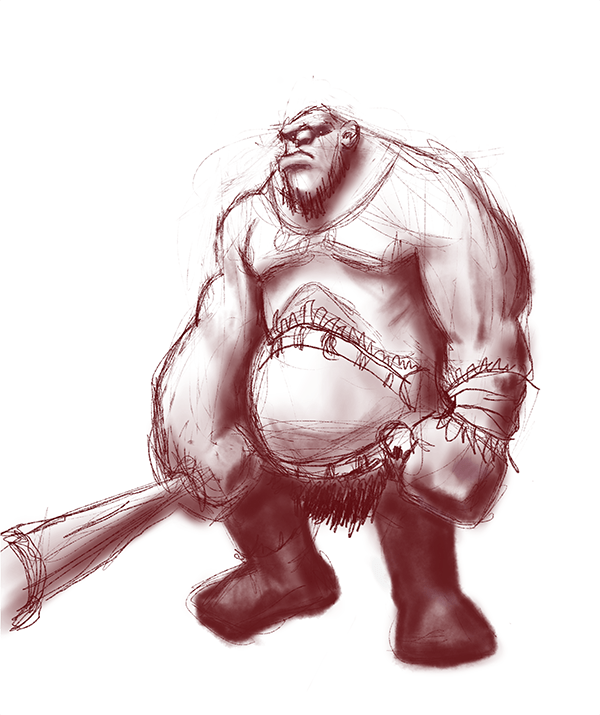


 Quirkworthy