God of Battles Designer’s Notes: Picking An Army

GoB_LOGO on white web

The GoB rule book includes 10 full army lists to choose from. In fact, that’s the bulk of the page count.

These lists are a mixture of the familiar and the unusual with some features common to most wargame rules and a few that you might not have seen before.

Overall, choosing an army follows the familiar concept of agreeing on a set number of points for a game with your opponent and then using the army lists as a shopping list to pick what you want up to that value. For God of Battles a small game is 24 points, an average one 36 and a large one 48 or more.

So far we’re on safe ground.

Cloven in Twain*

The first unusual feature comes when you look at the army lists themselves: each is split into two parts. The first part is called the Main Force, and is just that. This part lists units of infantry and cavalry and provides the bulk of the models in an army. It is what makes the army look like an army when you lay it out on the tabletop.

The second part of each army list is called Command & Support. This includes all the bells and whistles that add “chrome” to the army and give it more character as well as offering a lot more to think about during the battle. It has the army’s characters, bodyguard unit, war engines, monsters, and any character or unit enhancements that may be available. Some of the items bought from the C&S section add or modify a unit bought from the Main Force section whilst others are units in their own right.

When you’re choosing an army you get a fixed number of points to spend. In God of Battles, you spend this twice – once on each list. So, a 24 point army really consists of 24 points of Main Force plus 24 points of Command & Support. Note that you cannot swap points between sections – each total is dedicated to a specific part of the list.

I chose this structure for a number of reasons.

  1. It forces people to build proper looking forces rather than just picking 10 cannons and a wizard, or whatever nonsense the internet tells you is unbeatable this week. It controls the cheese.
  2. I can play the game with armies that have been chosen from the Main Force alone. This allows for easier training games, quick and dirty games when time is short and so on. The split very simply separates off the core of an army from all the extras, with all the additional choices and rules (and therefore time to play) they entail.
  3. It helps you to focus when picking a army. The process of building the shape of the army as a whole and the process of adding the fine tuning and the frills are conveniently separated.
  4. It means that I can have a reasonably balanced way of building an army with no further restrictions (other than occasional things being unique). Again: a simple rule with a lot of useful implications.

Point Values

I might talk about how the points are arrived at in more detail another time. For now, what I wanted to say about point values is that they are carefully balanced against the overall army sizes. Unless you’re playing a vast game (60+ points) you won’t be able to take everything you want. That is very much part of the plan.

Being able to take everything you want in an army is dull, unchallenging and uninteresting. For me, both the skill and the entertainment of the army building phase (something I greatly enjoy) is based on having to make tough decisions about what to take and what to leave out precisely because you cannot have it all.

It’s also why I am very strict on the points value being a fixed and immutable limit. If you pick a 24 point game and then “let people off” with a couple of points then you’ve just taken away all the challenge and allowed their laziness to win. Don’t let them off, instead show them how to finesse the army. Look harder. Try more options. That way you’ll learn more about both your own decision making as well as the army. In any case, God of Battles plays so quickly that you should be able to get a couple of games in an evening, so why not try out both army builds you were considering?

In order to give you a frame of reference, individual Main Force units vary from 2 to 16 points with most costing 4-6. Units with a cost of 10+ are unusual and tend to have a major impact on the battle, one way or another. You can see from this that most armies will have 4 or 5 units of troops to move about in a 24 point battle – not counting whatever they get off Command & Support.

Army Size

God of Battles armies are relatively small compared to, say, Warhammer forces. I’ve done this for a couple of reasons.

Firstly, needing to collect vast armies is a massive hurdle to getting new gamers to play, which is a Bad Thing in my book. It’s also a huge barrier to getting armies from the fevered mind of the general and onto the tabletop. I daresay that I’m not the only one who’s had their plans thwarted by the time or expense associated with collecting a vast new force. 24 points is an ideal size battle for a 4×4 table and is a great place to start. Obviously there are a lot of variations between the 10 armies, but 50 models would be a reasonable ball park figure for a 24 point army. My orc army has lots of goblins in it and comes to 57 foot figures and a chariot. If I’d chosen all orc units instead of goblins I could have done it with 24 fewer models.

Secondly, I want some space to manoeuvre. Too many games I see are shoulder to shoulder units across a battlefield with no space to move. All you can do is roll forwards and all semblance of tactics and thought go out the window. Having a lower model count allows some space to move in, and some flanks to protect and exploit. It adds loads more game play and is a real world example of less (units) being more (fun).

Thirdly, I wanted it to be easier to add to an army. Once you’ve built your core 24 point force, you can expand it to 36 or 48 by adding new units, or simply include some extra units so you can try different 24 point builds. By making units relatively small (6-16 models) you can get the fun and excitement of the new tactical challenge a new unit gives you without it costing as much or taking as long to get it on the table.

Fixed Units… Sort Of

One thing that is bound to cause some initial upset is fixed units. When you look at the various units in both sections of the army list you’ll find that they have a fixed number of figures in them. If you take a unit of nymphs there will be 8 of them. I can see people deciding against this as a terrible affront to their choice. Well I’d say give it a try first. I think it’s a really good plan.

To start with, the units aren’t entirely fixed. You’ve got to pick which of the standard bearer, musician or marksman model(s) you want in each. You can add characters to units (in fact you have to), and these characters can have various bits of extra kit and affect the unit in different ways. Most armies include a number of unit enhancements which can be added to units to make them tougher, fightier and so on. Layering several of these choices onto the same unit can make a huge difference, so they’re not quite as immutable as all that.

What you can’t do is faff about with adding a single model here, changing swords for short spears there. That’s all nonsense. You’re a general for crying out loud! You should be worrying about whether you need more cavalry or more elite regiments; whether the priest will be more useful than a really big cannon, and so on. I want to take you back to commanding an army, not piddling about finding a lost farthing in the accounts. A general needs to know whether that unit is city state pike or ogre gunners, not whether Jenkins has tied his laces properly or Hobart is wrapped up warm (his mother did ask). Deal in the big picture, the sweep of the battle, the army as a whole. That’s the general’s job – he has flunkies for the details.

Extras

One final quick thought about armies. I want my army to have loads of character and individuality to it. With this in mind, every army also gets a Camp and a Baggage Train for free together with 2 units: one of camp followers and one of sutlers who guard these areas. These are great modelling projects and ideal opportunities to use some of the brilliant models available which look cool and amusing but which have no real place in line of battle. I’m thinking here of things like Foundry’s vignette of goblins torturing a dwarf (by shaving off his beard). Character and fun.

I would also encourage you to collect scenery specifically for your army. When you set up a game in GoB you work out who is attacker and who is defender. The battle is then fought in the defender’s land, using the terrain table for that army (every army has their own) to generate the battlefield. Each terrain table adds more character to a force, and if everyone collects the terrain for their own army (their home turf, if you will) then you always have what’s needed whenever two armies meet 🙂

Only The Start

There’s lots more I could say, but I’ll pause here for the moment. There may be questions or comments. What do you guys think?

line

* It’s very unlikely I’ll be using this schlock piece of hack fantasy prose seriously, so I thought I’d leave it here, where it can’t do any harm.


Posted in God of Battles | 22 Comments

The Post of Christmas Yet To Come

Yesterday should have been an army building post, and I bumped it in favour of the GoB announcement because that underpins a lot of what I want to say about the army. Now I can talk about it properly, I’m going to go back and do a more detailed look at what I’ve picked for the Orc Warlords army next (which bumps the goblin discussion and test model bits in turn), but before I do that I need to explain a bit more about army selection in general for God of Battles. That’s a general article which people should find useful regardless of which army they want to play, and so it needs to be taken out of the army diary. That’s what will come later today, when I’ve done some more real work 😉

Posted in God of Battles, Random Thoughts | Leave a comment

God of Battles Official Release Date!

GoB_LOGO on white webLike it says in the title, God of Battles finally has a date set for its official release: the 1st of March 2013.

A handful of copies have snuck out already, and there’s even a review of the book online (though he hadn’t played the game when he wrote it). For most people, however, it’s been unavailable. But there’s not long to wait now.

To celebrate this momentous event, there will be an event at Foundry HQ on the 1st and 2nd of March. I’ll be there on both days to talk to anyone who will listen about GoB and run folk through the rules. Most of the demo armies seem to have gone walkabout with the change in management at Foundry last year, but I’m sure we’ll find something to use.

Anyway, just me doing my happy dance 🙂

Posted in God of Battles | 22 Comments

A First for DreadBall?

DB logo

Well I had an interesting chat with Ronnie at Mantic today about all sorts of upcoming gaming excitements – more of which soon enough. One tidbit I can discuss is the rather jolly news that DreadBall has now sold more copies of the game to trade customers than it did on KickStarter.

This is important for a number of reasons. Obviously more sales are always good, but it’s much, much more than boring numbers. We’ve been looking at KS a lot lately, and we reckon that this is not a common feat. It’s impossible to be sure, but I’d guess that the bulk of most KS-backed games goes to the KS pledgers. How many KS games have a life beyond that? Second print runs? Third?

Ronnie and I always thought of the KickStarter as only the beginning for DreadBall, and the great thing about these sales figures is that they are proving just that: the game’s got legs (and it’s running for the Strike Zone).

As I said at the time and in several interviews since, the best bit for me about the KickStarter was the creation of a vibrant community from day 1, and this is, I think, a major factor behind the ever increasing numbers of tournaments, painted teams and excited fans I see around the net and in person. There is a busy Facebook group, a rapidly filling diary of events and that’s before Season 2 is even out. The fans (that’s you), make DreadBall what it is.

So I’d like to say a hearty thank you to all the DreadBall playtesters, Coaches and fans of every shape and hue out there. It’s crazy, it’s exciting and it’s been a wild ride so far – but we’ve only just begun!

Posted in DreadBall - The Futuristic Sports Game | 14 Comments

Living FAQ: Lost Patrol

Lost Patrol logo on white bigger

Apparently GW are releasing a new edition of Lost Patrol in 2016. I know no more than you guys about this (presumably) revised version, and though I will be writing a review and some commentary when I get a copy, I will not be compiling a FAQ for it. 

This page deals with all the rules questions that you might have about the first edition of Lost Patrol. Please read the questions and answers below to see if your query has already been answered. If not, feel free to ask in the comments section at the bottom of the page.

If you have any questions on the game rules, or if you see a post on a forum somewhere that does, then please direct them here so that I can deal with them all in a single document. That way questions get answered consistently and everyone gets the benefit 🙂

Lost Patrol FAQ v02

line

To keep things tidy, comments and questions will be deleted from this page once they have been addressed in the FAQ.

Posted in Board Gaming, Lost Patrol | 8 Comments

Blast From The Past

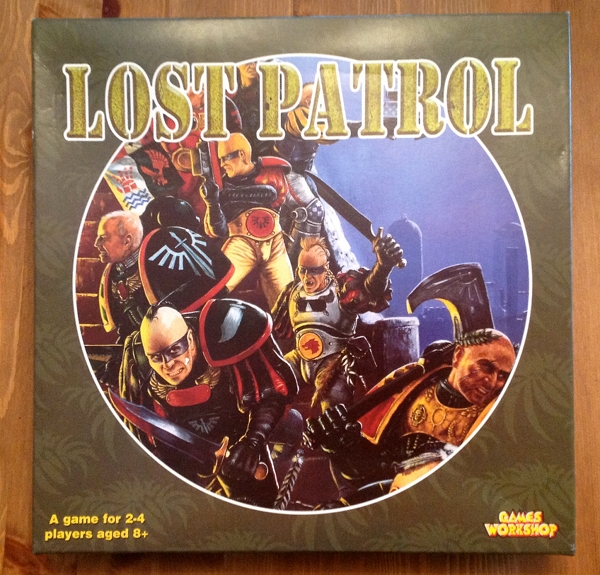
LP box

Played Lost Patrol for the first time in many years and was pleasantly surprised by how well it’s held up. I was, effectively, coming at it almost fresh as I couldn’t remember much about the rules themselves. There was one detail I think it’s worth creating a FAQ for, but other than that (and it was a tactical detail rather than a problem) I thought it was clearly written.

Tinpot and I played twice, swapping sides as intended in the design. Neither of us managed to get off the Death World, but that was always the most likely result. Next time though, next time…

It’s funny coming back to something after so long. I can see a few things I might do differently now, though in the main it’s a game I’m rather proud of. Someone was telling me the other day that I have a signature style to my designs (simple mechanics that hide a great deal of tactical depth and replayability). I think this is a good example of that, even though it’s old.

It’s a shame that it’s out of print, but there’s not a lot I can do about that. Even so, I think I might post up a few articles about it. There are the possibilities if offers for small painting projects, and then there are the expanded rules I have in mind. It’ll amuse me if nothing else 🙂

Posted in Board Gaming | 4 Comments

Review: Fluxx

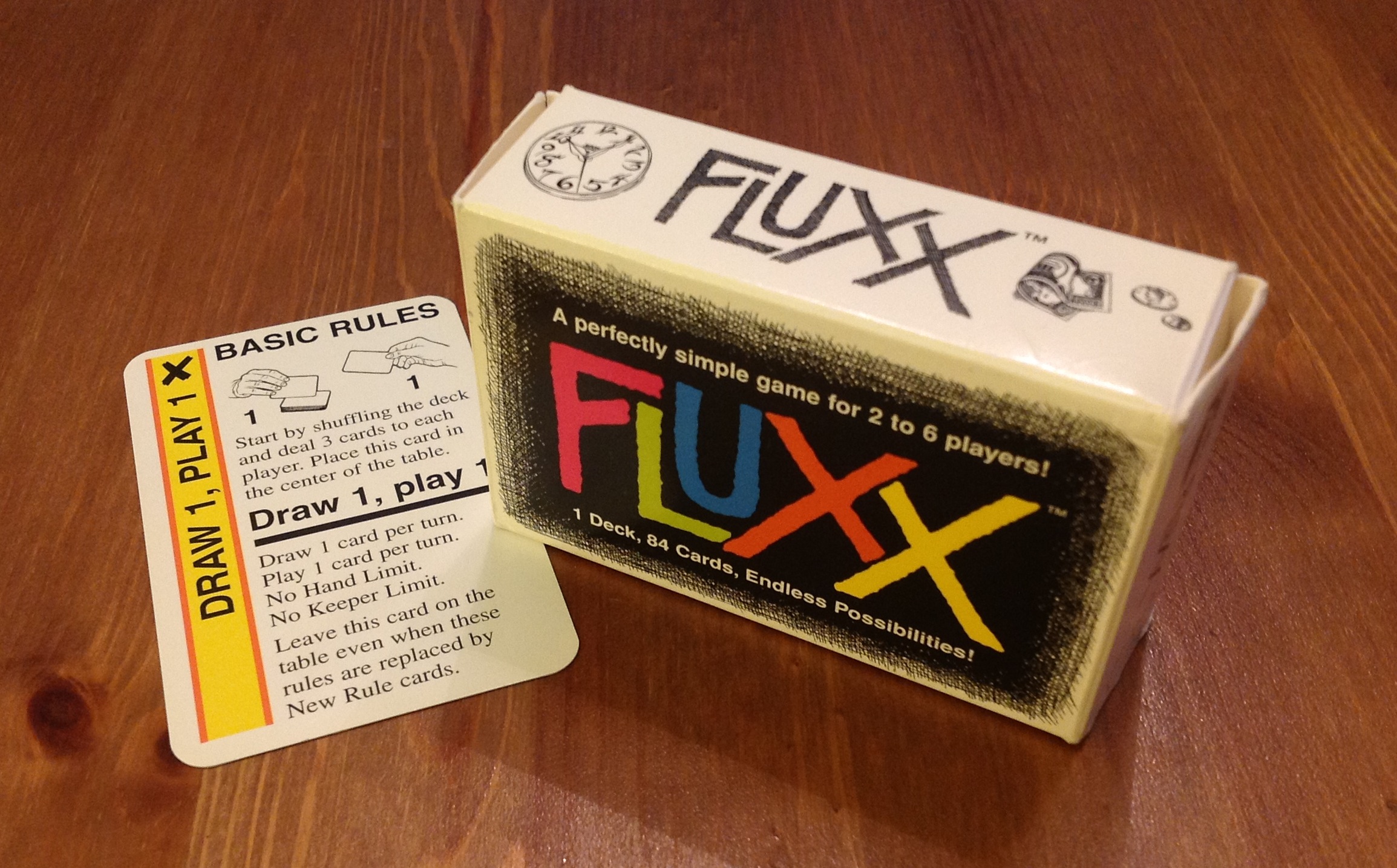
Fluxx boxFluxx is a strange little card game designed by the delightfully named Andrew Looney. No, I’m not joking. The copy I have is a 1998 edition published by Iron Crown and it’s this version I’ll be describing. The current edition is available from Andrew’s own Looney Labs.

The game itself comes as a single 84 card deck. The rules are simplicity itself: draw one card then play one card. Not much of a game you might say. However, some of the cards you play will change the number of cards you draw, may (or must) play, can keep in front of you and, importantly, what the victory conditions are.

Let me explain a little more.

There are four kinds of cards in the deck:

Fluxx rules

Rules: starting rules and new ones. Playing new ones change the rules immediately.

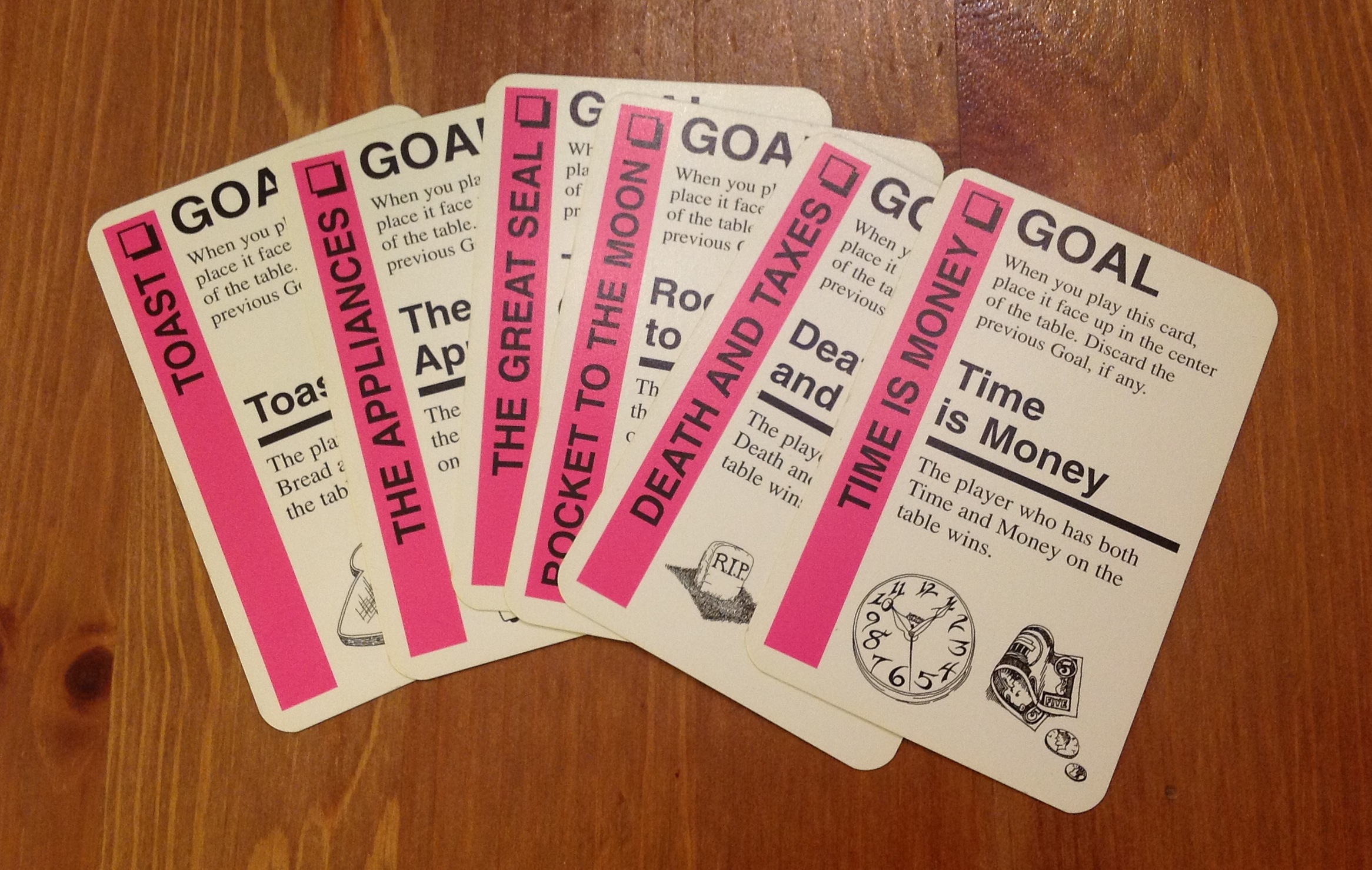
Fluxx goals

Goals: that define what you need to do to win. The last one to be played overwrites the previous one. Only one is in play at a time.

Fluxx actions

Actions: do whatever they say, such as take a card form the discard pile, trash a new rule, etc.

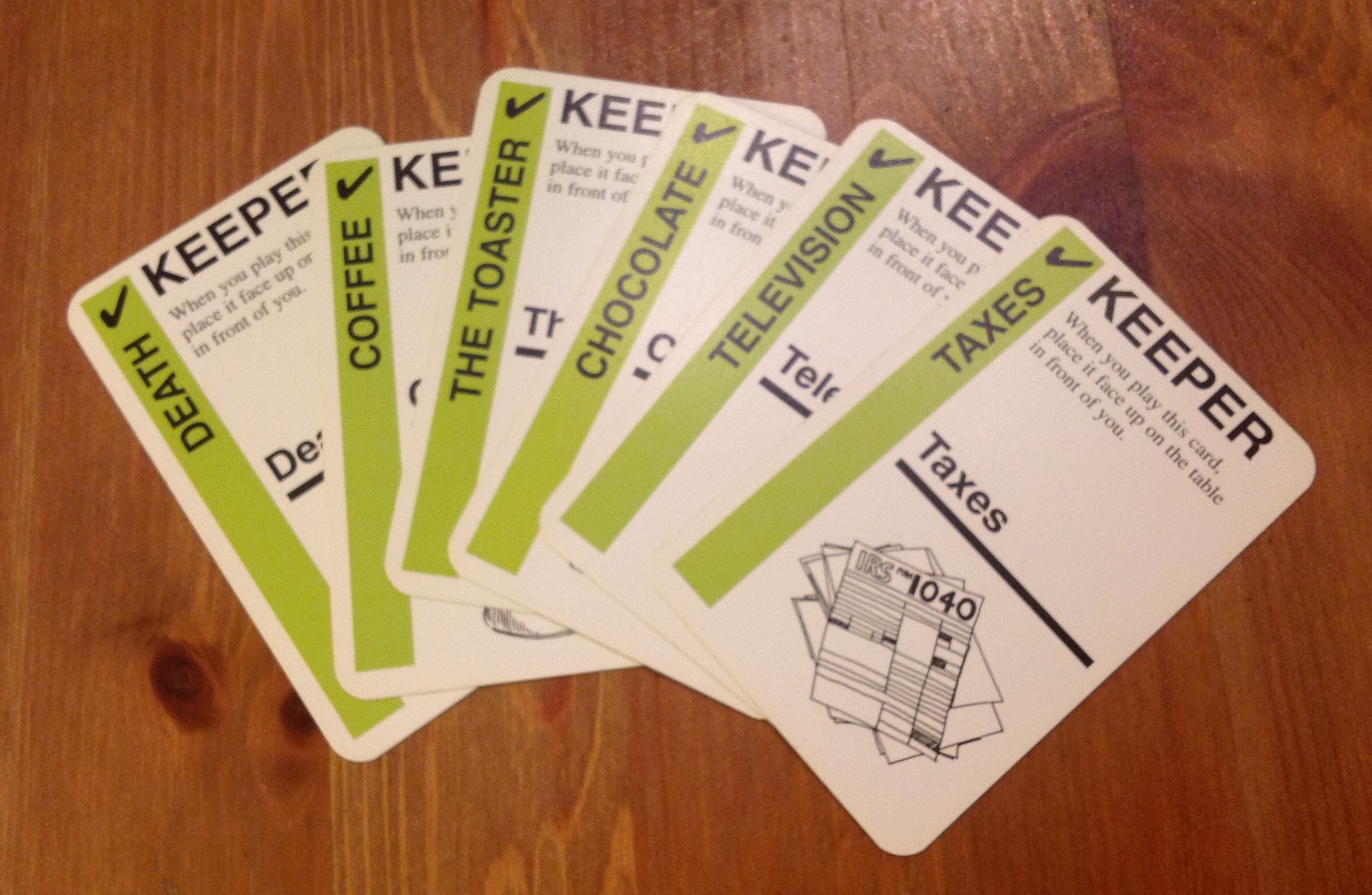
Fluxx keepers

Keepers: are things like chocolate, TV or love. Most of the goals are to do with collecting specified sets of these.


Game Play

You start off with the basic rule cards showing in the centre of the play area. Each player takes turns doing whatever the rules are at that point, say draw one card and play one card. However, many of the cards he plays will change the rules. For example, if he played a draw 2 cards new rule and had only drawn 1 at the start of his turn he would immediately have to draw a second (or he’d be breaking the rules).

As new rules are played they overwrite old ones which are discarded. As new goals are played old ones disappear. You go round the players, doing what the rules say when it comes to your go, until someone wins.

That, in effect, is the whole game. There’s a bit more to it because you have to follow the instructions on action and goal cards, but that’s about it.


Bad Bits

Fluxx is, as the name may suggest, immensely random. Not only is there the randomness of card draws, but the rules change constantly making planning almost impossible. This also means that there is nothing much to do while you wait for your turn as you can’t guess what the rules might be when it comes round again. Happily, the game tends to be short (though this is also very variable).

Winning the game is often more luck than planning, and it is not uncommon for someone to either win because of other player’s actions, or be placed in a position where they can win because of them (rather than something they’ve done themselves).

The game can get itself stuck in backwaters where you have no choice about what you play, or perhaps all you can decide is the order you play things (so what the final rule or goal might be). The game, in effect, plays itself some of the time, which isn’t much fun. I’ve even played games where it won while it was busy playing itself.

A final gripe might be the lack of theme, or at least the mundanity of what theme there is. The only things mentioned are everyday items and concepts and add little to the game. personally I like a stronger theme, but this is a matter of taste and it’s not something that the game is sold on the back of.


Good Bits

The whole idea of a game whose rules change massively as it progresses is an intriguing one. That is fun to watch, and on the occasions when you can manipulate things to your advantage with skill then it can be very rewarding. These occasions are sadly rare.

For all its mutability the game is clear and straightforward to play. As long as the constant change doesn’t throw you, there are few if any rules queries to worry about. In that sense the design is very clean.


Conclusion

For me, Fluxx is more of a curiosity and design exercise than it is a real game. I take it out to play with people who haven’t tried it before as a curio, not as a good game. Having played it, folk seldom ask to play it again over other games of similar complexity and speed.

Having said that, I do play it with everyone I game with as I think that it’s such a fun idea that every gamer should try it at least once. Not only that, but it’s quick to do so and you can use it as a filler to round out a session. If it was a long-winded game it would have gone on Ebay long since.

I expect that I’ve sounded all negative so far, but in reality it is a game that has much to ponder from a designer’s point of view. Fluxx is something that I think any game designer ought to at least have a couple of goes at because it’s such an oddment. In game terms it’s a bit like those buildings with all the plumbing on the outside: it’s workings are all on show. This allows you to examine all manner of assumptions and norms, which it clearly romps all over in its quest for mutability. Personally I always feel like I should be taking more from it in terms of conceptual thinking, and am somehow failing to grasp something fundamental that it’s telling me. Perhaps that’s just me.

So even if it fails as a fun game it succeeds in provoking thought and discussion every time, and that on its own is worth the price for me.

Posted in Board Gaming, Review | 11 Comments

Orc Army Diary – Part 2

I will be going into my army choice in some detail, though that will have to wait until God of Battles is closer to coming out. For now, the broad strokes are that I’ve picked a minimal sized army with none of the frills. This allows me to focus on the core troops needed and get an army sorted and onto the tabletop in the shortest time. Adding fancy bits will be fun later.

Even with the minimum army size there are a number of different approaches you can use to select your force. In this case I’ve concentrated on the real basics: 2 units of orc warriors to thump folk, a couple of units of goblin rabble to back them up and two mobs of goblin pests to stick the opposition with arrows while the rest advance. Six units then: two of orcs and four of goblins. That will give me a solid basis to expand the army later.

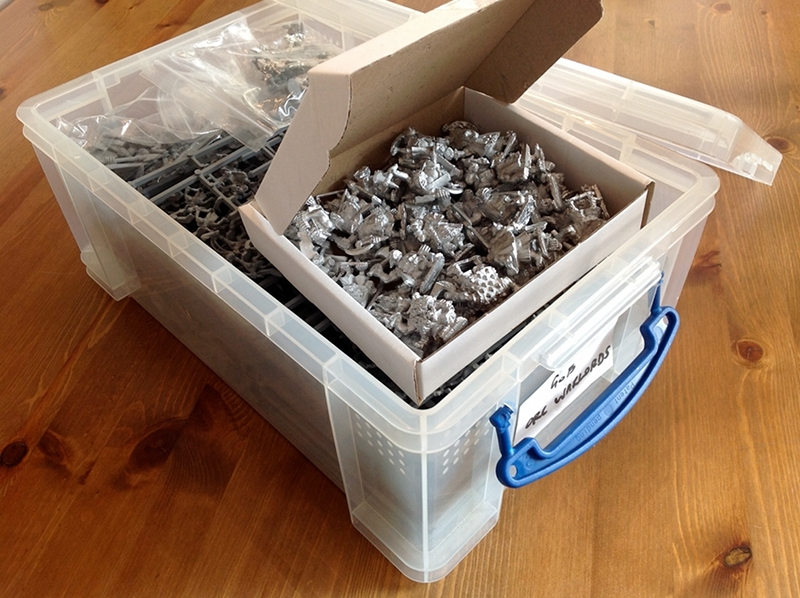
Having decided on this army, I rummaged in the box I’d been collecting models in for just such an occasion. I’m sure that I’m not alone in collecting things for future projects. In this case I already had a box labelled up into which I’d been putting the occasional purchase over the years.

box of orcs

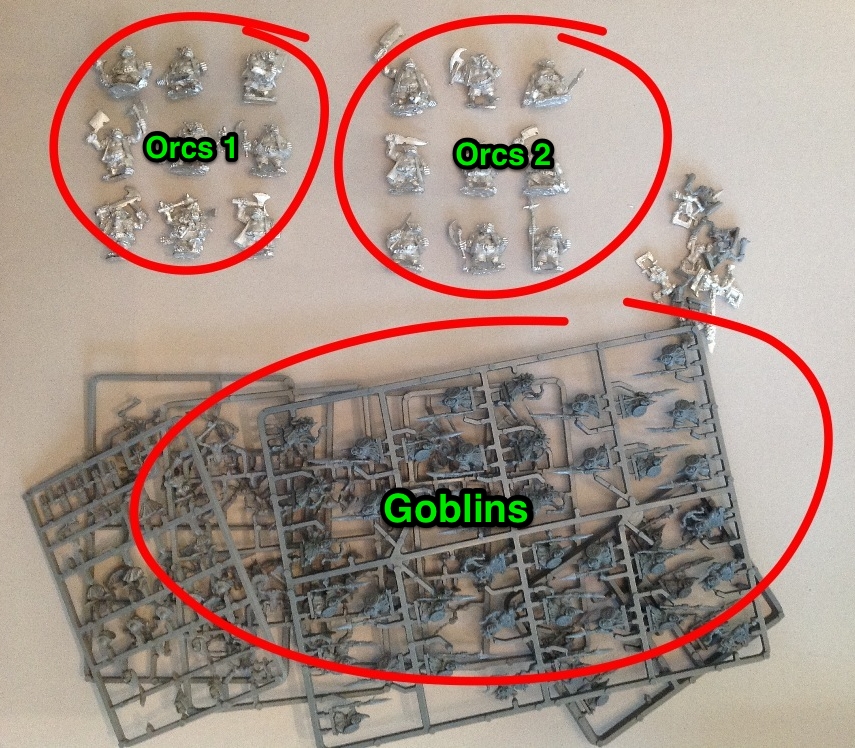
This photo is me laying out some models to check I’ve got the right sorts of numbers and don’t need to rush off and buy any more. I’ve actually got a lot more than this, so there are plenty of options for the Orcs. Looks like I won’t need to do too many conversions to get my desired lack of duplicates. That’ll speed things up nicely.

Orc army figs

The goblins in the photo are mostly GW ones as I’ve mislaid the Mantic ones I had who will be joining them. Can’t trust a goblin to be where he’s supposed to. Typical. Anyway, there are a lot more to add to the mix here, which already includes several generations of GW greenskins of the smaller variety. There are a handful of Foundry gobbos to come as well. However, my main interest here was to check I was on the right track in terms of numbers (which I am), and then I’ll be starting with the orcs. I have rather more chopping about planned for the little greenskins.

Posted in Painting & Modelling | 14 Comments

DreadBall Card Commentary

DB logo

Last update 13th Jan 2013

When I designed DreadBall I included a short card commentary in the rulebook, thinking that I would eventually have to expand on it here. As it stands, very few of the cards seem to have caused difficulty, which is great! However, because I think that it is still a useful resource and worth separating off, I’m collecting any card-related FAQs and discussion here.

CARD PLAY QUESTIONS

The following are dealt with in 3 steps rather than the more common 2. As well as a Question (Q) and an Answer (A) I’ve included a Discussion (D) section  so that I can talk around the topic as needed. This might explain why a rule is as it is, the history of its development or the tactical implications among other things. The intention is to give you a better insight and understanding into the decisions behind the rules as well as the rules themselves.

Q: Can you play a card you just “bought” (with an action) immediately, for instance getting a 3rd action for a player on the very same turn?

A: Yes.

D: Coaches often buy cards towards the end of a Rush, but there is no reason why they have to. Obviously buying a card in the hope of getting a specific action for a player who has already had 2 actions this Rush is a bit of a desperate move, but sometimes that’s what is called for. This is the kind of tactic that experienced players know is available and the lucky ones even make work for them!

Q: If I buy a card and it turns out to be an Event do I have to play it immediately?

A: No.

D: If you buy a card then you can keep it until you want to use it. This applies to all Event cards including The Ball Shatters. This choice of timing is the crucial difference between cards that are bought rather than simply turned to resolve something. Timing your use of the cards can be very powerful, regardless of their type.

Note that when you play an Event card from your hand it may be during either player’s Rush, but it only takes effect after “the current action and all associated dice rolls and card draws have been completed”. This stops you being able to interrupt the middle of a sequence of throw and catch, Slam and fall, etc, which is just as well because interrupting generally makes a huge mess of the rules and leads to a great deal of confusion.

INDIVIDUAL CARD COMMENTARY

THE BALL SHATTERS

Of all the Event cards, this one stands out because of the word Instant on the card. In the early versions of the DreadBall cards, there was more variation in when Events were played, but it became obvious after a while that most of this was simply unnecessary. Little was added to the game, and so I decided to make them all what were originally called “Remains in Play” cards. All, that is, except for The Ball Shatters, which obviously has to be resolved and then discarded. That’s what Instant refers to: the resolution of the card is a single moment in time as opposed to something that lasts as long as it takes to draw another Event card.

For everyone who doesn’t know the history of the card development the word Instant may be a bit confusing, and some folk think that this card must be played immediately. Not at all. It is resolved just the same as any other Event card: when it is turned if it is a random draw or when the owning Coach chooses if it has been bought into a hand.

Apart from its specific effect, the only difference between this Event card and every other one is the length of time it remains in play.


To keep things tidy, comments and questions will be deleted from this page once they have been included in the Commentary.

Posted in DreadBall - The Futuristic Sports Game | 11 Comments

Me Rambling On…

A little while ago I did a rather long and rambly interview for a Spanish podcast. They’re still working on the Spanish dubbing, which was the original purpose. However, I won’t be able to understand that so they’ve also posted the original English version 🙂

It is quite long, and I do wander off their organised series of questions rather a lot (I did warn them), but you might find some interest in it.

No major revealed secrets (that I can remember), but we do discuss:

  • my early gaming
  • how playtesting differs from playing
  • Battle of the Halji
  • Bunnies & Burrows
  • challenges for self publishing
  • Fugitive magazine and early fanzines
  • my time at GW
  • Lost Patrol
  • asymmetry in games
  • simple versus complex and the length of games
  • the rise and effect of Euro games
  • simulation versus game, reality in wargames, theme and mechanics
  • DBA
  • White Dwarf (and “Fat” Dwarf)
  • Dread Fleet
  • freelancing
  • cross-format thievery
  • Dwarf King’s Hold and Pandora
  • the most interesting bit of a design
  • self publishing (again)
  • DreadBall’s early life (as an ice hockey game) and development
  • Ultimate DreadBall
  • Season 2 teams
  • why self publishing?
  • Eternal Battles

Happy listening!

Posted in Random Thoughts | 10 Comments