Incoming Playtest Day

I’ve got a bunch of helpful comments to reply to on the latest threads. However, today I’ve been busy getting stuff ready for tomorrow’s DS playtest day. For that, we’re going to be splitting the group so that we can play both the core adventures and the expansions at the same time.

If it works like I hope it will, there’s going to be a great deal going on at once. I’m sure I’ll get very confused, dealing with queries across 5 campaigns simultaneously. Still, it’s the deep end where things happen, so might as well get chucked in there 🙂

Individual playtesters wil have a much more straightforward time as they’ll be focussing on a specific campaign. After all, that’s the gamer experience we’re testing. I have a rather unusual viewpoint.

I don’t know whether anything happened about the idea of streaming a live feed. I did pass the idea on, and we all agreed it was a fun thought. I just don’t know whether we have the people who know how to do this on hand or not.

We’ll all find out tomorrow 🙂

Posted in Dungeon Sagas | 8 Comments

DS Wizardly Things

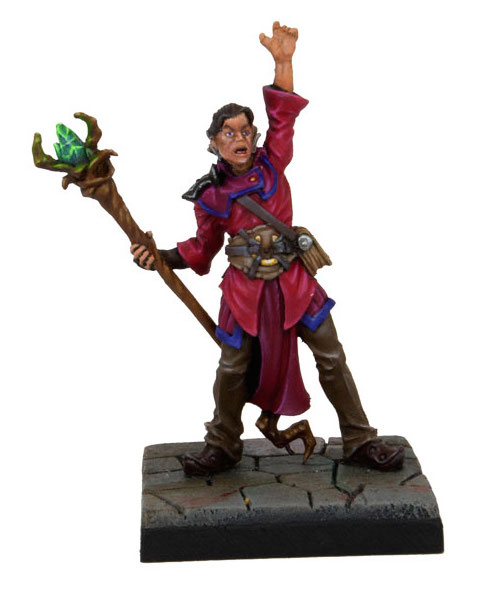
painted-danor-flatAnother brief note on some small changes to DS core rules.

The wizard was sometimes a little underwhelming at the start of the campaign, so these give him a bit more to do. Once you’re part way through the series of adventures he quickly gets more to think about than the other Heroes, so you’ve got to be careful about where he starts. Complex at the start makes him an impossible tangle at the end – especially if you’ve got one player looking after all 4 Heroes. This variability in play options is one of the challenges here – how to be sufficiently interesting when you only have one of the Heroes, but not overwhelming when you have all 4.

Anyway, the changes:

Firstly, if the Wizard is not in an enemy front arc he can use an action to create a new power 1 energy crystal. This is a toned-down version of what he can do in the Downtime section of the Adventurer’s Companion. Power crystals are always useful, so filling an otherwise quiet moment is a helpful option.

Secondly, the Flamebolt spell is now long range. It’s not the most powerful spell (though it’s better against Goblins and other stuff that’s easier to kill than zombies), and that’s exactly how it should be. It’s petty magic and can therefore be used every turn. It can, however, be boosted with power crystals, so every now and again it can be quite pokey. It’s intended as a backup, not the main magical event. Still, bumping it to long range makes it a little more useful without making it overpowered.

Lastly, the wizard gets an extra power 2 energy crystal in each of the Core adventures.

Added up, I think this nudges the wizard to where he needs to be at the start of the campaign, without causing lots of problems later.

Posted in Dungeon Sagas | 11 Comments

Replaying Campaign Adventures

A few people have commented that they’re not fond of the idea of refighting an adventure if they fail the first time out (as the Heroes). As I replied in the comments on the DS Beta thread, I think refights fit the backstory perfectly, aren’t an issue in other games, and are a nice, simple, easy to explain process.

Personally, I think that each adventure is a new puzzle, and one I want to unravel and solve. Losing means that I’ve not solved it yet, so I want to have another go. My gamer instinct doesn’t want to leave it unfinished. This is how I’ve always approached scenarios in games, and it feels entirely natural.

As I said though, not everyone feels the same way. After some discussion, we’ve got a couple of options to add to the rules. These are all for campaign play and don’t make any difference to one-off games.

Firstly, if the Heroes lose a scenario, instead of playing again they can simply take an extra 1 hour loss from their campaign total and move on to the next adventure. This effectively assumes that they played it again and won, but without actually doing so.

Secondly, there is an entirely different way to play the campaign. Instead of using a campaign clock, simply play each of the adventures once, in order, and tot up who won the most games. That side wins the campaign as a whole. You can’t get a draw as there are an odd number of adventures, so this will always result in a winner. Actually, both methods do.

Posted in Dungeon Sagas | 18 Comments

Hammerhead

I went to a local games show called Hammerhead yesterday, which was a bit of a break from sitting at my computer. It was the first time in a while that I’d been to a show with no work to do. Well, not much beyond a bit of research, at any rate. It was great to just bimble about and look at the stalls and the games – like a “normal” gamer.

Anyway, I wasn’t going to write up a long report, just wanted to say that it was a great show and that you should consider making the trip next year if you didn’t yesterday. Have a look at the link above to see a video (with pictures and everything) of the 2014 show. It was in the same venue, which was really rather good. One wall was floor to (30 foot) ceiling glass, so it was unusually light for a games show.

Of course, in the UK we’ve got Salute and the Expo coming soon(ish), so they’ll make this look rather small. Even so, I arrived at about lunchtime and could easily have occupied myself all day if I’d got there sooner. When kicking out time came I hadn’t managed to play a single game, despite there being at least 50 participation games on the go. Mostly I’d been nosing around the traders and talking to people I know. Sometimes both at the same time 😉

I also spent a little money buying toys, more of which anon. Not that I need more miniatures, but you know how it is…

Today I’ve got a couple of DB bits to finish before I properly get back to DS, so bear with me and I’ll be back with more cool stuff tomorrow.

Posted in Events, Random Thoughts | 4 Comments

DS Beta Rules Up

The beta of the core rules are up now. It’s a big download, so be aware.

Don’t worry about the end of the pledge manager coming up as there’s going to be a second one fairly soon. This gives you a bit of time to read the rules, maybe play a game or two, and have a think. If you play the Necromancer then you might want to practice your maniacal laughter too. No rush though.

As it took longer than expected to get them up, please use this thread for comments and queries about the Beta rules. Ta.

Posted in Dungeon Sagas | 75 Comments

A Second DS Playtest Day

In case you don’t subscribe to the Mantic newsletter, yesterday’s had this little snippet in:

“After the great feedback we had at the first event, we’re holding a second Dungeon Saga Playtest Day on the 7th March. Get in touch with Dave if you want to help us test our biggest and best game yet!”


Posted in Dungeon Sagas, Events | 7 Comments

Dungeon Saga Beta Rules Questions

Just had an email from the chaps at Mantic Towers. They’re about ready to release the beta rules to the KS backers, and thought it might be useful to have a thread here for you guys to feed back any comments and ask questions. So here it is 🙂

Backers should have a link to the files very soon.

Posted in Dungeon Sagas, Kickstarter | 71 Comments

An Aside

Excuse me while I have a little rant.

Every day I spend many hours sitting at a computer, working with a number of different bits of software. Most of them I’ve used for a couple of decades, so I’m pretty familiar with them. So I do wonder when software developers decide to change something that previously took a couple of seconds to do into a waste of half an hour or more (or simply something that can no longer be done at all). Call me old fashioned, but changing something that is perfectly slick and functional into a pile of festering donkey vomit doesn’t seem like progress to me.

Today I have lost at least an hour faffing about trying to do something that I used to be able to in a few seconds. Then, immediately after I finally worked out the answer, I found a second change in a second piece of software that was less functional than it used to be. I decided to simply abandon that particular task for today, having lost enough time already.

It’s extremely annoying to say the least as this sort of thing has a real impact on my time and therefore my ability to get stuff done. Of course, it does’t happen every day – it usually waits for deadlines to loom…

I expect the world economy loses billions every year to this sort of frustrating nonsense. Time, after all, is money.

Perhaps some software guru can enlighten me. I’m not worried about specifics, more whether there is some secret maxim in software development that encourages developers to deliberately make life difficult for existing users. I am a pretty experienced user of this stuff and it has happened time and again over the years. It may not actually be deliberate, but it sure looks like it.

I have tried to see this as comparable to a new edition of a familiar game. Some people always get upset when anything is changed. Maybe it’s communications that’s at fault. Perhaps there are brilliant reasons for every change, they just fail to communicate them effectively. That happens in games too. However, there is a fundamental difference here. If I change the way magic works in a tabletop game, then you can still play the game. The rules are still comprehensible. You may not like the change, but it does’t stop you playing the game. With software the changes can, and today have, meant that I simply cannot do my job when I have previously been able to. Not because the features was removed entirely, but because it was relocated¹. Actually, the second issue I had today could be gone for good – I’ve no idea.

It’s especially galling when these changes are labelled as “an improved experience”. Clearly some new use of the word improved that I’m not familiar with.


line


1: When I say “relocated”, what I mean is entered into the witness protection program, given a new name, extensive cosmetic surgery, and whisked away to deepest Alaska.

Posted in Random Thoughts | 17 Comments

DS Tile Thickness

Someone asked me about this the other day, so I thought I’d put up a pic.

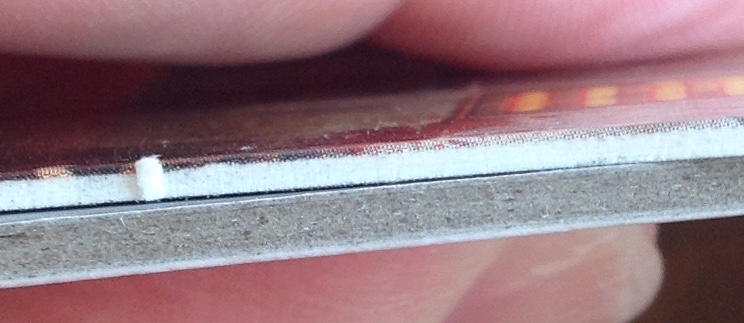
The DS tiles are on board that’s a touch over 2mm thick – perhaps 2.25mm. Hard to be precise without precision callipers.

The board I was measuring was a sample from the factory that has been approved by Mantic (and then “liberated” by me for this).

This first pic shows it compared to the thickness of the tiles in the original DKH. It’s a bit tricky to see because the DKH board has a rounded edge (due to the cutter), whereas the sample board is square edged. The new board is a little under twice the thickness of the old.

Board 1The second picture is edge on, with a Mantic base and a GW slotta base sitting on top for comparison.

Board 2As you can see, the tiles are going to be nice and chunky 🙂

I don’t have a photo because they’re not made yet, but the tiles will be held together with transparent plastic H-shaped clips.


Posted in Dungeon Sagas | 4 Comments

The Adventurer’s Companion

One of the most challenging areas of Dungeon Saga has been deciding where best to make the split between the core game and the Adventurer’s Companion. From the start we knew that there was going to be this division, and we agreed at the outset that the main divide would be in terms of the out-of-game options. The core game was designed to be something you could take down from the shelf, set up and play quickly without needing to make lots of choices beforehand. You just pick an adventure to play and follow the map. It’s ideal for people who don’t play often or just want something light.

But dungeon gaming could be a great deal more than this, and although it’s not what everyone wants, it’s definitely something that many do. So, while the core game is prescriptive to ensure speed and simplicity, the Adventurer’s Companion is a sandbox to play in that needs you to invest more time and creativity between games. Again, this will suit some folk perfectly, but has been sectioned off as it will just be confusing dead weight to others.

At least, that will be the retail split. I think most of the KS backers and my readership here are in the camp that wants both bells and whistles 😉

Anyway, having agreed on that split, we had to decide which elements went in each part, and that’s been very tricky. To be honest, there isn’t a right answer. So, the Adventurer’s Companion is designed in sections that are, where possible, independent of each other so that you can add as much or as little as suits you. Obviously some parts are more independent than others. For example, the experience system doesn’t make much sense without the campaign rules.

So what’s in the book?

Well, so far we have the following areas (in alphabetical order):

  • Abilities: Lots more abilities to learn. These allow both Heroes and minions to explore a wide array of different career paths. There are some general rules to explain how to read the abilities and an explanation of those abilities which come in a series of ranked steps. Abilities are split into 5 main areas: combat, general, illegal, magical and musical. Some categories only have a couple of abilities in, but even a single ability can make a big difference to a Hero.
  • AI rules/Solo games: rules for replacing the other side. This is the area I’m currently least happy with so I’ll explore this in another post when I’ve done some more testing and am happier with the result. Currently it works, but needs a bit more input from the remaining player(s) than I’d like.
  • Bestiary: loads more creatures to populate your dungeons with. These include (where appropriate) the stuff needed to make Bosses of the appropriate race – see DIY Heroes  for what this is. The bestiary is broken into families of different creatures, each of which contains several different stat lines of game values and abilities. For example, the Basilean’s include Men-At Arms, Paladins and Sisterhood. The families are: Abyssal Dwarf, Basilean, Dwarf, Elf, Goblins, Ogres, Orcs, and Undead. So far that’s a total of three dozen or so lines, a few of which you’ve seen before (in the Undead list), but most of which are new. We’ve decided to add a few more too.
  • Campaigns: how to run them. The core idea is that you play a series of adventures with a Downtime turn between one and the next. Downtime turns consist of several steps such as recovering from wounds and getting gold. Did I mention there was a currency? Anyway, the main thing is choosing the location you will spend your Downtime in. You can always choose the Tavern, and deal another location card per Hero to pick from. Each location offers some benefit. Most require a dice roll; some abilities give you extra rolls; some locations might sell you extra rolls for some of the gold I mentioned. Each Hero can only go to one location each Downtime, though the Heroes can split up and go to different ones if they choose. Once you’ve resolved everyone’s locations then you spend any experience you earned on your adventure. You do this at the end because some locations can offer extra options for spending experience. What I’ve tried to do with campaigns is use features like locations to give a taste of the whole RPG thing without all the complexity.
  • DIY Dungeon: this is a somewhat discursive section that goes through the steps to make your own adventures. As this is such an immensely varied process, all I can really do here is provide some guidelines for prospective Overlords (as it is they who build them). The intent here is mainly to provide some structure for you and to point out the main pitfalls to avoid. It’s actually quite a straightforward process – the complexity comes in balancing them, which is really just a case of replaying them till you’re happy.
  • DIY Heroes: how to design your own hero. This simple process is a case of choosing which race, gender, profession, bonus and name you want your new character to have. Each step offers a selection to choose from. The 8 races and 9(11) professions form the bulk of this and define the majority of your Hero. Their starting stat line is made up of a baseline from the race, modified by the chosen profession. The bonus is a bit of a wild card to allow you a degree of personalisation, though the real place that new Heroes become individualised is in the experience process. Some professions require additional choices of spells or songs.
    • Races: Human, Dwarf, Elf, Halfling, Naiad, Dryad, Salamander, Air Elemental.
    • Professions: Barbarian, Bard, Cleric, Demon Hunter, Druid, Fighter (has 3 sub types), Paladin, Thief, Wizard.
  • Environment: a few more rules to expand on the possibilities and make the dungeon more challenging. Things like magic furniture, hidden compartments, expanded rules for locks (so they can be picked as well as smashed), plus various types of trap (on the floor or the lock).
  • Experience: collect glory by winning adventures (primarily – though there are a few other ways). When you have enough then you go up to the next level. Each time you go up to a new level then you get to pick a bonus of some sort. This could either be money or abilities. Usually, you’d pick abilities. The choice of abilities you have depends on your race, profession and level. Each race has a table with a single experience choice per level. This allows them to be characterised a bit. Then, each profession has two choices per level, again allowing them to be characterised. By having it broken down in this way, an Elf Thief and a Halfling Thief share two out of three choices, but each has a third which is different to retain a bit of variation. A few locations add a fourth choice to this process. It’s making these choices that really individualises your Hero. You may get a second chance to get a given ability at a later level, or you may not. And these variations are cumulative, so after a few levels and a few different choices the Heroes that both started out as basic Thieves (or whatever) could he evolved quite differently. This process is full of hard choices because there are way more cool abilities than you can get. This ensures that no single Hero can do everything on their own, meaning that there is always a reason to be adventuring as a group and playing cooperatively.
  • Feats: a list of extra feats, in much the same way as the list of abilities.
  • Magic: there are a few bits of general commentary for magic items and spells, but most of this is the decks of new item and spell cards. Spells are broken into families, and a spell caster will know one or more of these. You can only cast spells from families you know. The core family is petty magic, and all spell casters know that. This gives you a sort of bread and butter set of spells. The particularly thematic spells tend to fall under one or other of the families. There are currently over 60 spells and about half that in magic items.
  • Random Dungeons: rules (and cards) for building random dungeons for when you’ve played all the pre-written adventures and haven’t designed your own yet. The tiles are divided into groups, each group having a small set of different layouts on cards. You randomise which sets you use and which card from each set you use. This forms your dungeon layout and is only revealed as you explore it. By breaking up the tiles/cards like this you won’t get layouts that you cannot make with the tiles you have. While you’re bumbling around in the dungeon you turn event cards to see what you find. These are generic in description as there are loads of possible types of beastie and Overlord. Speaking of which, just because it’s random doesn’t mean you don’t, or can’t (or should or shouldn’t), have an Overlord. You can if you want to, or you can tie it in with the AI rules. Anyway, the event cards define encounters in numbers of levels of creatures, and the bestiary lists the level of each type. So, you can have an encounter with 15 levels of things. As you decided at the start what type of Overlord you were up against and what models they had to hand, this is actually very quick (and obvious) to resolve on the fly.
  • Songs: a few general rules for using songs (they work much like spells), plus the cards to go with them.

You noticed that I said “so far”, right? Well, I think the above covers all that was promised during the KS, but we haven’t stopped yet. Since I wrote the first draft I’ve had a couple of extra ideas I’d like to add (which aren’t in the above list), plus the guys at Mantic have got a load more cool suggestions. So this list may get bigger 🙂

Anyway, I hope this gives you a bit more of an idea what’s coming. I’ll delve into the sections in their own articles. As you can see, there’s a lot to cover, and at over 1,700 words I’ve only really scratch the surface…

Posted in Dungeon Sagas | 75 Comments