
Orcs it is then! Just have to decide on which models. Actually, I decided some time ago, but I’ll walk you through the thinking as it may be of interest. At least, I’ll ramble about orcs for a bit 🙂
One of the first armies I had was orcs. At that point I’d collected a miscellany of models for managing combats in D&D, Runequest and the like. There were quite a few of them, but they weren’t a coherent force. Not by some distance. When I started playing Reaper and then 1st edition Warhammer I needed something a bit more organised. Unfortunately, whilst I could find plenty of people who were happy to play the games occasionally, none of them were willing to invest in a whole army. So, undaunted, I collected two: one Dwarfs and the other Orcs.
All but a tiny handful of these models are long since gone and so I am starting with a clean slate. This is probably for the best.
 Where Do Little Orcs Come From?

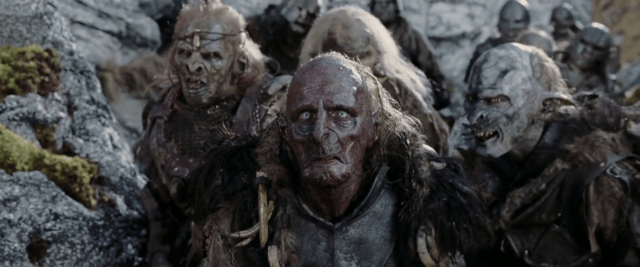
Orcs in the modern fantasy sense are based on Tolkien’s interpretation, taking an Anglo-Saxon word meaning “demon” or “ogre” (or probably more accurately, “monster” in a broad and unspecified sense) and giving them a specific and defined form. In effect, this moved orcs from the dark and shadowy corners where they had long lurked, and out into the light where one could see what they looked like. This is essential for making models of them though is at the expense of some of their scariness. It also had the result of having to define something that had previously gained some of its fearful reputation by being unknown. There has been some difference of opinion on exactly what form they should take.
In terms of models, orcs generally fall into two broad camps. The first are what I think of as simply ugly humans. They might have fangs, scars and odd weapons, but essentially they are human in anatomy. More recently, this is the sort of thing you saw in the LOTR films and, therefore, the GW ranges that followed. This is nothing new though.
When I first saw orcs it was this sort of anatomy I was greeted by. These were Grenadier models sculpted by the very talented Tom Meier. Beautifully rendered models, though not really to my taste. I did have loads of Nick Lund’s Chronicle orcs which were not as finely sculpted, but had lots of character (and a vast range to choose from). Still basically ugly humans though.
Many other ranges have followed in this general vein. Whilst they may be stooped and grimacing and dressed in strange armours, they are still just ugly humans.
The second kind of orcs is the less human, more distorted (anatomically) and somewhat comical. This is epitomised by the greenskins of Kev “Goblinmaster” Adams who produced most of the classic range of orcs from Citadel. These vary in anatomy, ranging from frequently hugely overmuscled to occasionally spare and wiry, but almost always with long, gangly arms and huge heads with massive fang-lined jaws. Whether these creatures would work in terms of real world anatomy is somewhat debatable. That never seemed to reduce their popularity though, and they were a staple for Citadel and GW for many years.
Brian Nelson introduced a more carefully considered anatomy and a carefully rendered level of finer detail to the GW orcs a few years after Kev left. This has defined the classic GW orc to this day. However, they still retain the essential features laid down by Kev for GW: long, gangly arms, huge muscles and a massive head with prominent fangs.
Given its market dominance, it is hardly surprising that many smaller companies have produced orcs that are very much in GW’s style. Over the years people have produced some excellent individual pieces and these deserve to leaven the armies of the discerning Warhammer player. Others have cut their own paths with all manner of alternatives on offer. Have a look at this post which lists 41 different ranges of orcs.
Nothing Like Nostalgia
Having started with orcs, and having spent many years at GW playing with Studio orcs armies, I have a great deal of nostalgia for that range. However, it’s also linked very strongly with Warhammer, as it should be. Much as I like various generations of GW orcs I can’t bring myself to collect an army of them for something else.
The ugly human approach has never really appealed to me. The only times I had such an army was when no alternative had been invented. Even then the Chronicle orcs I chose had a tongue in cheek charm that they shared with Kev’s later, classic GW orcs.

Which leads me to the Foundry orcs. These were also sculpted by Kev, and so share a style as well as a humour which I find appealing. However, they have no association with Warhammer and are sufficiently different to have a style of their own. They are not po-faced, by any stretch, but even with their obvious humour you’d not want to meet one down a dark alley.
These are the orcs I’m going for. I’ve included a couple of photos of what they can look like en masse. For more nicely painted images take a look here.
Goblins
Pretty much every orc army also includes smaller critters who fight alongside them: goblins. The history of goblin models is very similar to that of the orcs, with Kev and Brian repeating their respective roles for GW.
Kev also made a load of goblin models for Foundry, but although I like a few of them they are not all to my taste. I also have a more disparate notion of the smaller greenskins and so I’m not limiting myself to a single range. Instead I’ll be including models from a variety of manufacturers including GW, Foundry, Mantic and beyond. What I want to see on the battlefield is the same motley band of mis-matched renegades I can see in my imagination. I’m thinking that with a careful selection of models, some judicious conversion and a unifying paint scheme I can meld together the efforts of a variety of sculptors into an intriguing whole. We shall see.





 Quirkworthy