 Caveat: this second part is for the 5% of the gaming population who immerse themselves in the world of games and gaming as much as I do, and who are as curious and particular about how things work as I am. Sticklers for details, beardy idiots, pedants, geeks; call us what you will. For the saner and more normal 95% who get their gaming fix by sticking some models on the table and rolling the dice, the first part is probably sufficient. You were warned 🙂
I will assume here that you’ve read part 1 of this review and so you understand the basics. This part is about the details.
Unfortunately, it’s in the details that this edition of Kings of War creaks a bit. I do look forward to the 3rd edition, which will, one assumes, have fixed all these things, and be full of amusing background material too. If Alessio hasn’t killed me by then I’ll happily review that when it comes out.
For the moment, we have what we have, and if you’re just throwing down with a mate for a friendly game using an army you have kicking about then KOW2 is fine. If you’re taking it more seriously then you’ll need to be writing some house rules. I would, however, suggest that you do give it a try. Mantic are very keen to read your comments and you don’t often get a chance to have this much input. Download the rules, drag out your old Warhammer armies and give it a blast. Then let Mantic know what you thought (good or bad). They’ll appreciate it.
Now put your protective harness on and stand well back – I’m about to get picky!
 What Works?
The core game works. This is a short paragraph, but it is the bulk of the game. Personally I don’t find the “I-go-U-go” whole-army-at-a-time turn sequence to my taste, and I have issues with the way individuals work, but you can’t deny that the game is slick and functions well as a basic system.
 What Needs Work?
Several areas. A few specific units are currently broken, others are a just bit too good for their points. The poster boys for brokenness are the Masters of Death (assassins). Take multiples of these in your army and you’re laughing (but your opponent won’t be). Not only do they have +2 to damage in both melee and shooting, they can appear anywhere on the battlefield – guaranteed (no dice roll required) – in whichever turn their owner wishes. This includes behind the enemy, of course, and I forgot to mention that you triple your attacks if you charge from the rear. Alessio is entirely aware of this and even now his little grey cells are being burned by the million as a clean and simple answer is sought.
The human captain who gives lots of units Vanguard (a double move after deployment) also needs work, but again Alessio is on the case.
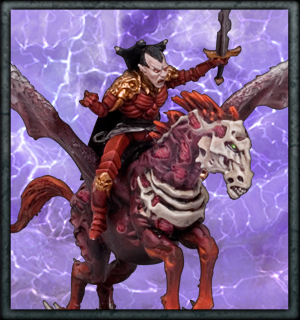 Vampires (Soul Reaver cavalry) are perceived by some as needing a nerfing, though I personally don’t agree. After 7 games with a Soul Reaver army I think they’re nasty, but very killable if you’ve thought it through. They are, in fact, so expensive for what they do that I reckon you’d be better spending your points elsewhere. If they have their Bloodbath rule removed (as was discussed) then I really would think twice about taking them unless they drop very dramatically in points. Two units of the lesser Undead (or even better, Twilight Kin) cavalry is only very slightly more points and is a much better option in my opinion.
There are other issues in terms of points balance, such as the relative costs of lesser and greater Obsidian Golems, and I think that many of the war engines are overpriced (or under-useful). Some characters feel like their relative battlefield usefulness is not reflected well in their points. But all this points juggling is easy enough to fix with playtesting. It means that this edition is a bit exploitable, but don’t let that stop you. Go out and exploit things, my children. It is for the Greater Good of the 3rd edition!
(Just remember to tell Mantic what you’ve found broken).
 So far we have had cosmetic and easily fixable issues that will clearly fade with time. A 3rd edition was planned from the start and the KOW ship is on course. None of them should really be a concern. My next thought is more worrying, though increasingly theoretical. It’s about Individuals. Models with this special rule are basically those on foot or riding a normal mount like a horse. Those on big monsters don’t get the benefits. An Individual doesn’t have to worry about turning and can charge all round and this is where the trouble starts. There is no restriction on characters moving around and between units and this means that a single fighty Individual can destroy whole regiments on their own, almost regardless of relative points values. You get double attacks from the flank and triple from the rear, and any character worth his salt should be doing this at all times. Advance in the lee of a “real” unit (or fly, or teleport in like assassins) and then skip through the gaps in the enemy line and start hacking away. Enemy units must leave an inch gap between themselves, and an Individual model is generally on a base that will fit in between…
One potential fix for this that was mooted at the tournament was to disallow doubling and tripling for Individual’s attacks. They do not suffer this problem as they have neither flank nor rear themselves, so why are they getting the benefit? This would go the bulk of the way to fixing the issue and I’m sure that the assassin problem will be ameliorated too. However, I still think that we will be left with the rump of a problem, which will still essentially require you to take a fighty character of your own in any serious army. Their job will be as a sweeper to protect the flanks and rears of the fighting units, because even if an enemy doesn’t get additional attacks, they’ll want to hang about outside the front arc as that way they can never be charged by their target. As damage is cumulative, a character nibbling away at a unit will erode it on their own given time, and can easily make the difference to an otherwise evenly balanced attack going in from the front. Mantic want us to play with huge armies, so having a rule that encourages you to forgo a unit or two so that you can take an über Individual model seems counter to their intentions (plus a bit odd in general). For those of a greybearded persuasion like myself, it’s harking back to the days of what used to be disparagingly known as “Herohammer”.
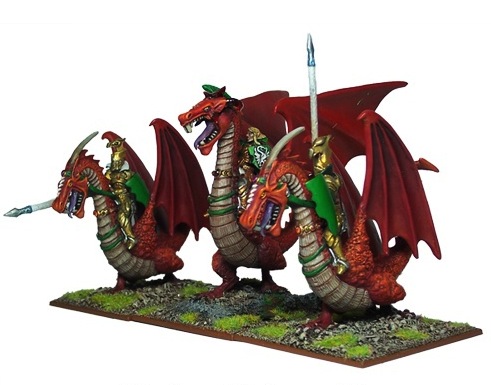 Flying units are another area that seems a touch over powerful. They are often several models strong so the benefits for flank & rear charges are fair enough. Being able to fly them over the enemy battle line and then spin 180 degrees (all flying units get the Nimble skill so they can all do this even when they double move – usually a total of 20 inches) means that they should be in a position to charge into the rear of an enemy unit in their next turn. A unit of 10 Gargoyles has 20 attacks at 4+, and only costs 90 points. If this is going into the rear of a unit that’s an average of 30 rolls to damage (triple your 20 attacks, half of which hit), so you’d expect 5 hits on a target with the highest damage of 6. As you move your whole army at once, attacking with multiple units against single targets is a common and highly effective tactic. Put two Gargoyle units into the back of a single enemy unit and you’re getting 10 damage on the highest damage unit in the game – and all for 180 points. Of course, Gargoyles are not particularly resilient to damage themselves, but if they’re behind you then this is hardly a problem. It’s a similar issue to the assassins: they are weak in defence and strong in attack, but if you can never attack them because you can’t see them…
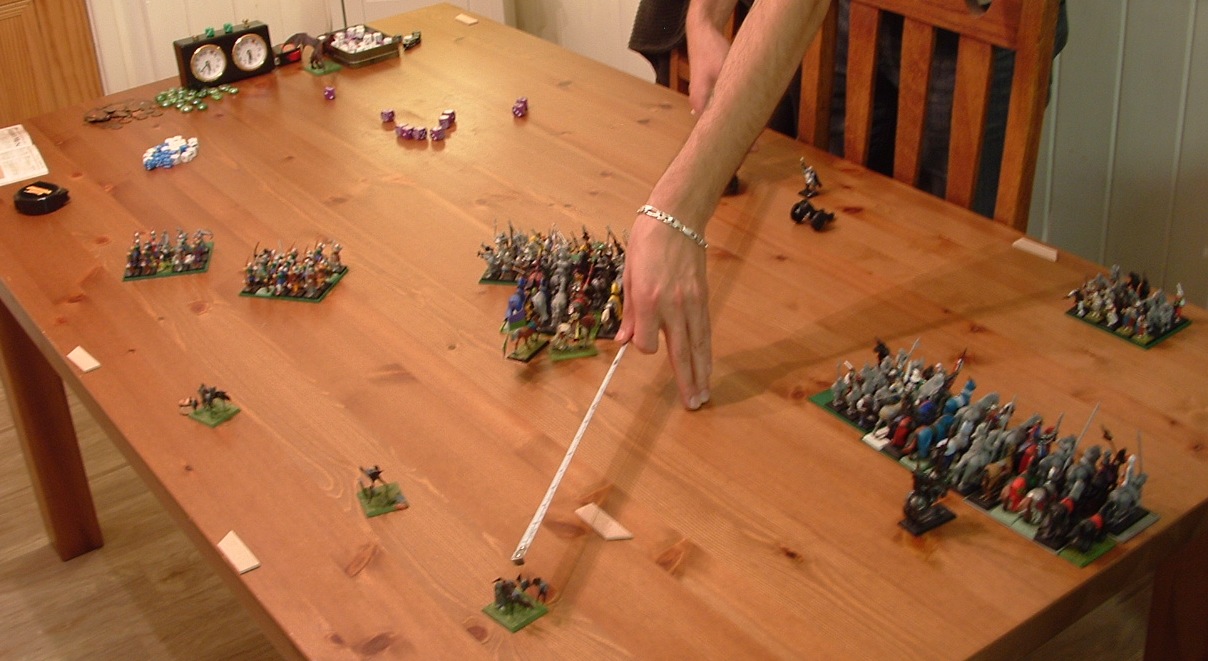
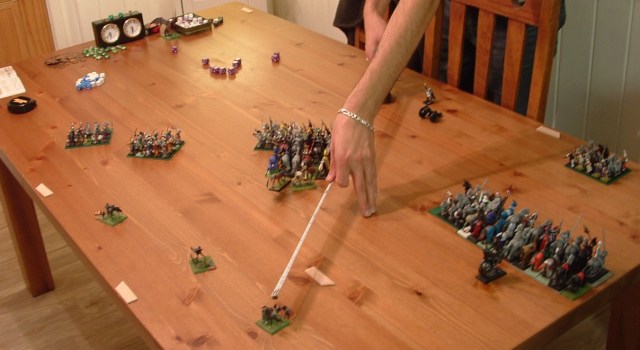 Pre-measuring is another aspect that I believe causes problems with competitive games. If I have a unit that is faster than yours, you should not get the first charge. Ever. There need be no guesswork required. You have no tension of whether you have judged things right or not (something I rather like in Warhammer); here it is all about the geometry of the position. Now it was instructive to watch the top players in the tournament exploiting this feature to obliterate my army, but they weren’t what I’d call fun games (in an abstract sense – my opponents were a good laugh though). And now I’ve seen people who do it well I’d try it myself. Why would I not? Not using the tools at hand feels very odd to me, so I’d feel I had to. If both players are doing the same thing and both have taken the fast armies then you’re back to an even playing field, but where does that leave any army without move 6 foot troops, or, more importantly, move 9 cavalry or move 10 flyers? If both players have equally fast armies do you then get a good game or just a stand off? Is it like playing Chicken? I don’t know the answer to these last questions, but it’s something to consider and try out. Please comment below if you give this a go on the tabletop.
Finally, I wonder whether using chess clocks elicits the intended behaviour or not. Again, I expect it to act to reduce the size of the armies being fielded, rather than expanding them. Physically moving troops is time consuming, and if time is tight then that has to be a consideration in army builds. Again, Mantic’s desire for huge armies comes under pressure from the other direction.
 Conclusion – Serious Play
After the feedback from the Tournament, Alessio is working on a series of changes to the tournament pack that will be available from the Mantic site and will (presumably) apply to future tournaments. This will doubtless go some way to removing the most heinous of the broken units we saw at the first tourney. However, I predict that this will simply leave the next level of imbalance to be exploited; a level that was masked by the sheer obviousness of the Masters of Death and Captain problems. Kings of War is plainly not finished yet in terms of detailed balance, nor is it expected to be. I do expect it to be fine when it is finished (which will be the 3rd edition, next year). At least, it will be much more fine. There’s a load of playtesting to do yet, and if they add a bunch more armies into 3rd (and I expect they will) then they will also need testing. If they go in as the new ones did in 2nd, then we’ll be right back to where we are now.
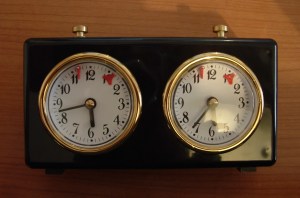 I’m quite taken by the idea of using chess clocks, though I remain unconvinced that all the ramifications were thought through well enough. Chess is a very different proposal to a tabletop game where your armies are mutable. Adding time pressure is tricky to balance, and will put off as many people as it intrigues. Naturally slower players, or players who wish to field larger armies, will be penalised if the times are set for faster, smaller armies. If the times are set to accommodate the larger forces then smaller players are unpressured. It’s a tricky thing to balance. Using chess clocks for chess competitions don’t have this problem as chess has fixed “armies”.
Whilst KOW2 is fine for casual play, I’m not sure it’s ready for serious tournaments yet as the playing field is not even enough and the lists not sufficiently refined. I could be wrong – maybe that’s what tournament players really want: room to exploit. For me I want to have a close game and if I win I’d like that to be because I played better and not just because I’m more able to spot the broken bits. Maybe Alessio’s revised tournament pack will fix enough of these issues to make it all fine. I hope so. You can all help to rectify this as well. You all need to go out and play Kings of War and let Mantic know what works for you and what doesn’t. I’ve played it a reasonable amount now and these are my thoughts to date. What do you think? Am I wrong? Let me know.
 Lastly, on a personal note, regardless of the clean rules, fast play and even ignoring the balance issues which I’m sure will be sorted soon enough, I feel that Kings of War is missing something. This is a very “touchy; feely” kind of thing to say, and unhelpfully, I can’t really tell you for certain what this “something” might be, though I will hazard a guess or two. It could be the lack of background. KOW2 is rather generic, and this is always less appealing than a game with an immersive fantasy environment. It is more likely to be what I see as a missing level of detail. KOW is not sufficiently abstracted for me to see it like DBA as an overview, yet it lacks a level of ability to tweak. For example, there are no magic items, and the magic system is perfunctory (though this may expand with 3rd ed). All I can do is pick from a fixed palette of units and unit sizes (and choose to have banners/musicians or not). I think I’d like a bit more mutability, though it’s hard to say what else this might be. It could even be that I want more boundaries in army selection. Who knows? There is just a niggle at the back of my head that Kings of War 2 is missing a little something. If I work out what this is then I’ll be sure to tell you.













 Quirkworthy