Well I’ve given you my initial impressions on opening the box, and gone through building the ships. What happened when I got it on the table?
This is a review of the game rules and gameplay based on a single game of the first scenario which just uses one ship per side (though they are the flagships and there are also auxiliaries – small ships and monsters). I’ve arranged another game with all 10 ships in a few days and I’ll write that up too. Most of Dreadfleet’s scenarios play with more than one ship a side, so this was just to go through the rules and get our heads round it. Oh, and rather than stop when we should have done (when one ship has 8 damage on it) we carried on till one sank. Just call us bloodthirsty lunatics.
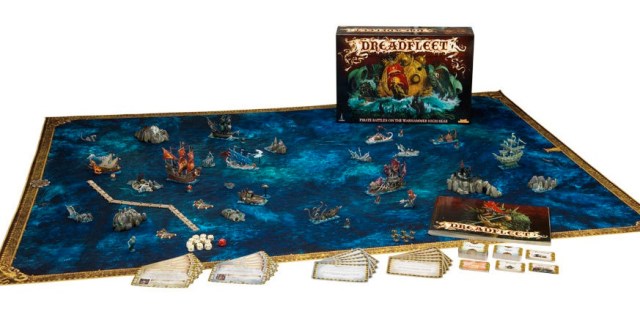 Components
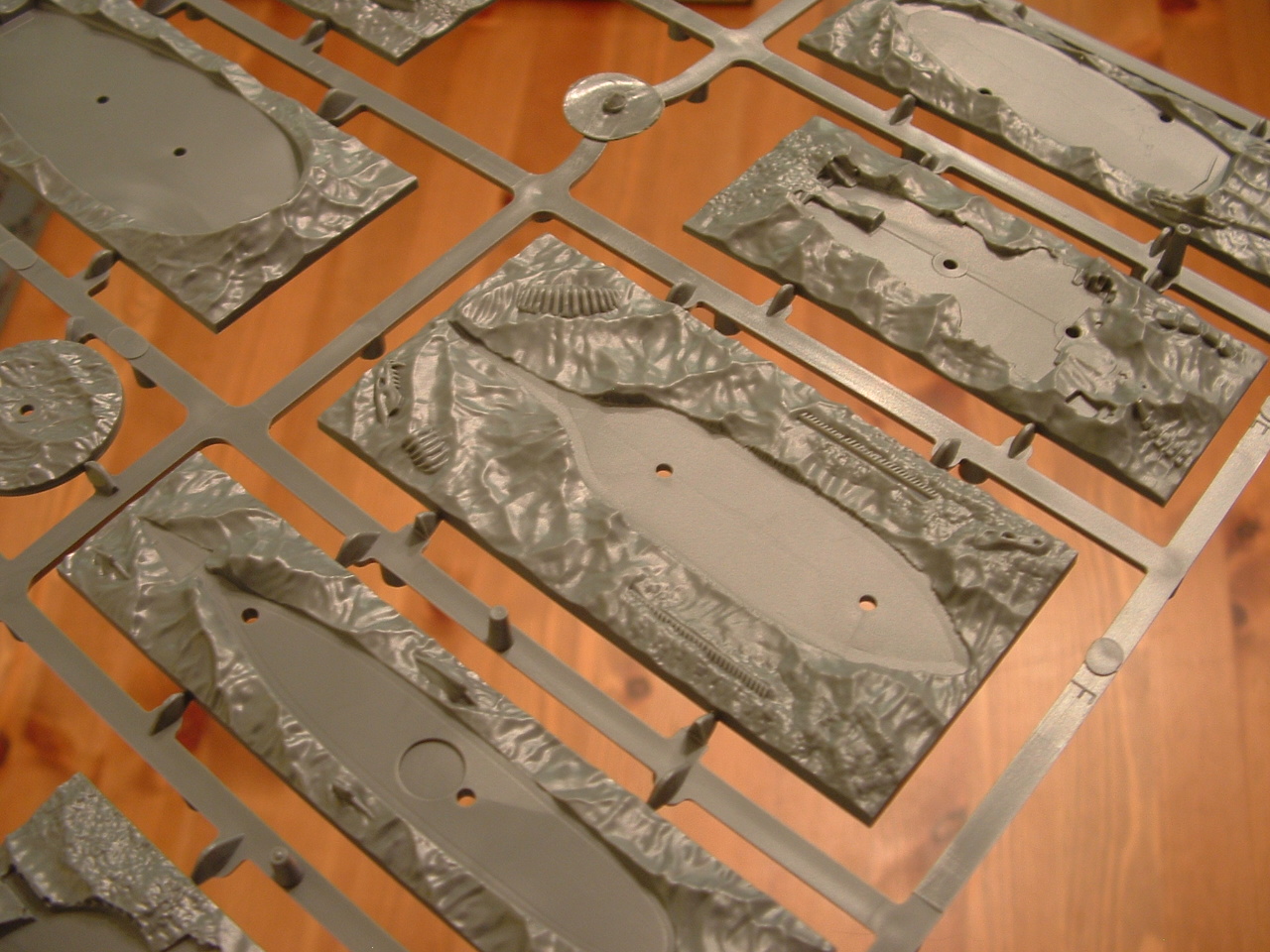
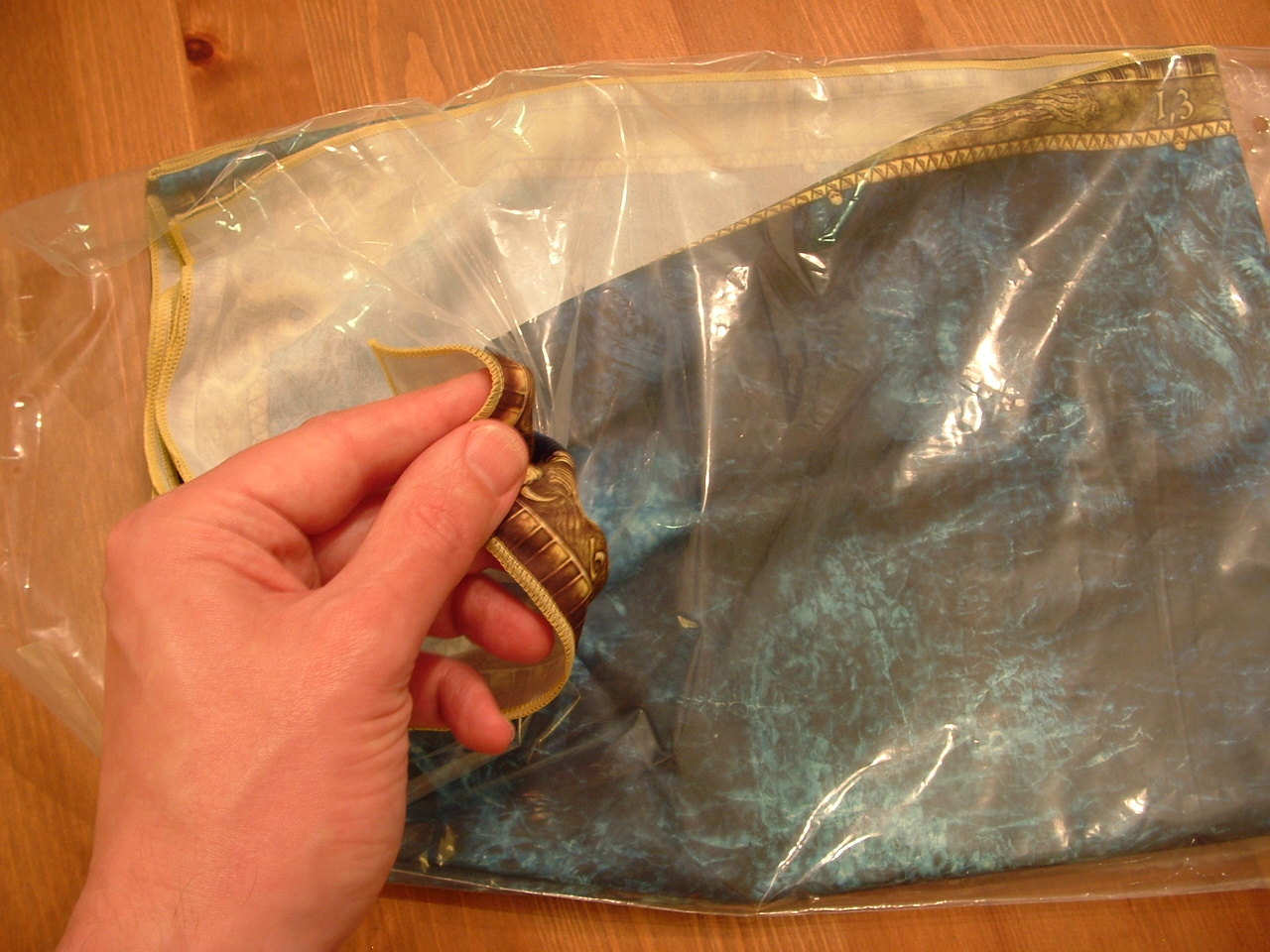
The ships are the best bit, I think. The seascape is nice too and may see service elsewhere. However, I’m not sure how well it will do with heavier vessels such as Spartan’s resin ships or my old metal historical ones. The seascape is very thin and light, and rucks up easily if its snagged.
I had a problem with my rulebook’s binding breaking (so it’s been replaced), but other than that it’s a pretty volume. I personally like a lot of John Blanche’s art, and this book has loads of it in. It’s very colourful and the rules are laid out well. Each rule section is kept to a spread or two; each ship and captain is described on a single spread; each scenario is on a single spread. There is an index as well as a contents age, so finding stuff was pretty easy during play. The rules are written clearly enough for the most part. About half the book is rules and half background.
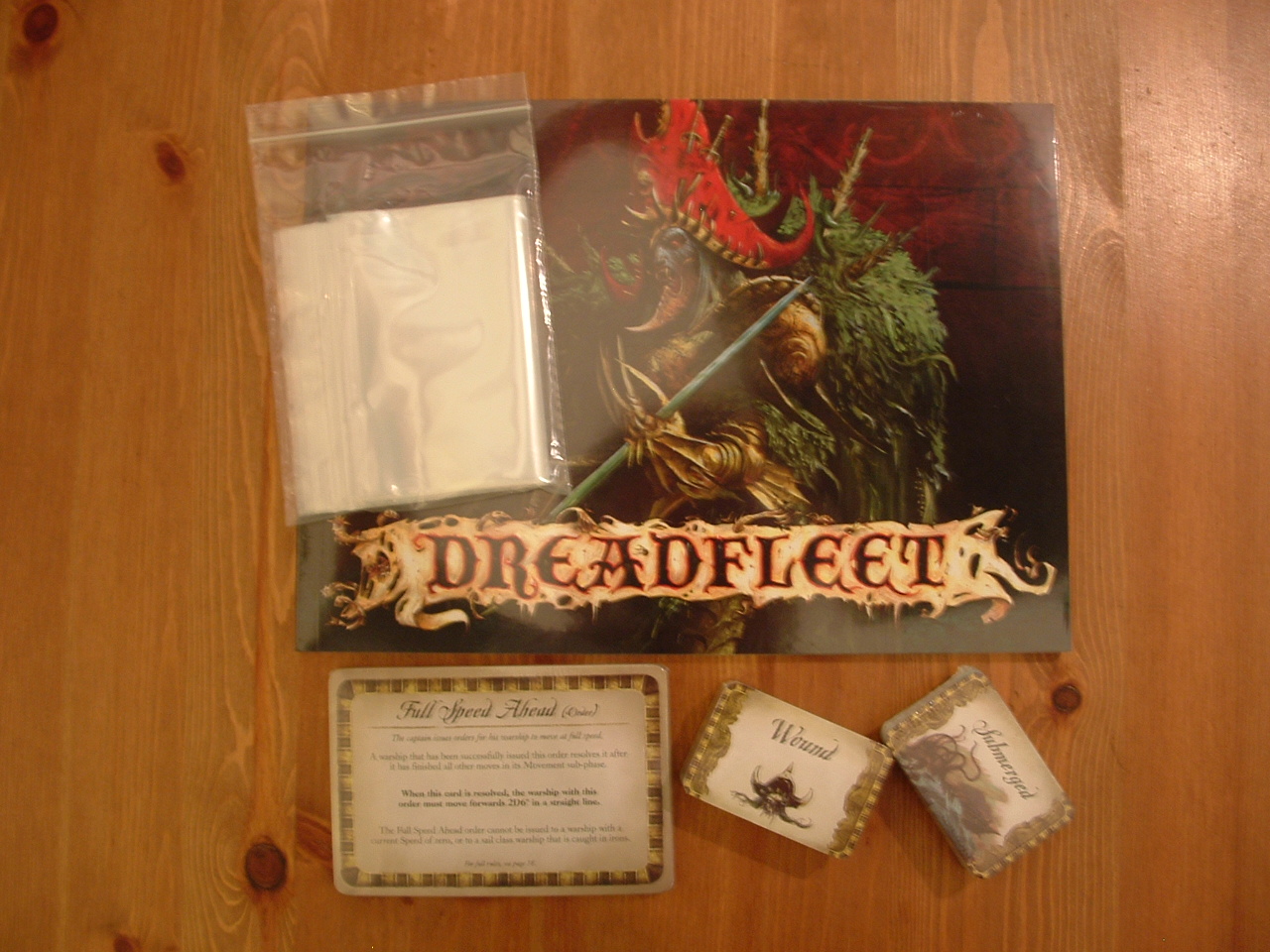
 The turning widget does its job, and the ruler is useful too. The design allows it to be fixed at 45 degrees t give arcs as well as distance, which is very helpful and a nice touch. The dice are off white (apart from one red) and felt slightly cheaper than their normal fare, though they are just D6 after all so that’s hardly a problem.
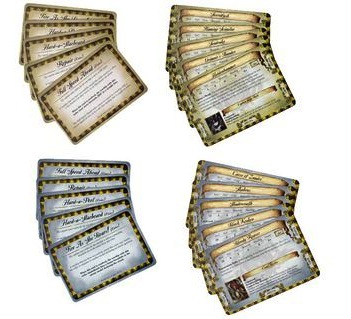
There are several decks of cards as well as a card for each ship and a card for each order (for each player). Apart from orders and ship cards, the cards are quite small, though not overly so. My only quibble with the cards is that they feel a little thin. Given the amount of punishment they take in a game I’m not sure how long they will last.
Quick Run Through of the Rules
Dreadfleet’s rules are fairly simple and there’s nothing particularly innovative to amaze or confuse. This is not a bad thing, just a thing. The game uses several decks of cards as well as dice and is very random. This is a style of game design that evens the playing field so that less skilled players can beat highly proficient players just by being lucky. Whilst this is always possible in theory, the closer to the lucky end of the luck-skill scale you go the less advantage a skilled player has. If you want a serious game then this is bad. If you want a silly and unpredictable game, or feel like giving your 10 year old a chance without deliberately throwing the game, then it’s all good.
The turn is split into several phases:
Status: effects that are still in play (mostly Fate cards) are rolled for. Most turns had one or more random effects to roll for.
Fate: both players draw and immediately resolve a Fate card. More random stuff, some of which was extremely potent. This also changes the wind direction and strength.
Action: players take turns doing stuff with their ships, one at a time. I use a ship, you use a ship, I use a ship, etc.
End: check to see if anybody’s won.

Status phases at the start of the game are quick, and as the game goes on more and more cards build up that need to be checked every turn. This is often roll a dice to see if it happens or goes away, then resolve the effect or not depending on the roll.
Fate phases produce random events that do things to one of the ships, usually bad, but occasionally useful.
The End phase is a nothing of a phase.
The Action phase is where the game really happens. When it’s your turn you pick a ship and then do the following steps in order:
Orders: the big ships with named captains (5 on each side) can try to issue an order. Make a command check (beat a score on 1D6) to do the order. 3 of the 5 modify movement; one is Repair; the last is sort of overwatch (get to shoot back if you are attacked).
Movement: Move and turn. If the wind is in your face you go slower, if behind you then it’s a boost. Turning is only allowed after a straight move of a set distance or more depending on your ship type. All normal stuff for naval games.
Broadside: a 90 degree arc to either flank, so pretty generous shooting opportunities. You can even carry on doing this whilst boarding people. Each ship has a Broadside value. Roll this number of dice and try to get 4+, 5+ or 6 depending on range (in 6 inch bands). A ship’s first broadside in the game gets it +1, and raking a ship (firing longways down it) gets a +1. That’s it for modifiers apart from odd things on Fate cards. If you hit the the target gets to roll for its armour save. Any unsaved hits get you a damage card to resolve. Damage cards are usually just a single loss of crew, speed, hull strength or some more problematical special or status effect. cards sit under the ship until it is repaired or the ship sinks.
Boarding: if you touch an enemy ship your movement stops and you have to fight a boarding action. A turn of boarding starts with a duel between captains. They roll their Swashbuckling number of dice, aiming for a 5+ on each to get a number of victories. The captain with the most victories wounds his opponent. In a draw both are wounded. Penalties apply to each step and after 4 wounds a captain retires to his bunk. His ship continues but he is no longer in play.
Once the captains have had their fun the crew have a go. This is the same process as with captains, but they use the remaining crew as a number of dice to roll and the loser takes the difference in damage for the ship, not just 1.
How Our Game Went
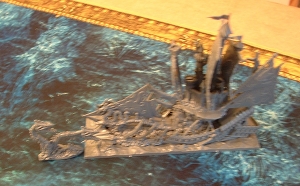 In the first scenario you start in opposite corners of the table with all the islands in the middle (in the way). I drew a Fate card that put a sea monster on the table, and I chose to place it directly in front of his ship. This meant that he couldn’t avoid hitting it. As he was playing Count Noctilis, he is able to control monsters in stead of using an order, so he tried this. When he passed the test he didn’t have to fight it, but after my turn we realised that he couldn’t do anything with the monster. The little ships and all monsters count as “auxiliaries”. This is a sub-type of warship that is the same as the big ones with a few exceptions. One of these stops it breaking off from such collisions. I re-read the rules several times looking for a way out, but it seems pretty clear. The sea monster couldn’t move, and the Reaver couldn’t sail through it. The Reaver could have tried to break off, but I’d just have moved the thing in again as I’d have got to act with it. In the end he got rid of it by fighting boarding actions against it. The I picked another monster on a Fate card and did exactly the same thing with that too, just before the first one died. Seemed rude not to.
While he was thrashing about with the sea monsters, having moved all of 1 inch in several turns, I had to sail across the whole board to get him in range. Sympathy please, gentlemen.
In the photo below my ship is just visible on the far left. The Reaver is off shot to the right.
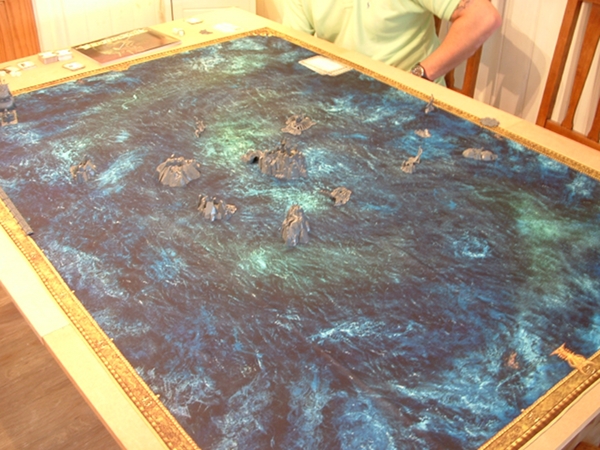 Anyway, after I sailed across the whole board, we ended up fighting the battle pretty much in the corner where he started. I managed to open up with a raking shot and did some more damage to add to the lumps bitten out of him by the monsters. As he killed the second one and finally looked like making headway towards me the honours were not at all even. As you can see, he’s got 7 damage cards and I’ve got none. In the scenario you’re supposed to end when one ship has 8. I had taken some damage from all the fate cards that were thrown at me, but I’d been able to save or repair all of it. The Reaver, on the other hand, was holed below the waterliine and on fire.
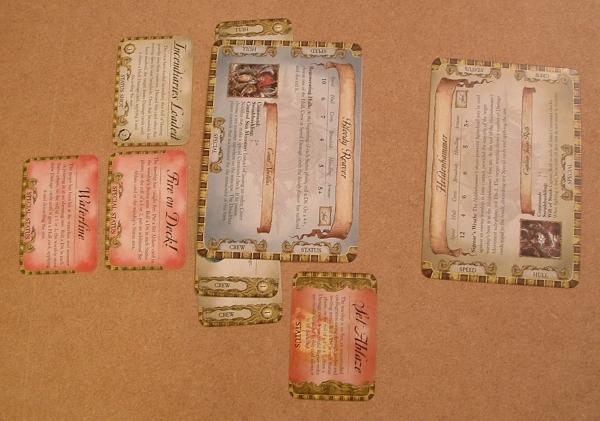 We carried on after the point we should have stopped as we were learning, and putting the ships away doesn’t teach you much about the game. I pulled across his bows, firing more raking shots down the length of the Reaver, but mainly because I’d drawn a fate card that allowed me to turn the little cog auxilliary I carried into a bomb ship! That sounded too good to be true, so I weighed anchor to launch it safely. Then the Reaver rammed into my side, and we were off on a Boarding frenzy. For a number of reasons, we never managed to disentangle ourselves.
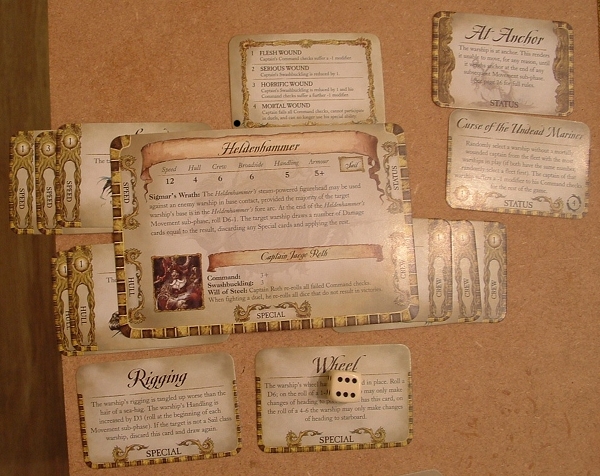
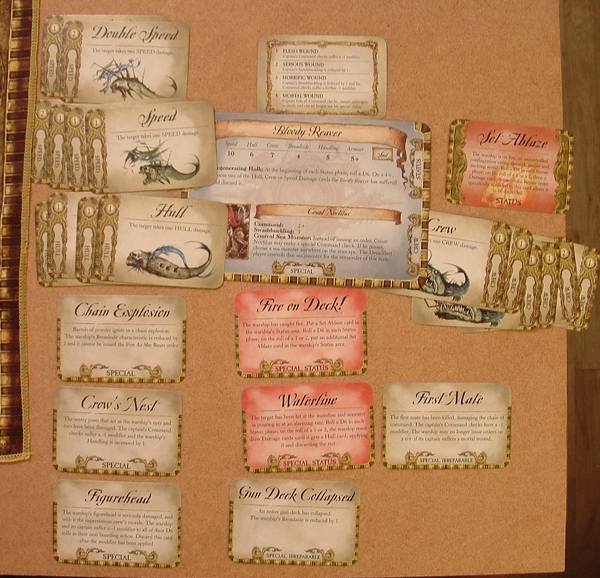
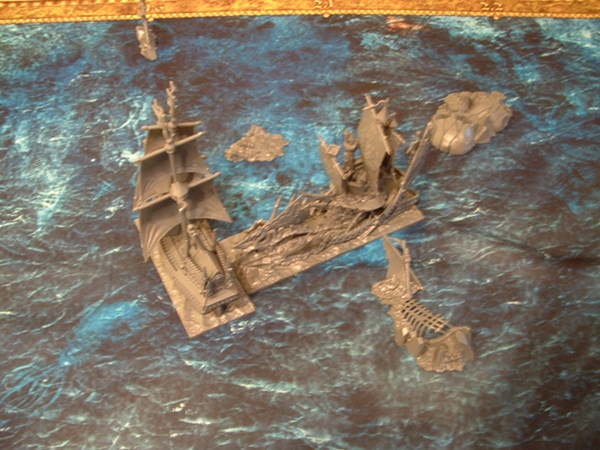 To start with we were happy fighting, and by the time we wanted to break free we were too scuppered to make it work. At this point the Reaver got pretty lucky and managed to avoid almost all of the extra damage it should have taken from the waterline damage and fires. My ship, on the other hand, was taking damage like it was going out of fashion. I was, at several points, a single card away from sinking. As the fight went on, both captains went out of action. Then, finally, I managed to sink the Reaver. We were both very battered. So battered, in fact, that when the Reaver finally went down the two ships had something like 33 of the 55 available damage cards between them. I do wonder whether there are enough for the other 8 ships in the game. The final state of the ships was as follows:
Thoughts
Pro: it was fairly entertaining.
Pro: I think the ship models are nice and will paint up well.
Pro: everything you need to play is in the box. We used nothing else and were fine. Even the plastic ruler did the job.
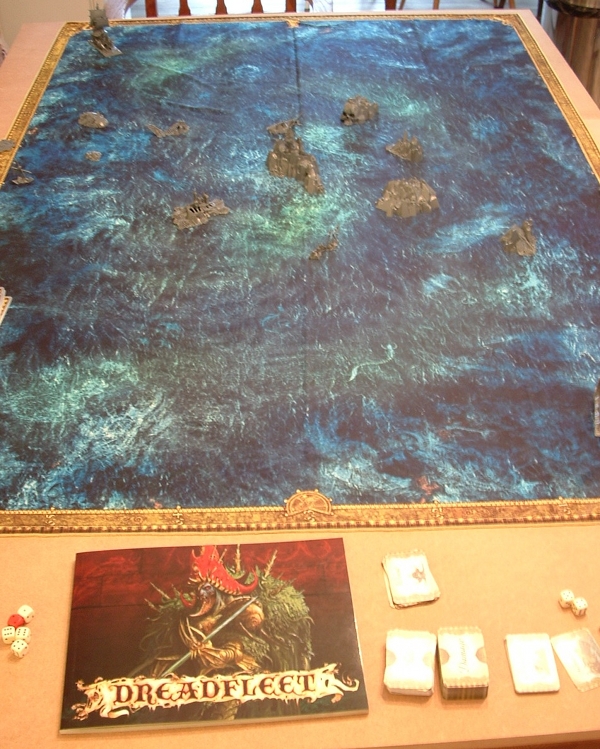
Con: The game is a massive space hog. The boards the seascape is laid out on are 6×4 foot exactly. You can see that there’s not much room left and this was with only 2 of the 10 ships. We both thought that all 10 ships were going to be a bit cramped. Nor can you push the edge of the map off to make more card space as you need the yellow edge to track the wind direction.
 Con: the wind moved about so much that you couldn’t really plan your movements with any confidence. Again, the random nature of the game.
Con: the random events will become repetitive fairly quickly. The card decks are fairly small and cycle quickly. You draw so many you’ll see all the cards again and again.
Con: the cards are not terribly sturdy and I question whether they’ll stand up to repeated play. The rules require you to go through the decks repeatedly. Much shuffling is needed; more with more ships.
Note: In case anyone has not realised, this is a miniatures game, not a board game. It just happens to come in a box.
Note: random, random, random. Whilst skill will still come through, you will find yourself winning and losing through blind luck more than you may be used to. Whether this is a good thing or a bad one depends on your preference.
Note: mind the mat rucking up. I assembled everything with clippers alone to see if I could. Before my bigger game I want to clean up the underneath of the bases so that the tiny, sharp little remainders don’t catch on the fabric and drag it along (as it did occasionally this time).
 Summary
At present, it seems to me like an OK game, but not a great one. I’m not convinced it is worth the price. I was going to get a second copy to keep for trading, but I’ve cancelled this. It is not a sufficiently good game to be tempting collectors with in the future.
I’m not yet convinced that it’s worth the effort of painting the models. There’s lots to do and as they’re all different it’ll take longer than painting coherent fleets. However, it would look loads better with painted fleets and they would be fun to do. After we’ve played a game or two at the full size (if we can fit it on the table) then I’ll decide. I expect I will probably keep it for the moment and see if I get more use out of it.

 Now, on with the games! Being overexcited I forgot to take notes, so the details of what’s going on may be fuzzy, but hopefully the pictures are sharp (see what I did there?) 🙂
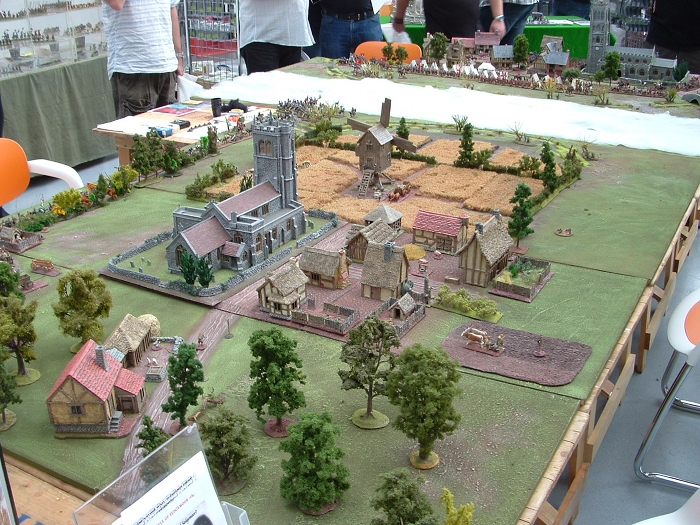 It’s an English convention, so there’s an English Civil War game (or three). There are also other periods such as this particularly pretty battle of Sedgemoor from the Monmouth Rebellion. It developed over two days and the fog (I think that’s what it was) in the background had gone on day 2. One army is deployed behind it and the other is marching into position from the bottom left corner of the picture above, and the top right of the one below. It was nice to see them deploy from march column as it’s something you see so rarely in games.
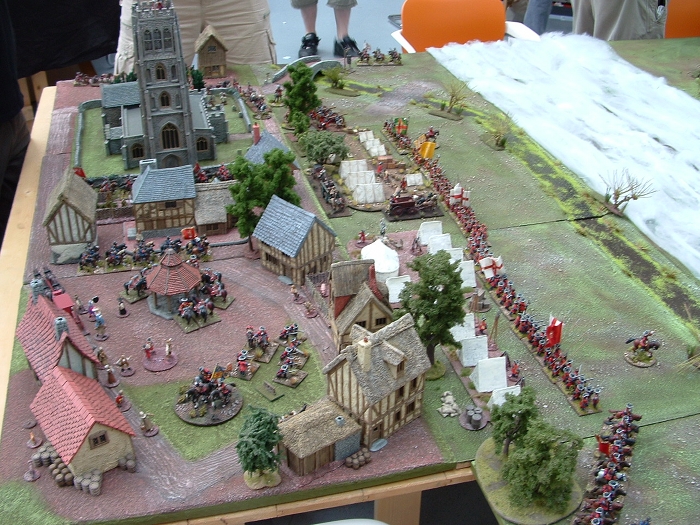
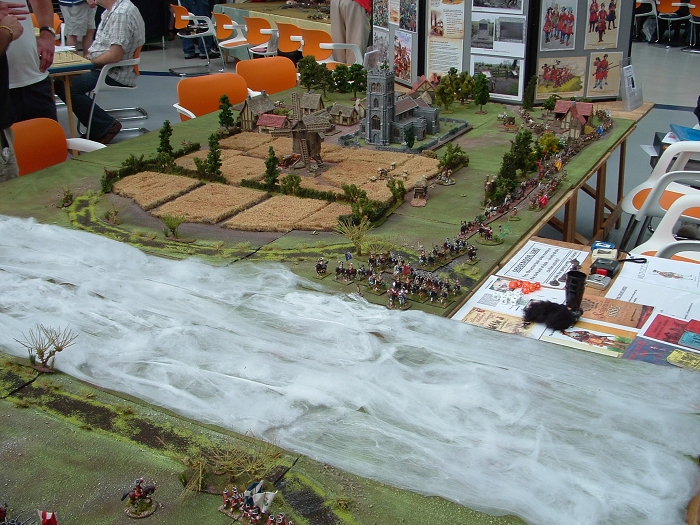 This is what they’re defending: a beautifully modelled town with a camp of scruffy soldiers on the outside (their tents are nice and clean though).
 On a completely different scale of both table and model we had Baccus demoing a 6mm game. ACW I believe. Unfortunately he is conducting the cardinal sin of having rubbish obscuring an otherwise nice display.
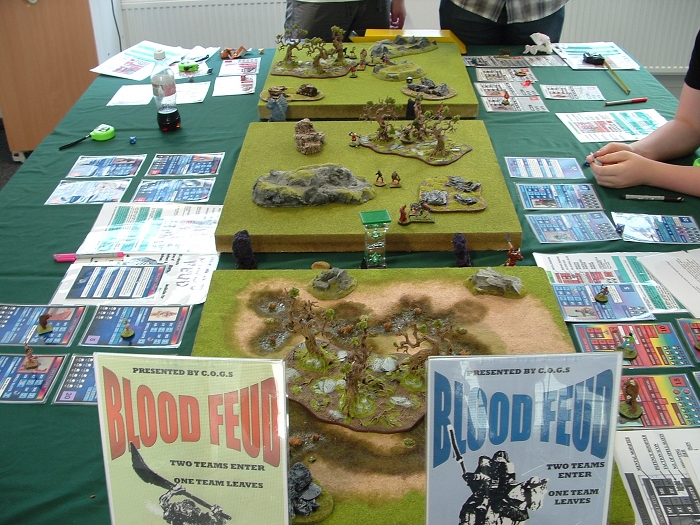
 And to show that it wasn’t all historical, here’s a fantasy skirmish demo. Their tagline made me smile 🙂
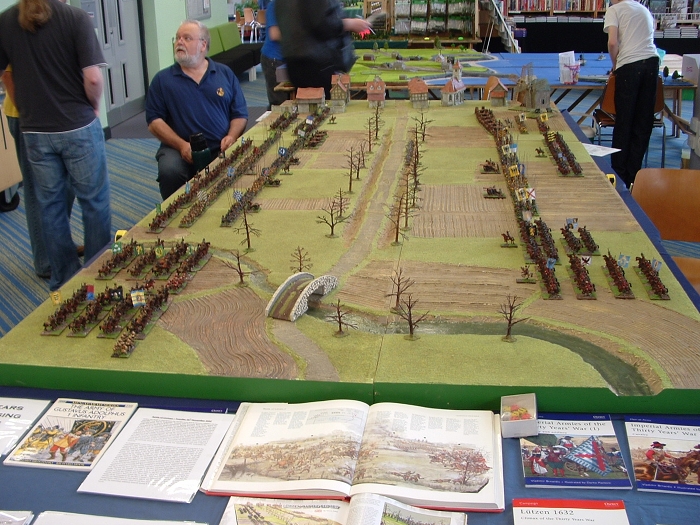
 It wouldn’t be a convention without Lutzen in one form or other. This is the 30YW version, all ready to kick off.
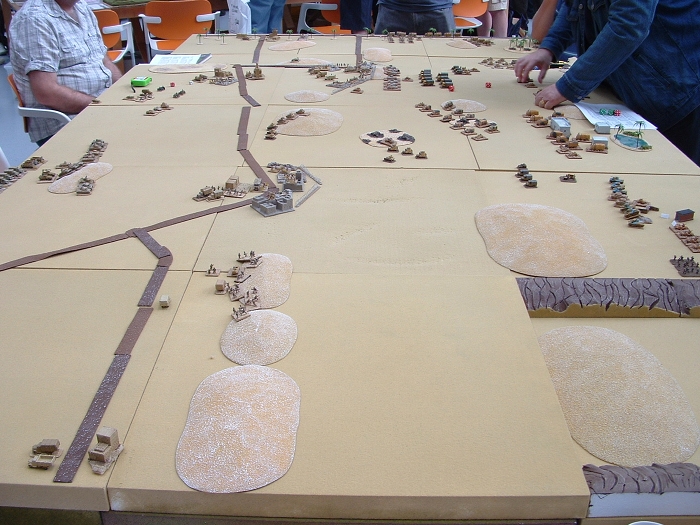
 WWII was being re-fought in the open desert…
 …and the clutter of NW Europe. This was a particularly nice table. Sadly a lot of my pictures came out blurry.
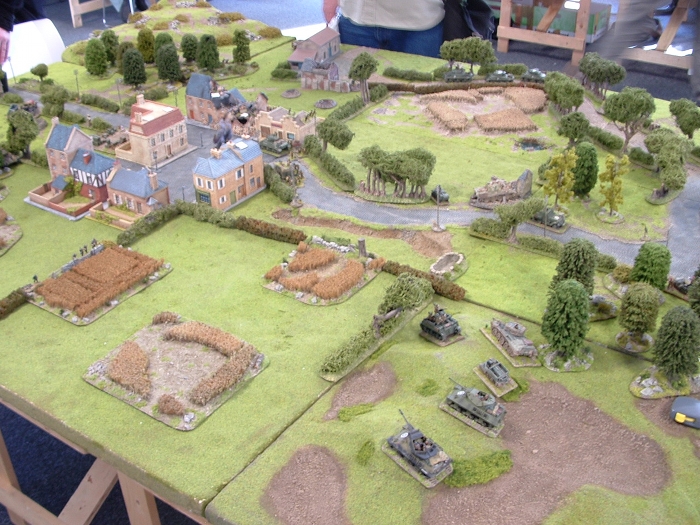 I did, however, stop trembling for this one. Very evocative.
 Good grief! This post is going to be vast. Still loads more games to go. This was an enormous Celts vs Roman game of Hail Caesar by the Warlord Games chaps.
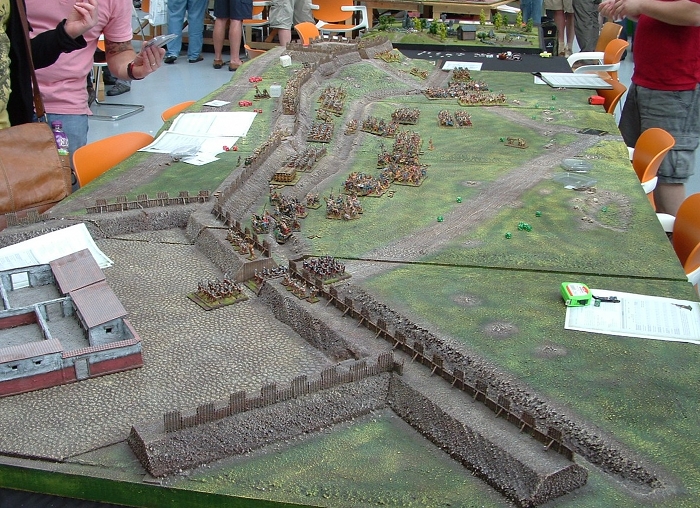 And another angle.
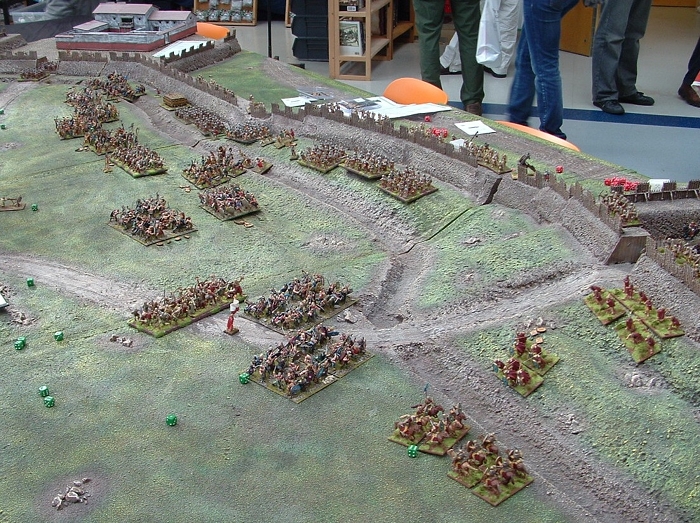 Warlord were also showcasing their Bolt Action WWII range with the complete opposite size of game.
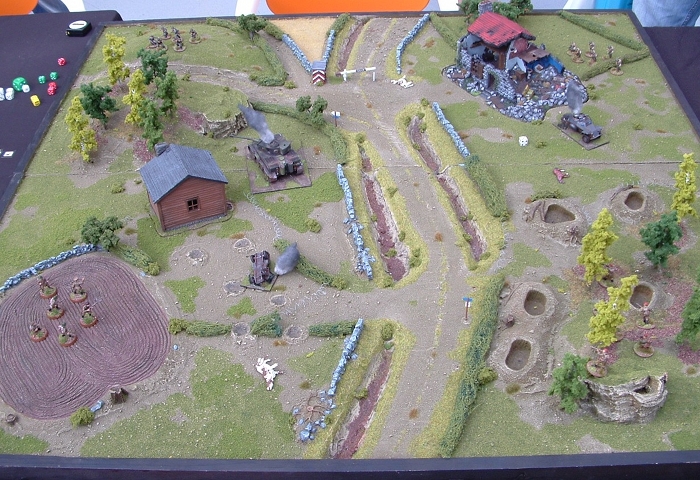 Lest you think that SF was completely abandoned, here is a futuristic scrap. These chaps made all the models themselves in 3D and then had them 3D printed. Sounds like it’s a bit pricy at the moment, but it’s the coming thing. Give it a decade…
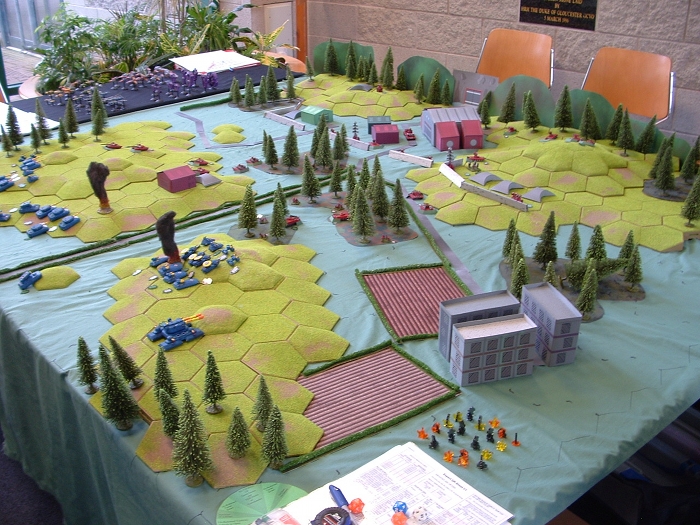 Aren’t you a bit small for a stormtrooper? More 6mm battles. I really liked the look of this game, in part because the units themselves looked so good. No tiny regiments of 5 models here…
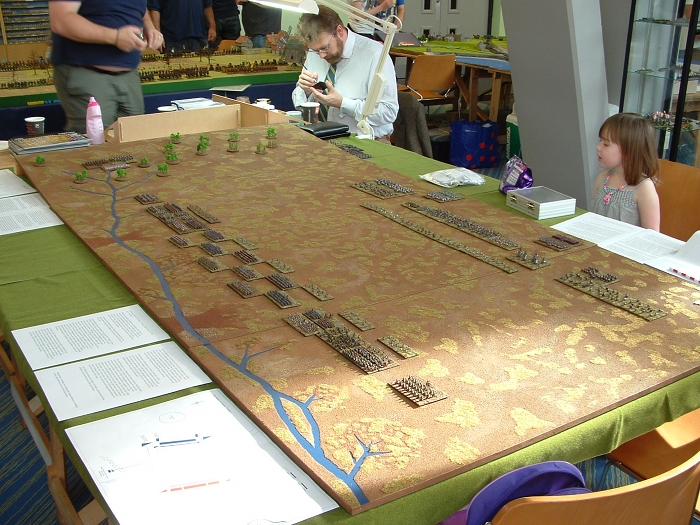 …as you can see below. I do like the tiny model scales for that bird’s eye view of battle and the sense of masses of troops.
 And here is another vast 6mm battle, this time I think it’s Towton. Now that looks like a real battle! Vast units.
 Enough of the 6mm stuff. I know it’s not everyone’s cup of tea (though you can’t deny the grand sweep of battle it allows). There were more games there, and even ones I took decent photos of, but I think you get the idea. Loads of stuff going on. Actually, before I finish, there was one last game that particularly caught my eye as innovative:
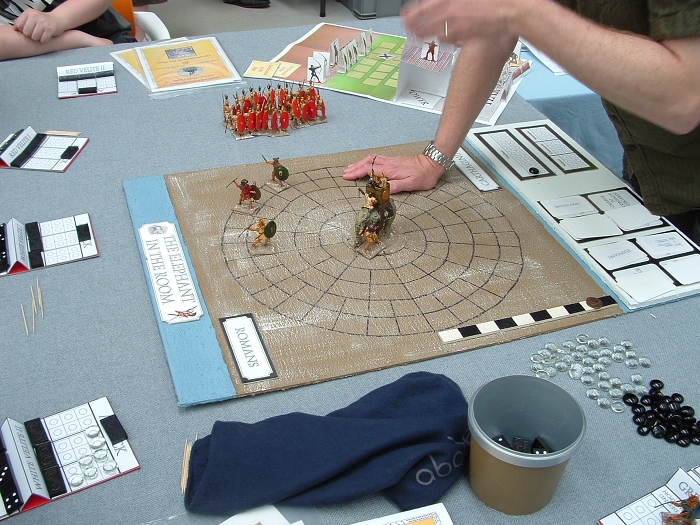 I think this was the Society of Ancients being entertainingly crazy again (they do it so well). The game centred on a Carthaginian elephant, and the Roman velites that were attacking it circled round it. Looked fun, and reminded me of those games where you are all the crew of a WWII bomber and everything revolves around that as you do your mission.
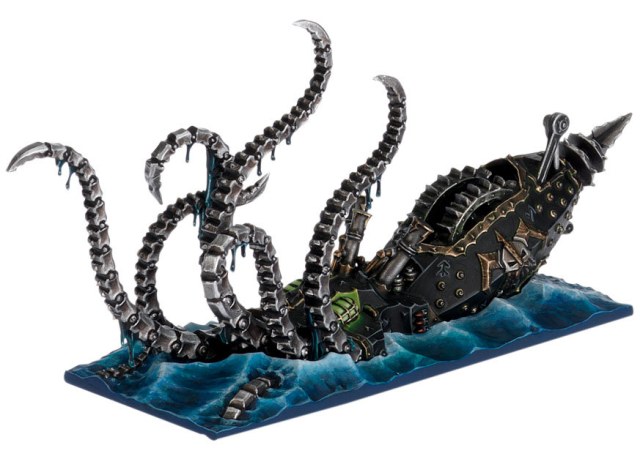
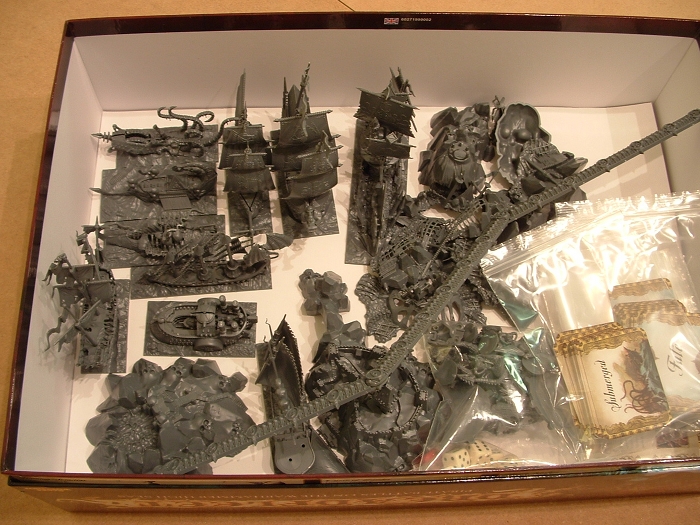
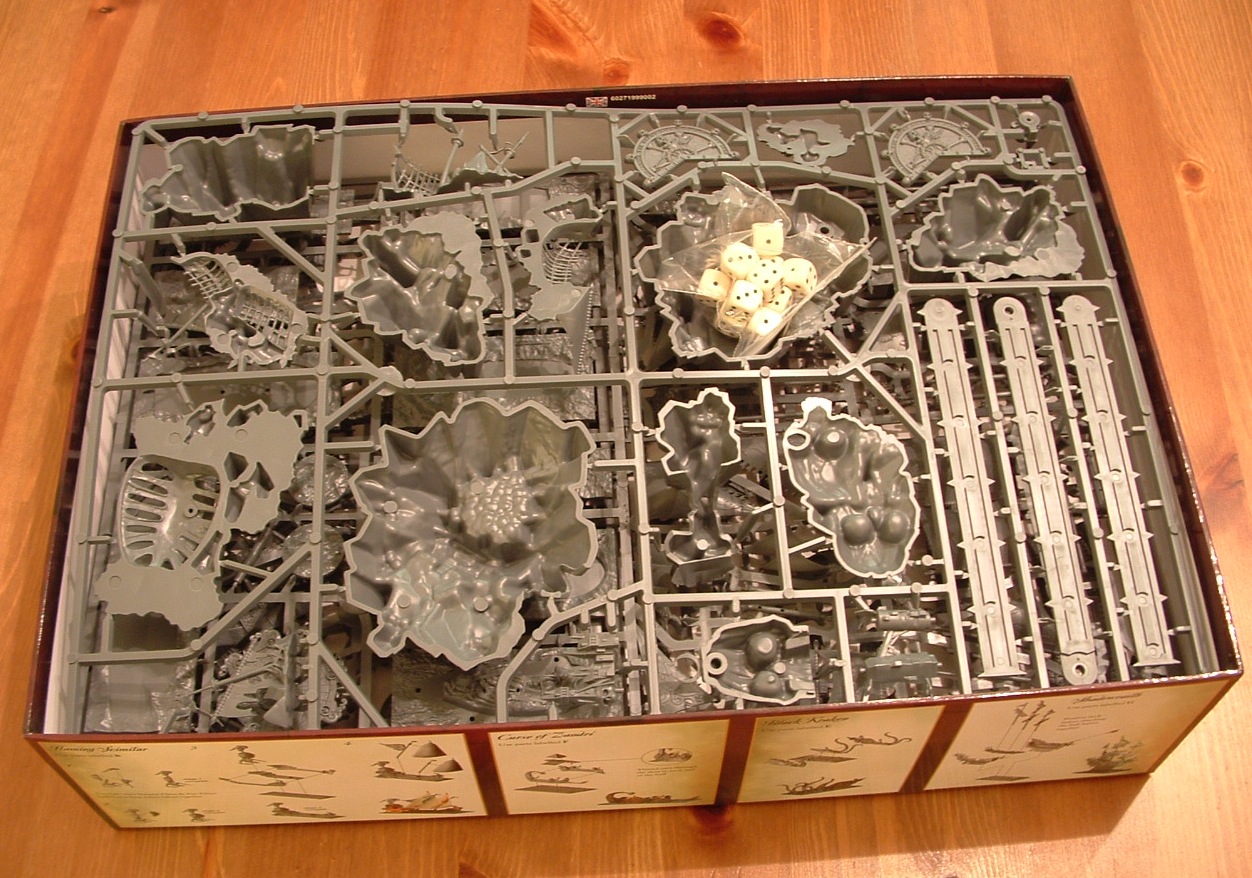
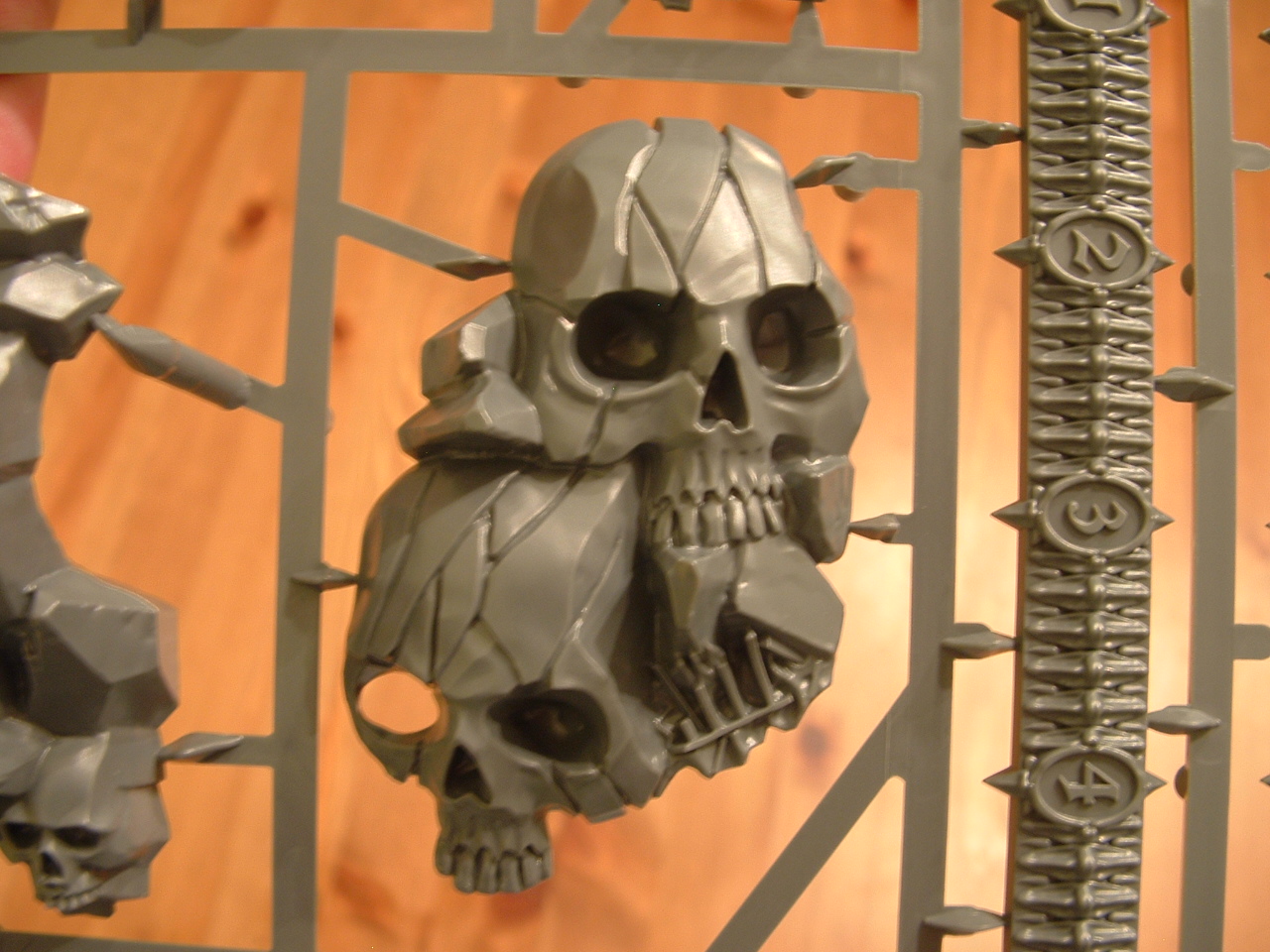
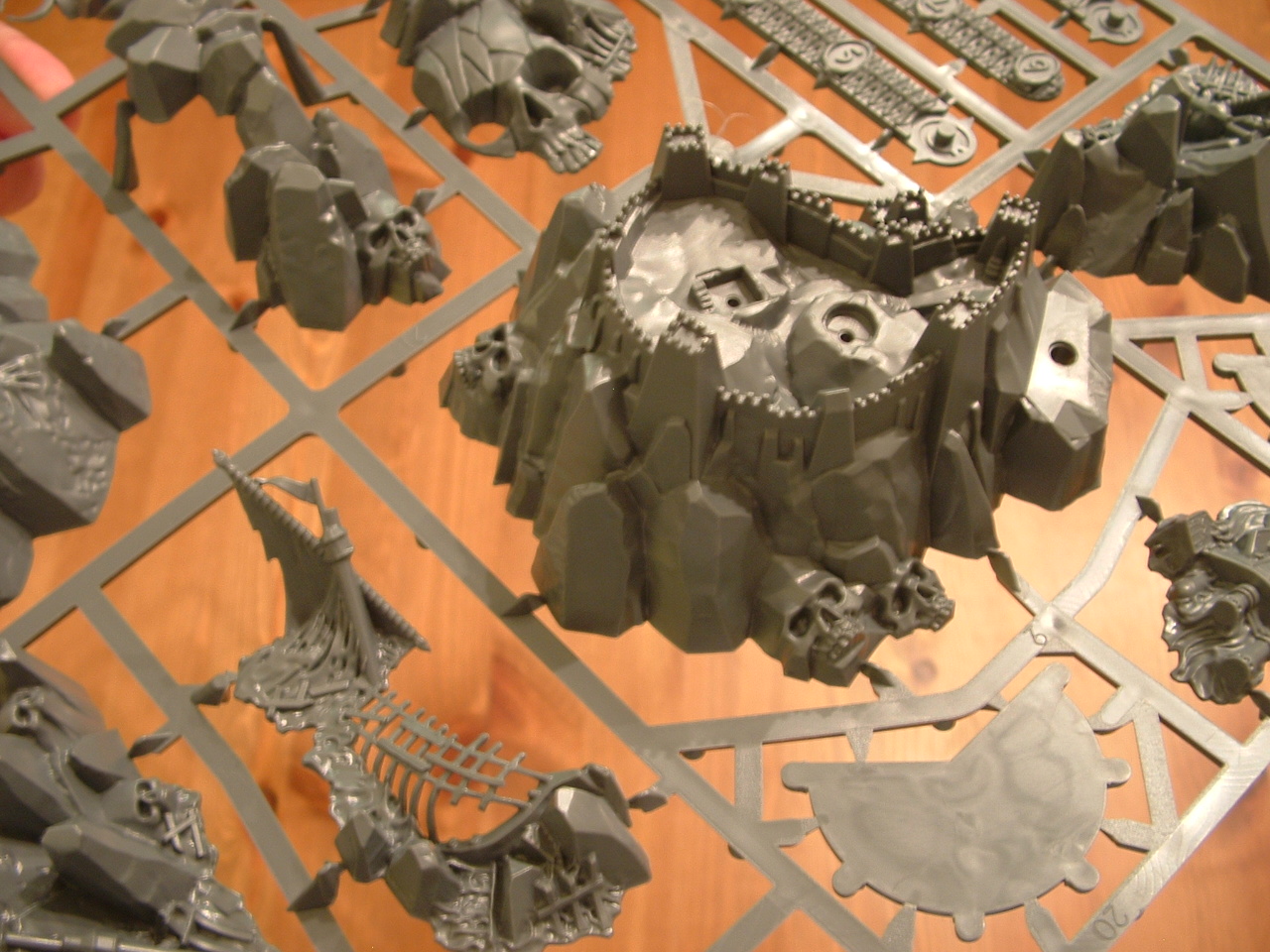
 I left these ship photos bigger so you can see them up close.
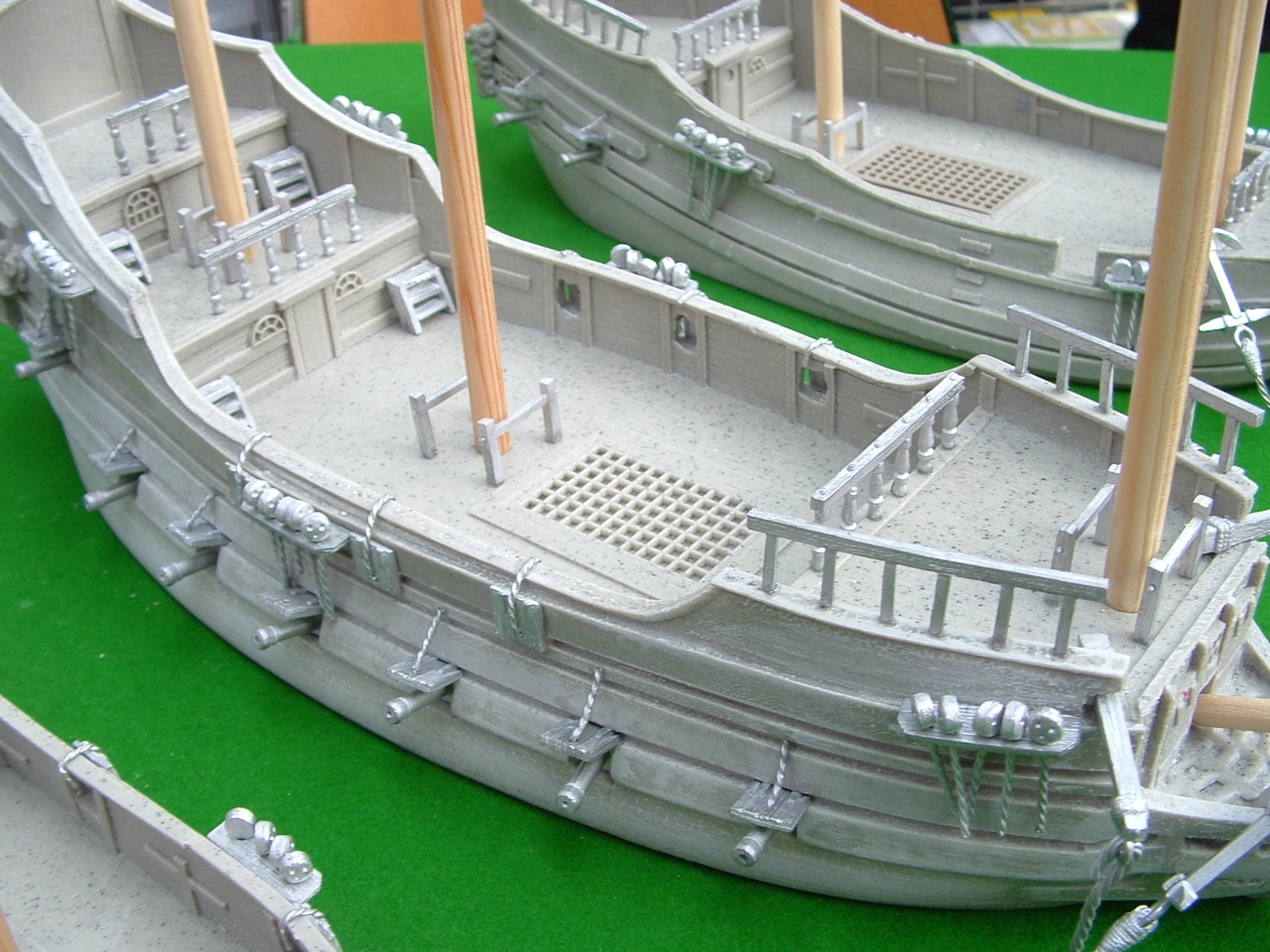 Anyone for pirates?














 Quirkworthy