Special Ops

Following on from yesterday, here’s another KS project I’ve pledged for: Spectre Miniatures. It’s still live so you can join in too if you like 🙂

Delta operatorThese are 28mm modern special forces and the African rebels to fight them. On show are a variety of shadowy western types from the British and American special forces, CIA, and private contractors. They’ve even brought their dog, Shep. As the Kickstarter rolls along, more and more sets of these are available to pick from. You see, each pledge gets you a certain number of 4 model sets, and it’s the options to pick from that we’re seeing expanded. Mind you, the latest promise is some more KS exclusives once the last of the currently listed stretch goals tumbles. Less than 1k to go now.

Sprectre miniatures militiaOn the flip side we have a selection of militia in the usual rag-tag mix of equipment and somewhat ostentatious (and entirely credible) fighting stances. Having recently spent some time doing photo research on Africa’s small wars, I was rather pleased to see this lot on Kickstarter. Not all are so obviously civilian in origin with a few looking fairly regimented. At least, they were before they went looting. They’ve also got witchdoctors and “bullet-proof” militia.

african warlord

Leading the militia are a selection of “big men”and warlords, in various flavours from military to sartorial.

We already have a few manufacturers doing similar types of ultra modern troopers, Empress being one example. It’s telling that Spectre have included a comparison shot with Empress (below). Looks like they’ll get along just fine 🙂

scale vs EmpressThere aren’t as many militia options about, though even with some similar things on the market, there are some unique pieces here, and some nice variations to mix in and add to the variety in those modern skirmishes.

There are also some promised rules to go along with these guys, though to be honest I’m more interested in the figures, myself. I expect to use these for Eternal Battle, and though I’ll read them, I doubt their rules will change my mind. You never know though.

All told there’s not really much to say about these guys that you can’t see from the pictures. I think they let themselves down slightly with the paint jobs, but that’s being picky. You can see the quality from the greens. Speaking of which, they’ve sculpted loads already and I’m looking forward to getting my Kickstarted toys without the traditional year’s wait 😉

Posted in Kickstarter | 1 Comment

Money And Sense

Normally, I think I have more sense than money, but every now and again I feel the urge to buy something. I’ve mentioned before that I’m getting increasingly picky about what I buy, partly because I already have so much and my time is limited, but also because the quality of what we have on offer seems to just keep going up. In fact, there are so many enticing goodies on offer that I have to be picky…

These days, that urge often leads to a trawl through the games section of Kickstarter. It’s something I can do while I have a break from writing stuff. Probably not quite what the Display Screen Health & Safety lot recommend, but at least it’s looking differently.

Luckily for my wallet, and less so for theirs, a great many of the interesting projects add so much for shipping from the US that they become impractical. Several that I costed out doubled the pledge cost when I added shipping and import taxes. Almost invariably this means that I cross them off my list as a KS, and put them in the mental “when they come out” pile. Of course, by then I’ll probably have forgotten all about them, so it’s a sale lost to the project owners. Need to sort your European distribution, guys.

Anyway, I thought I’d write a post of two to share a small selection of things I found interesting. Today, one project that I’m not pledging for and one that I am.


Leviathan 3000

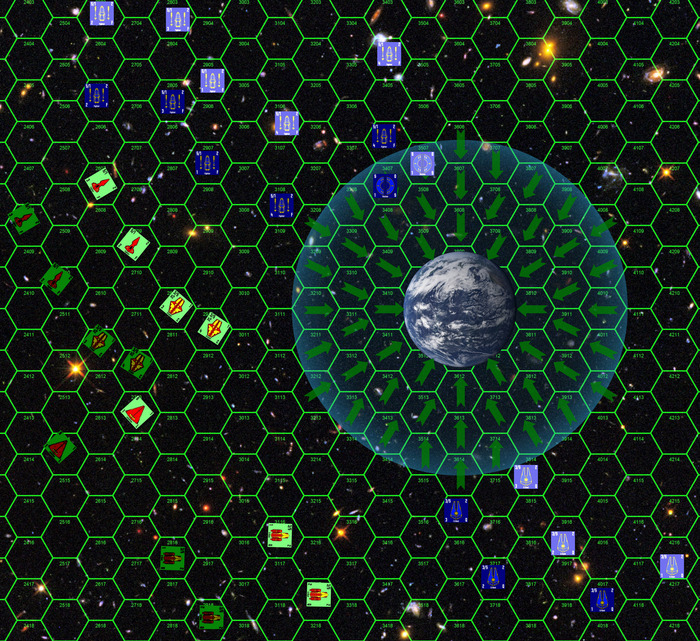
Leviathan 3000 is an old school hex and counter space game. Warp over and have a look – you’ll need to be quick as it ends in a few hours!

I suspect that this is mostly interesting to me for the same reason I’m not pledging, namely that I designed something very similar an equally long time ago. In fact, mine was even more pernickety about the physics. I retained momentum indefinitely (he only tracks for a turn – much simpler), mine was in 3D (points for nerding, but largely unnecessary), and also logged rotational momentum as well as vector (told you it was pernickety). The last was actually quite interesting in play. I will admit that as I never intended mine as something other folk would see beyond my own play group, it’s not an entirely practical game.

Leviathan 3000As I already had much this game gathering dust on my shelf already I didn’t feel the need for another verison. It did make me have a rummage though, and when I find all the counters I’ll give it another go. I used to play it quite a lot and had several whole fleets of multi-hex counters in different colours. Somewhere.

Of course, you probably don’t have a stack of old game designs cluttering up your shelves, so you might find Leviathan 3000 of interest. It’s a classic design problem and he looks to have a simple way round the bulk of a tricky problem.


Custom Game Dice

Gamers like dice. Game designers often want very specific components, like dice. Most of the time the cunning scheme you have come up with will use either normal spot dice, or something that nobody makes (yet). Custom Game Dice might prove useful.

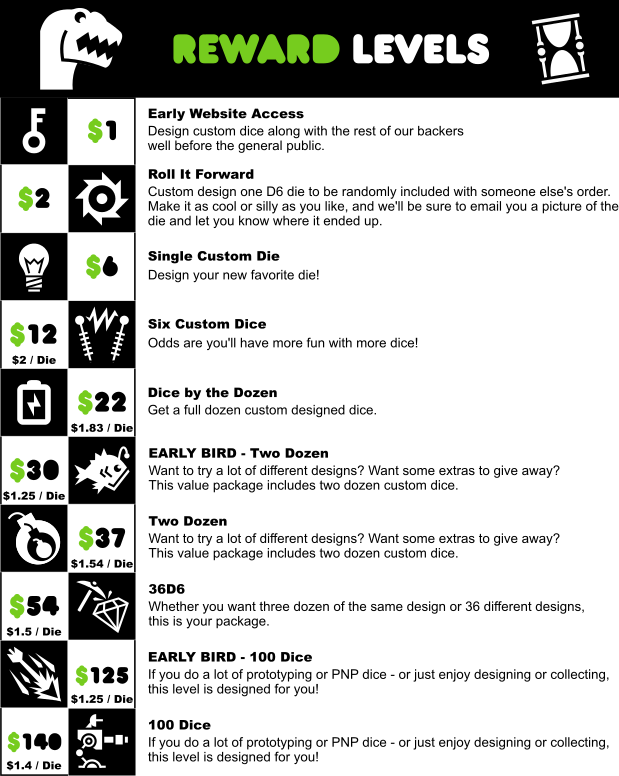
Rather than show you a picture of a dice (I’m guessing you’ve seen those), here are the reward levels.

Dice pledge levels

What is especially useful for any budding designers out there is that:

  1. You can design all six sides of your dice (if you want to).
  2. All the dice in your pledge can be completely different (sounds like a headache for the producer).
  3.  You don’t have to decide on all of your dice immediately.

I’ve pledged for a hundred dice. I don’t know what they’ll be yet, but then I don’t need to decide for a month or two. It’s nicely timed as I’m working on a new game that might be able to use some custom dice, at least as a “would be nice” option. I know I can get custom dice made anyway, but this seems like a reasonable price and insanely flexible. The flexibility is particularly tempting as I can make up several speculative designs and have them all made, or simply save some of my pledge for later. If you’re in the US the postage makes it an even better deal. However, even outside the You Nice States it doesn’t add a lot as dice are conveniently light.

Whether it’s custom dice for a shiny prototype game you’ve designed, or simply bespoke dice for your favourite game, club or faction, this seems like a project that might be worth a look.

Posted in Kickstarter | 12 Comments

New DZ FAQ

Posted a new FAQ for DZ. I said it would go up today, and though it’s a bit later than I’d expected as far as I’m concerned it’s still “today” till I’ve gone to bed 🙂

There’s more to do, so I’ll post another step forwards in a few days. I’m working in chronological order at the moment as that seemed to make most sense.

As always, if you have any new questions, please post them to the Living FAQ page rather than here. Thanks.


Posted in Deadzone, FAQ | 1 Comment

Progress

I’ve decided to post the next iteration of the DZ FAQ tomorrow rather than today, as originally planned. Some of the answers I’ve been working on are a bit involved and need some more cross referencing before they’re published to ensure that they fit what’s already in print and cover all the various permutations.

However, keeping things moving is important, so I’ll post up a new version tomorrow regardless of where I’ve got to.

Iteration – great word.

Posted in Deadzone, FAQ | 1 Comment

Games Industry Survey

If you’re interested in games as a business rather than just a pastime, Purple Pawn’s annual look is well worth reading. It takes a while to collate so this latest one is data from 2013. Some interesting nuggets in there.

Rather than link the pdf, I’ve linked the site as it’s worth exploring 🙂

Posted in The Business of Games | 3 Comments

DZ FAQ Update As Promised

Well here we are at the end of the week, and as I said I would, I’ve added some more updates to the Deadzone FAQ. Most of the time I’ve been able to spend has been on the long discussions of defender shields and the infinite fight chain, but as these were two of the most commonly asked questions I thought it was worth getting them out of the way. I also included the errata from the reprint of the rulebook in the update. I’ve posted this before, it’s just simpler to have it all in one place.

The next stage is to work through the rest of the questions on the Living FAQ pages, many of which have already been answered, and incorporate them into this pdf. I’ll do another update midweek.

I’ve also got all the bits for the new camera now, so I’ll be trying my hand at some video this week too. I’ve no idea how well that will work, so I’ll not promise any dates. Will let you know how I get on.

Before anyone else asks, I want to focus on getting the DZ FAQ up to date, and then I’ll tackle the DB one. Not forgotten, just forming an orderly queue 😉

As before, please add any DZ questions to the Living FAQ page rather than here.

Thanks. 

Posted in Deadzone, FAQ | 7 Comments

Deadzone: Infinite Fights

Plague-lord-fin-009Probably the most common question I’m asked about Deadzone are about linked Fights. This has been called several things like daisy chain combats, infinite fights and so on, and according to some folk it’s the most over-powerful thing going. Opinions differ though, and I’m one of those who hasn’t found it a problem. There are some subtleties in this area of the rules, so to make sure we’re all on the same page I thought I’d go through the process in detail and then discuss the issues that have been raised.

I’ll start with the basics.


How It Works

A model moves into a cube containing one or more enemies. This requires them to Fight one of those enemies immediately, as part of that Move action¹.

If the attacker doubles the target model then they can make either a free Fight action (if there are still enemy models in that cube) or a free Move action (if he’s already killed them all). If he takes the free Move and there is an enemy model in an adjacent cube then he can Move in and will have to Fight that model too – again, as part of that (free in this case) Move action.

Assuming that the attacking model doubles every single attack they will keep getting free actions. However, remember that a free action cannot trigger another free action of the same type, so no free Fight – free Fight. Note also that the Fight included as part of a Move action is not a separate free action – it’s an intrinsic part of the Move action.


Long Range Version

This sequence can be combined with Move cards and extra actions from Command tests to give a melee model a very long range (probably most of the tabletop at the extreme end). At least, it can in theory.


Limitations

Getting this to work requires everything to go right for the attacker. A single break in this chain and the whole thing stops dead. Most stages require a dice roll to work, and some require use of a limited resource. All require your opponent to help you (and why would they do that?) or be unaware of the tactic.

For the long range version you need a model that can use a Command action, is close enough to the attacking model, and doesn’t need to use their action(s) for anything else (like staying alive). You also need to have a token left in your Command Pool. These tokens are in very limited supply, so if you use one for something then it’d better be worthwhile. If all this is true then you still need to make the command test. It’s not that hard to do, but it is a dice roll and we all know how they can be 😉

Ideally you want a Move card in your hand as well.

The long version will involve at least 2 actions that the other side can potentially Overwatch against. If the moving model is Pinned, Suppressed, Injured or Killed in either of these actions, then the “infinite Fight” is over before it starts.

Even in a normal Turn, without the benefit of Command actions or extra Move cards, there are many things that have to go right for an attacker to pull off anything spectacular. To start with he has to double his first opponent in the Fight. This is likely in some combinations and less so in others. It’s never guaranteed.

In order to cascade this into a series of Fights against multiple enemies you have to get the right results every time, plus the enemy have to be positioned in the right way. For example, let’s say we have an attacking model called Attacker, and a set of 2 target models in 2 different, adjacent cubes called Targets A and B.

The Attacker takes a Move action and moves into the cube containing Target A. As part of this Move, he must now Fight Target A. They roll for the combat and the following results are possible:

  1. Attacker loses. Fight chain ends.
  2. Attacker wins, but fails to double. Fight chain ends.
  3. Attacker doubles, and doesn’t kill Target A. Attacker may take a free Fight action or choose to stop. He cannot take a free Move action as there is still an enemy model in the cube. They roll again and the same results are possible in this Fight. However, in order for the chain to continue, the Attacker must get result 4. If he gets result 3 then he can no longer take a free Fight because a free action cannot generate another one of the same type.
  4. Attacker doubles, and kills Target A. Attacker may take a free Move and go into the adjacent cube containing Target B. This will cause an immediate Fight as part of that free Move. This time, if the Attacker kills Target B in one roll then they cannot take a free Fight (no targets in left to Fight in the cube) or a free Move (because that was the free action that triggered it).

Things are different if there are 2 or 3 enemy models in a cube, but I’m sure you get the general idea.

The limit on repeating free actions is a major restriction here. If the enemy aren’t stacked up in exactly the right way, and you don’t roll exactly the right results every time, then your “infinite” Fights won’t last long. This limit on sequencing can be forgotten in the heat of battle and may account for this seeming to be more dangerous than it actually is.

Of course, if your enemy knows that this is possible they can try to either avoid the potential chain by positioning their models carefully, or use it to their advantage to lay a trap². Protect some models and leave others out as bait to get the enemy to go where you want them to. Into the sights of overwatching heavy weapons would be a preference for me. And for those who suggest that the attack simply suppresses the overwatchers first, I agree: that would be a grand plan. However, it assumes that you can see them. If an attack has to move into an enemy position (as melee assaults tend to) then it is likely that at least some of the overwatchers can be positioned so that they are not visible from the enemy lines, where the supporting models are. They will come into view only when the attacking model has advanced.


Thoughts

This is a nasty trick that experienced players can use to flatten novices. It’s also something that a lucky player can pull off against an unwary or careless opponent. It is, in my view, a perfectly reasonable tactic to attempt, but that view has a caveat: both players need to know it’s possible.

It’s not much fun losing to a trick you didn’t know was there, whether it’s this trick or any of the others. If, on the other hand, it’s a trick you know about, could employ yourself, are aware of possible counters and have just either been careless, taken a risk or been outfoxed, then this is all part of the contest of wits. I have spent quite a bit of time trying to layer in a series of different tactics and counter-tactics into Deadzone, some of which are more obvious than others. Some only work with certain factions or with certain models. As normal in any game, many of these tactics are particularly nasty the first time you encounter them, and this seems fair enough to me. If we play and I lose then I learn, rethink and come back with a plan to counter you. It may take a few goes for me to come up with an equally nasty surprise, and then the circle starts again, but reversed. This tactical equivalent of an arms race seems to me to be one of the more interesting things about gaming. If it was the same every time it’d be dull.

Pulling this off against an opponent that’s aware of the possibilities should be seen as an achievement, just as any other plan that bears fruit. It is hard to do though. Scarletsquig asked why I didn’t just remove this possibility if it was so rare. That’s simple. It’s all about balancing the relative usefulness of melee and ranged troops. There are many very nasty shooting tricks (aim, weak spot, clear shot, etc) and these can all be done at no risk to the Shooting model. I’ve seen more battles won by overwhelming shooting than I have overwhelming melee power. Both are possible, and both can be devastating if done right (and with a bit of luck). As the melee beasties have got to get past all that shooting stuff to do anything at all they need a nasty trick of their own if they get up close. Even if it’s hard to get right, even if it is rare, it’s something that makes an opponent wary. And when we’re talking about huge, plague-ridden monstrosities, wary is what you should be.

 

line


1: This last bit is very important: the Fight caused by moving into a cube is part of that Move action, not a separate Fight action (free or otherwise). In the initial print run of the rulebook the relevant wording was “… it will Fight for free as part of that action.” This was confusing as “for free” didn’t mean it was a free action, just that it happened as a bonus without costing you another action. My bad. The second print run of the book fixed some typos and included some minor corrections (see the FAQ), one of which was to change this line to “… it will Fight as part of that action“. The rule hasn’t changed, it’s just been made less confusing. Again, the critical bit here is that this Fight is part of the Move action.

2: Positioning is a key aspect of the game, and there is rarely an ideal solution. The game is also designed to generally work better for a fluid set of positions. Static defences are weak in most DZ situations – keep moving! The board is a small area and it can be hard to get away from threats with long reaches. But this is part of the point. The area is intentionally cramped and claustrophobic to better represent the nature of close quarter battle.

Posted in Deadzone, FAQ | 15 Comments

Deadzone: Defender Shields

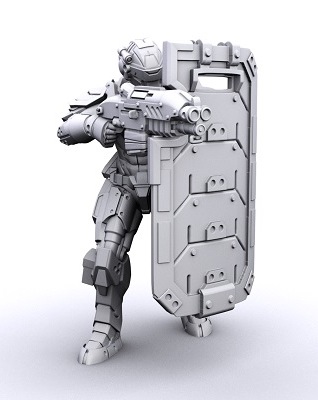
Enforcer-with-ShieldEven though you guys haven’t got the models yet, there are obviously people who want to proxy some Enforcers with defender shields. Alternatively, you might be playing in a campaign and have acquired them there. Either way, here are not only the rules for defender shields (which you’ve seen before if you visit often), but an explanation of why they work as they do.


Real Shields

There is more than one type of shield, and each type is designed and used differently. I have a habit of starting with reality and extrapolating from there. So, defender shields are based on how modern security forces use them. How is that? Well, modern militaries tend not to use shields at all unless they’re acting as police, so the nearest analogue we have are the police themselves. Riot squads and SWAT team equivalents across the world use 2 main types of shield: riot shields and ballistic shields.


Riot

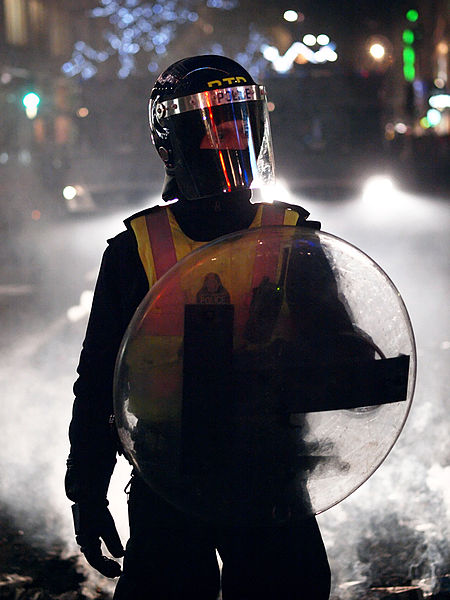
The first type of shield comes in two broad shapes: round or rectangular. They are generally see-through plastic shields and are used mainly by riot police.

Riot shieldsThe most common type is the large rectangular variety, with or without rounded corners and in various dimensions. These are mainly designed to be used in walls to contain the disorder, blocking off some areas and advancing in formation to shove the protestors where the police want them to go. They are also good protection against thrown stones, molotovs and the like. They are not bullet proof. In may ways they are like the Roman legionary’s scutum, being are designed to work en masse and in formation.

London_Met_Police_riot_gearThe small round shields are lighter and more easily portable. They are designed for a number of peripheral uses, sometimes being given to leaders and those not intended to be part of the main “battle line”. They are also sometimes issued to snatch squads and similar groups who deploy on more fluid missions, needing to move quicker and not in formation. They often hide behind the main shield wall until needed. In terms of construction these round shields are the same as the rectangular ones.


Ballistic

“Dynamic entry” is one phrase I’ve come across to describe the situations in which more than the typical riot shield is needed. If the bad guys are holed up somewhere defensible, and they are well-armed, you may need to go in very forcefully to overwhelm them. In these situations you’re likely to take fire, so you need more protection than a riot shield is going to offer you. This is what ballistic shields are for.

800px-Special_Reaction_Team_prepares_to_charge_into_a_room_to_rescue_simulated_hostages_taken_by_simulated_perpetrators_during_a_Force_Protection_Exercise,_2004These are very heavily built and can withstand direct weapons fire. They are generally used by already armoured troopers, and are an additional, mobile piece of armour to hide behind rather than something to parry melee attacks. The one shown above is a relatively light one. The really serious ones are wheeled. Of course, if you’re wearing a full suit of futuristic armour then you’re likely to be able to carry the serious ones without help.


Rules

The defender shield is a ballistic shield, not a riot shield. The rules are the same they’ve been for a while:

When a model with a defender shield is moved to a new position, always align the shield with one of the four sides of the cube on the level you are on (ie, not the top or the bottom). Any attacks that trace a LOS across that side of the cube count the model holding the shield as having +1 Armour.

This reflects the sort of static protective benefit that ballistic shields offer and allows models that are so equipped to withstand a lot more punishment. This is what they need when they’re on point, which is what it’s designed for.


All pictures except the top one from Wikimedia Commons. 
Posted in Deadzone, FAQ | 11 Comments

Deadzone FAQ Updated

As promised, I’ve expanded the DZ FAQ. I’ll post a further update at the end of the week.

If you have any further questions, please post them to that FAQ page rather than here.

Thanks

Posted in Deadzone, FAQ | 9 Comments

Deadzone: The Complications Table And “-” Values

Rebs-Judwan-MedicModels that have ben resurrected or have been treated with emergency medical aid may suffer complications in surgery, as you might expect. This reflects the fact that dead guys should really stay dead, and people heal best when left to do it over time.

Some of the bad results on the table are stat reductions, as physical or mental faculties are degraded in the process of either bringing them back from death or rushing their healing. But what happens if the model in question has a “-” value for the stat to be reduced? The answer is simple: nothing. Well, nothing bad, at least. They recover without mishap as if they had rolled a 6-8 result.

Now this has caused a few highly analytical folk to raise their eyebrows. Surely this gives models with “-” stats an advantage? Well yes, technically it does. In the unlikely situation that a model reduces their stat to the worst it could possibly be they will die, and a model with a “-” value for this stat is obviously immune to this. However, this is only a very slight benefit indeed. To start with, there are only 2 models currently in the game that have a 7+ stat, and could threfore die with one bad roll. All other models need to get themselves into this situation repeatedly and then you have to have and choose to spend the points to resurrect or buy emergency care, and then they have to roll exactly the same result again. So yes, being able to avoid this is a bonus, but a tiny one. Most people won’t ever see a model die from reducing a stat this way.

Remember also that the model with this supposed advantage is also labouring under a complete lack of that stat, and so are already at a (IMO rather bigger) disadvantage. The most common stats to lack are Shoot and Command; the former limits your combat ability and the latter can trigger a lost battle. Both are things I think hugely outweigh any benefit that may accrue in the very rare (and somewhat self-infllicted) situation of repeated complications.

Posted in Deadzone, FAQ | 1 Comment