It’s Quiet, Too Quiet…

Well you may be forgiven for thinking that I’d fallen asleep at the wheel there, but I’m still here. Been very busy working on some projects that I sadly can’t tell you about yet, other than to say that it’s looking like quite a few things (at least 4) I’ve designed will come out next year. That, in itself, is pretty exciting (for me, at least), but there’s more.

I can tell you that DKH3 is coming along nicely and that future plans for the series are looking good too. This is far from the end for the naughty folk rampaging through the Dwarfs’ ancestral home.

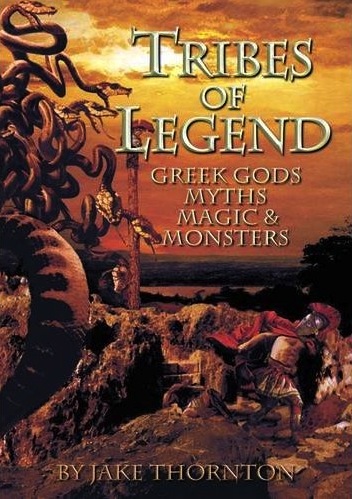
I’m looking at the possibilities for support and expansions for Tribes of Legend so that things are in place when the slow boat from China finally arrives.

I can also tell you that the fantasy tabletop game I’ve done is currently slated for the first half of next year. So that’s cool too.

Finally, there are some really oddball possibilities currently kicking about that step outside the normal run of Fantasy/SF backgrounds as we know them. It’s quite exciting to be working on something nice and original 🙂

On top of this work stuff I’m wondering whether it’s worth putting up some of the early stages of a campaign environment I was working on to play Stargrunt II in.

But that’s all next year. In the more immediate future I’ve got a load of first look/open box type reviews to put up, with more in-depth ones to follow, plus the first of what will probably be several book reviews. I’ve decided that it’s worthwhile including a few books among the reviews in order to illustrate their possibilities as sources for game and scenario ideas as well as the more obvious painting, modelling and suchlike volumes. They are, in many ways, as much a gaming resource as the terrain.


Posted in Random Thoughts | 8 Comments

Avert Your Gaze

No, the title doesn’t refer to the Medusa, but I am talking about the forthcoming Tribes of Legend from Foundry.

Apparently Foundry has been trying to upload some pictures of the pages so you can all have a look inside, and several of them have been rejected by the Guardians of Morality at Amazon for having boobs showing. We are talking here about models of harpies and Amazons here (ironically), not hardcore pornography, but it’s a funny old world.

As a comparison, I tried putting “porn” into Amazon’s search engine to see what would happen, and you get far more explicit images from their web site than a bunch of toy soldiers, I can tell you. All very strange.

Anyway, just to let you know that you may have to get permission from a responsible adult to be allowed to gaze upon the naughty bits of the Amazon and harpy models (and some of the goddesses too, I suspect, like the floozie shown here). Oh, and in other news, the models themselves may be coming out sooner than I’d thought too 🙂

Posted in Tribes of Legend | 6 Comments

Dwarf King’s Hold 3 – Points System

One of the reasons I’ve been thinking about points systems of late is that I’m including one in the next addition to the Dwarf King’s Hold series of games. This third set (cunningly codenamed DKH3) is in development at the moment, and is due out early next year. Unlike the first two sets, this is not a standalone game, but builds on the earlier releases of Dead Rising and Green Menace. One of the core features will be more troop types for each of the existing 4 races, together with a mechanism for building your own choice of force for each scenario instead of just using the ones given (ie, a points system). You’ll also be able to play any of the existing scenarios with any of the 4 races, in any combination. At least, I think you will. There are a few wrinkles left to iron out, but that’s the idea. This will mean that you’ll be able to get loads more game play out of each of the existing scenarios as they can present very different challenges when you change both sides.

If you’ve read my comments on the future of DKH you’ll know that I was wanting to fit in some new races. Unfortunately that isn’t going to be possible. I’ve already bumped the rulebook up by more than 50% in size and it’s still creaking a bit at the seams. There’s just too much stuff I want to include. The Abyssal Dwarfs and the rest of the extra races will have to wait for another day.

However, the good news is that DKH3 will include about 20 new types of model to play, a points system to design your own forces, rules for 3 and 4 player games, rules for putting any army into any existing scenario, some completely new scenarios, new tiles, models and so on. Overall my idea is not to make it a different game, but to take what’s already there and give you the opportunity to explore it further.

Posted in Dwarf King's Hold | 25 Comments

Design Theory: An Alternative To Points

As with my previous article on points systems, I’m talking here about the mechanisms used to produce balanced and “fair” tabletop miniature games. Those used in board games are slightly different.

The more I thought about possible alternatives, the more obvious it became that logically there were none. If you stick with the parameters I defined in the first article and ignore the storytelling and narrative approach (for now), then you must use some variant of a points mechanism.

If you want the sides to be equal, fair or balanced (pick your dubious and debatable term) then you need some form of measuring stick to quantify the varying abilities of the myriad troop types available. Regardless of whether you define them as individual models or units, and whether or not you accurately account for the synergies and multiples I spoke of in part 1, you still have to allocate each feature a value, ie you have to use a points system.

Most often, a game will use this in its “raw” state. Model/unit A costs 5 points, model/unit B costs 10 points, etc. Both sides agree on a total for the game and choose models for their army until they meet it. This supposedly makes things “fair”. This system is familiar to most gamers.

You can try to hide this approach by sticking another mechanism on top. A few options were mentioned in the comments for the previous article. For example, you could have a system of card draws. Each side has a deck and a scenario calls for a certain number of cards for each side. You may be allowed to swap or refuse a number of cards. However, despite the fact that each card may be different and drawn at random, what you have changed here is not the points system that must underlie the things that are on the cards, but the means you use to choose an army. Varying army selection is another (related) topic and doesn’t change the fact that if you want to have games that are at all balanced the items on each card must (at least roughly) equate in game value. In other words, they must be based on a points system, however rough.

I once devised a hugely baroque and involved flowchart for army selection in a fantasy game about mercenary armies, but despite the fact that it looked very different on the surface, and felt different in use, it was still based on points underneath. This was just changing the army selection rules.

My thinking here is that we cannot escape the logic that in order to balance something we must quantify it, and quantifying it means a points system. It doesn’t matter what you measure things in, it’s all logically identical. This, in turn, suggests two further thoughts:

1) as they are inevitable let’s do them properly. “If a job’s worth doing, it’s worth doing well”. Trite, perhaps, but I do believe it. The first article covers a number of common failings.

2) even though the core concept remains the same, it can be dressed in a variety of interesting fashions to engage the gamer in different ways. The points system is only part of the army selection mechanics, and other parts can be varied to advantage. Perhaps that’s the subject for another post.

Of course, all of this is only relevant if you feel that gamers should be playing balanced and fair games. It is by far the most familiar format these days, and I still use it because of this familiarity. However, perhaps my favourite variation of presentation for points systems borrows heavily from a more freeform approach: bidding.

In this system, you have a conventional points system and army lists. These should be balanced and calculated accurately as normal. When it comes to playing a game, the players agree on a scenario to play from the selection offered, and this defines what they were bidding for. Let’s imagine the scenario is Rourke’s Drift in 1879, where thousands of Zulus besieged a tiny force of British redcoats. For the purposes of bidding, one side is fixed. Let’s say the Zulus get 3000 points of warriors. Both players then secretly bid to play the other side. What they are bidding is the minimum number of points they think they could win with. They player who bids lowest gets to play that side using however many he has bid. His opponent gets to prove him wrong.

The nice bit about the bidding system is that it reduces the importance of the points system and allows the players to define what is fair for them (thus accounting for their varying skills, etc, which they know, but which the designer cannot hope to factor in). It’s also a fun way of setting up a game and introduces an entertaining extra element of bidding, bluff and bragging rights.

As you can probably tell, my personal preference is for the more storytelling and narrative approach, and we’ll come to that next.

Posted in Game Design Theory | 41 Comments

Design Theory: Why Points Systems Will Always Be Broken

There he goes again with the contentious statements. Well, not so much, as you’ll see. Here I am talking about design theory, and that differs a little from practice.

The points systems I’m talking about here are those used in tabletop miniature games to choose the armies/gangs/warbands and so on you fight with. Their intent is to produce a “fair” and even game between supposedly equal forces, and in this aim they are invariably doomed to failure, for reasons I will explain. However, despite this, they are still the best tool we currently have for picking reasonably even forces from variable lists. What is important is not that they will fail to be perfect, but that we know that they will do so and do not expect them to always be right.

So why do I say they will fail? The easiest way to explain is to go through the process of producing a points system.

Let’s say you’ve come up with a new tabletop game for fighting fantasy battles. There are many different types of warrior in your game, from lowly goblins to mighty dragons, and everything in-between. You could play narrative and scenario driven games in a rather 1970s sort of vibe, with no worry about the sides being balanced or fair. Putting to one side the debate on the relative merits of different gaming styles for the moment, let’s assume you take the more currently fashionable approach of aiming at a tournament style “balanced” game. Unless we think of something better, this means coming up with a points system.

In a points based system, each type of model or unit in the game is given a cost, and the armies are chosen to an agreed total. If the points are worked out right then everyone assumes that this makes the game fair. The cost of a unit is generally based entirely on its “stat line”: the list of game values it uses to move, fight, cast spells and so on during the game. These values are put into a “points calculator” which gives varying weight to each stat and comes up with an overall value. It’s always possible to do this bit wrong, and there are many debates online about individual units that are seen as being too good or bad for their points cost. Let’s assume this bit is done as well as it can be. There are still problems.

The reason why points systems will never be truly balanced is because this is where they stop. In reality there are a number of other factors that can have a great impact on the value of a unit in a game, and these are seldom, if ever, included in the unit’s points cost. I will give you a few examples.

1) Multiples. Points systems measure a given unit as if it is on its own. Often, points systems measure a single model, and the value of a unit is a simple multiple of the number of figures that comprise it. A more reliable approach is to devise a cost for the unit as a whole, regardless of its constituent parts. If it fights as a whole, then it should be costed as one. A unit of 20 models is unlikely to have exactly the same game value as 2 units of 10 each, even when the individual models are identical.

In addition, the third (fourth, etc) unit of a given troop type is often worth less than the first in terms of adding additional skill or options to an army as a whole. For example, if I add a unit of fast flying scouts then I can zip about the battlefield with them and grab objectives, attack vulnerable units, etc. If I have none of these, then adding one makes a big difference to my tactical options. If I already have 2 then I am starting to run out of places to use them all simultaneously (and so the third is worth less).

Sometimes the third of a given unit type is worth more. For example, if you have a very powerful shooting unit then it is good to have one. However, if your whole army is composed of them then they may be so powerful that they reach the point where they can destroy the enemy at will before they can test their vulnerabilities.

2) Synergy. Certain combinations of troops are more powerful than others. For example, powerful shooting units are generally weak in melee. If they are protected by another unit then that weakness can be ignored, and the discount they were given when their points were calculated is now unwarranted.

In many games a combined arms approach is more potent than a monoculture. Having cavalry for the flanks, artillery and archers to shoot the enemy as they approach and melee troops to fight them when they arrive will generally work better than having only one of these. In other games a monoculture may be more potent. Neither concept is included in the points system.

3) Opposing Forces. There are some armies that have an easier time dealing with certain enemies than others. Some match ups naturally favour one side. Points systems generally ignore the values of an army as a whole, focussing instead on individual units and assuming that the whole is always exactly equal to the sum of these parts. It seldom is.

Of course, one can argue that some or all of these factors are actually to do with player skill rather than points systems. Is it not down to the player to pick and choose the army he will take to confront a particular foe, and to tailor his forces accordingly? Possibly. However, that would be the case whether the points system accounted for it or not. If the points system should not include this then I think it is fair to ask why have a points system at all? Why not just say to players that they should pick a given number of units, whatever they are, and allow them to decide what is good and what is lacklustre? Presumably we have points systems to level this playing field, and if we do then we cannot logically abandon it half way through and say it should be player skill that decides just because it gets fiddly to actually work it out.

Many of the shortcomings mentioned above are to do with points systems focussing on the value of a single unit rather than an army (assuming that the army = the sum of the units). Theoretically one could attempt to calculate the modifiers to this value for multiples, synergies and opponents and factor them all in. This would be a vast amount of work, though it could be done. I doubt, however, that it is worth the time.

In reality, the above failings in the system do not majorly impact on the bulk of games played. If a designer discovers a problem that he feels worth addressing, then he will tend to cover these factors by fudging the costs for individual units, abandoning the mathematical system that is typically used to start with. This is a very slippery slope, and leads to compound errors as the game system expands and develops.

Some of the factors involved in a game are not costable because they are related to the terrain on an individual model battlefield, and a designer can never know that in advance (assuming traditionally modelled terrain). For example, let’s imagine we have two units that have been assessed as being of equal value by our points calculator. One unit is a shooting units that is deadly at range, but rubbish up close. The other unit is devastating in melee, but has no ranged attack. If we place our two units on a flat and featureless tabletop a single move apart and give the first turn to the melee unit, then the shooting unit will probably be slaughtered in the fight before they can loose off an effective shot. Obviously the exact game rules will modify this, but that is the normal overall effect. In this situation, the shooting unit is clearly not really worth as many points as the melee one. On the other hand, if we place an impassable river between the two units then it is the shooting unit that has the advantage and is worth more. This is a detail example, but the same principle can be applied to whole battlefields. Terrain placement has an impact on the relative value of units (as does going first or second in most games) and so logically should also impact points values. It never does, and it is hard to see how it could.  

 So what am I saying here?

Points systems are inherently flawed. However, if we are wanting to play a reasonably balanced game then, flawed or not, they are the best mechanical system we currently have and do a fair job, most of the time. What is important is to remember that they do not account for everything and that the more seriously you take the requirement for balance, the poorer job they do.

On a personal note, I still use points systems in my game designs. My calculators are absolute and I never fudge values. If I feel a result is wrong then I assume that I need to change the calculator to include some other factor I have missed (and revalue other troops accordingly). Fudges breed inaccuracy, and are best avoided. I have been able to mitigate some of the above issues, but they are all still present. However, as my current designs challenge a number of accepted norms I felt it was important to leave a few touchstones for folk to feel comfortable with. Points values are one of those.

Until someone comes up with a better alternative we are stuck with points systems. What I’m going to talk about tomorrow is a slightly different approach.

Posted in Game Design Theory | 62 Comments

Amazons on Amazon

One thing I’ve mentioned a few times, is how long it can take between me finishing a project and it seeing the light of day. So, it’s good to be able to finally talk a little about Tribes of Legend, which has just been put up for pre-order on Amazon.

ToL is a collection of 3 different games together with painting guides, scenery building, and all the extra gaming goodness you might expect. The setting is the world of the Ancient Greeks, but as they viewed it rather than as you will see in academic texts. This means that armies include drunken centaurs and lithe Amazons as well as the bronze-clad warriors of the city states.

Of the three games, one is a mass battle game, one a skirmish between groups of a few warriors, and the last is a solo game in the ethos of the old Fighting Fantasy game books (though it is entirely different rules).

Foundry have done a complete new range of models to go with this, and one of the reasons this has taken a while is that it is illustrated with nicely-painted examples of the range throughout. This means that it’s a very pretty book, helped along by rather splendid art alike you see on the cover.

The release date is still a bit up in the air (I’m told that Amazon made up the one online). This is because it is on the slow boat from China (literally) as I type. Once it’s arrived and cleared customs then they’ll decide. Soon though.

Posted in Uncategorized | 33 Comments

The Impossibility of Clear Communication

Writing on the internet is fraught with confusion and misunderstandings, all the more so because I am expressing opinions. Over the weekend I posted my Dreadfleet review 2 to BoardgameGeek. If you don’t know this site and are at all interested in board games you really should go and have a look. It has a data base of over 50,000 games and is the reference site for board games on the net. I thought that I would add my review to the corpus of reference material there because it would temper the shallow glosses I’d so far read. How silly of me.

I have to admit that I was warned against doing so. I will refrain from using the same descriptor of the posting community that I was given, but suffice to say that it was not complementary. Me being me, decided to give them the benefit of the doubt and ploughed on regardless. If you’re interested in following the whole thread it starts here, but I have picked out the nub of the problem below.

The review itself is the same as the one here on Quirkworthy, sans photos, so you’ve probably read it already. There was some debate about individual bits of rules, which was fine. Then we had (and I’m excerpting bits of longer comments):

Poster A: “My main problem with your review is that I don’t believe it to be representative of the true quality of the game (for most players) as well as the slight hinting (which is possibly just me being over-sensitive) that anyone enjoying it is, well, a bit simple.”

Is my review representative for most players? I’m honestly not sure how you could ever test that empirically. Without a possibility of an exacting analysis, I work on the assumption that most people want to have a game in which they can feel their choices and those of their opponent make the difference between winning and losing more often than not. The review basically says that DF is too random to allow this, hence my conclusion.

But everyone who enjoys it is a bit simple? Not what I was saying at all. So I wrote back:

“I don’t mean to suggest that enjoying this makes you simple (as in stupid or foolish). If pushed, I might say it made you less critical than I, or less demanding, or less competitive, but then I often think that it would make life a lot easier to be so, so that’s far from being an insult.”

I know that I am competitive and that I can’t help myself looking at the odds and looking critically at a game’s mechanics. It’s just how my brain works. I also know that this sometimes gets in the way of my enjoying games, which would be more fun if I could turn off the critical and analytical bits of my brain. I have had many discussions with gaming friends over the years on just these topics. Someone else piled in though:

Poster B: “Is this really an even handed thing to say? People who disagree with you can only reasonably do so because they have lower expectations? I’m actually having trouble finding how that doesn’t insult everyone who disagrees with you.”

Being less critical, demanding or competitive seem suddenly to be interpreted as being retarded. Personally, I am less critical of what brand of baked beans I buy than what kind of game I buy. Am I selectively retarded? The accusation is nonsensical, and seeking to find insult where there is none. It also seems deeply ironic because, as I replied:

“the comments you decide were insulting were actually coined by a good friend of mine of himself when we were discussing why he liked some games and I wasn’t so keen. I’m fairly sure he wasn’t insulting himself, nor was that how I intended it here.”

As usual I find myself beset by an inability to communicate (or perhaps by Trolls) whenever I venture out from the calm waters of the Quirk. Perhaps I should confine myself to these shores.

On the other hand, perhaps I really am a rude and curmudgeonly old man, whose arrogant ramblings are universally insulting. Perhaps. But if so, quite a few people still come to read them, and so I shall continue to write my thoughts on gaming as they come to me, and review games as I see them, and try not to worry about whether or not I am repeating what is safe or popular to say. If a game needs panning then it shall be panned; if paeans need singing in its praise, then you’ll hear my atonal croak in their honour.

As always, polite and well-argued comments are very welcome, especially if they have a new angle to illuminate the debate. However, please do try to assume that I’m not out to get everyone. It’ll make life ever so much simpler.

Posted in Random Thoughts | 80 Comments

Dreadfleet Review 2 – More Ships, More Battles

Please can I have my money back?

Those of you that know my writings will be aware that I tend, if anything, to be too even-handed in my approach to reviews, even if I am occasionally a bit blunt. If something is good then I’ll be the first to say it, as I will if there is a flaw. However, I always try to see behind the result to work out the why of the journey, if I can, as well as the what of the result. I don’t write stuff to bash GW or anyone else just because. However, having already posted my initial thoughts, I feel obliged to explain my subsequent ones.

My initial review of Dreadfleet was based on a single play of the first game (as I said at the time), and there I gave the game the benefit of the doubt. Have a look at that and my earlier posts about the contents for a fuller picture. Today I played against another of my regular opponents, Bob, and we had a couple of games. The second was the largest you can have with 5 ships each. Although I would normally want to play rather more than 3 times before giving a proper verdict, the rules for DF are very simple and I feel I’ve learned all I need to know. And had all I can stand.

Sad as it is to say, I think Dreadfleet is the worst game that Games Workshop have ever made. Bar none. I’m not talking about the components here (which are fine), or the price (which is high), I’m talking about the playing experience (which is the worst).

The worst? Really? Worst by Phil? Worst this year? Nope. Worst ever. I’m trying to think of something that comes, as a whole package, further down the list than this, and am failing.

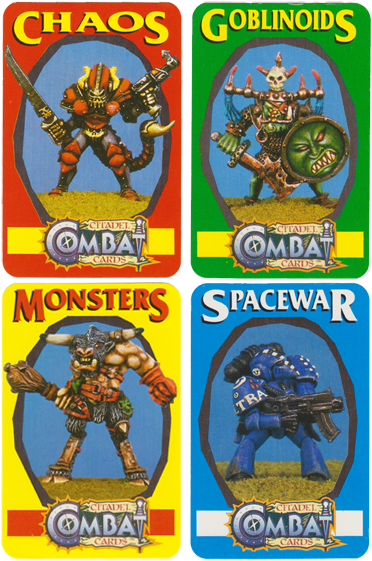
Worse than Combat Cards?

Worse than the Troll games?

Worse than Kerrunch! and SpaceFleet?

Yup, yup, yup.

Combat Cards are (effectively) GW’s take on Top Trumps. A tried and tested forumla that was enormously popular for the reason that it was full of numbers and stats so kids could be the best; it was easily portable and quick to play (you could even stop in the middle, stick it in your pocket and finish it later) so you could play it in break at school or in the car on the way home. It filled a similar niche to the handhelds you see now (DS, etc).

Troll games were trite children’s games, and never pretended otherwise. They had cartoony art in bright colours and a tape of silly songs, all of which was bang on for the market it was aimed at. Playing these games with young children was actually quite entertaining because they were entertained.

Kerrunch and Space Fleet share the odd mechanic of rolling dice in the box lid, but they were still real games where you made actual decisions that had an impact on the game.

Dreadfleet, on the other hand, is a bloated monster of a game that has to breathe in to fit on a 6×4 table. Our game with 5 ships a side took almost 4 hours, and I don’t think it would be much faster with more practice (it was my third game and Bob’s second, and the rules just aren’t that hard to remember). Bob said afterwards that he’d “lost interest about half way through and the rest of it was just a tedious run through to finish the game”. He was not alone. I felt utterly drained and demoralised by the whole thing.

Bob actually won both games (though I think we felt more like winners when we could stop and do something – anything – else). He said there was “nothing I like less than a hollow victory” and both of them had been that. In the first game we went from me winning by a good margin, to me losing on the turn of a card. We were both surprised. Neither of us felt that we’d had anything to do with the victory or loss: it had just happened. And that’s the key failing for me: the game is random to the point of farce.

Now let me just say that I don’t mind randomness in games, nor the use of either cards, nor buckets of dice: they all have their place. However, here the design compounds randomness on top of randomness until you, as a player, have so little input in terms of meaningful choice, that you may as well not be there. The best example of this was Bob turning over a Fate card in the second game that allowed me to put 14 Damage cards on various ships (12 on Bob’s and 2 on mine). This crippled 2 ships and damaged 2 more. It could easily have sunk a couple had the random damage cards been different. Spiralling randomness.

If the game was that random and lasted 30-45 minutes then we’d be fine. Silly randomness is fine in contained bursts and as a “filler” game. Not for something that takes several hours. I had hoped that there would be less randomness and more planning or tactical options with more ships, but if there was it certainly didn’t feel like it.

It is a real shame, and a badly missed opportunity. Despite thinking that the ships would have been much better if they were proper fleets rather than a mish-mash, they are undeniably nice models. They would paint up brilliantly, and even without it they look grand on the “seascape” (mat). Sadly, for me and everyone else I have spoken to personally, the rules let the whole thing down.

Perhaps the core of the problem is that the game seems to have no idea who it’s aiming at. It’s not a kids game because the models are too fiddly and delicate and the art too “arty” and grim. OK, so maybe it’s aimed at the older gamers who may have left the core games and are playing the likes of Space Hulk, Bloodbowl and Necromunda. I doubt this is the case, but if it is then it’s a big miss. The rules make Snap! look deep and tactical.

Which leaves us with the core audience of current GW fans. These are early teens boys who are into 40K or Warhammer (presumably more the latter). Perhaps this level of randomness is what they’re after. Leave your brain in a jar and just roll some dice. That is what I am told 8th edition Warhammer has done, so perhaps this is the coming thing and I’m just too much of a dinosaur to notice. Foolish me wants a game where I get to make tactical decisions: where I make the difference between winning and losing. Apparently that was so last year.

The rule to decide who had won this scenario was simple: Get as many ships off the table as you could, then roll a dice. In our case, after 4 hours of play, we rolled a single D6 to decide the game. On a 1-2 I would win; on a 3+ it would go Bob’s way. Did that make it all feel worth the effort? I’ll let you guess.

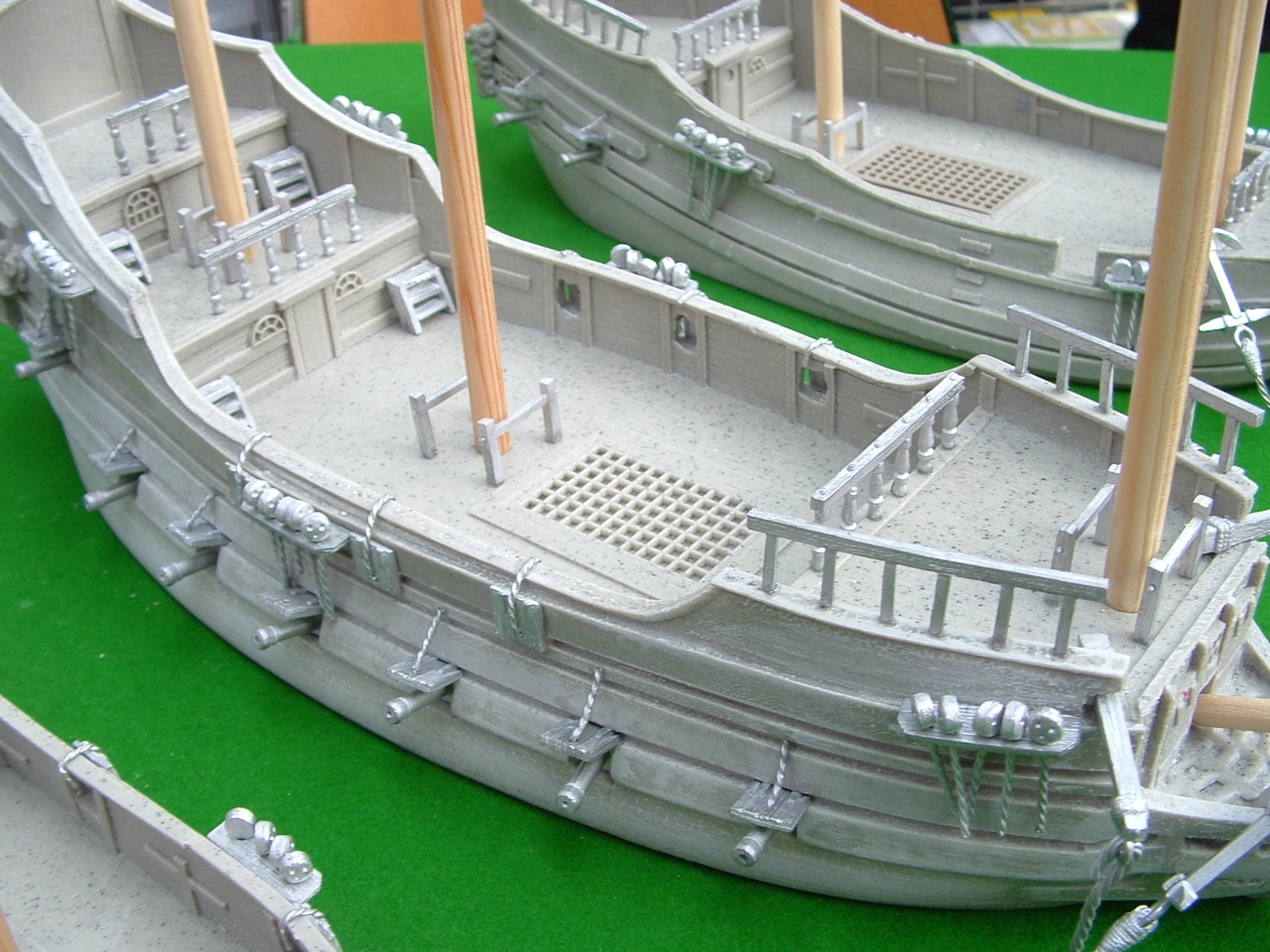
I could have bought a gorgeous 28mm Pirate ship from Ainsty (like the one above) with this money. I could have bought a couple of well designed and entertaining Euro games, or a sizable Epic army or two starter fleets and the rules for any of Spartan’s games, or any one of a wide number of entertaining models and games. But I didn’t; I bought Dreadfulfleet. Whatever you do, avoid making the same mistake as I did.

If you want a game that poses a series of interesting tactical challenges, keeps you on the edge of your seat with excitement and allows you to engage in a cunning battle of wits with your opponent, buy something else.

Pros: the ships and mat are pretty.

Cons: everything else.

Posted in Dreadfleet, Tabletop gaming | 112 Comments

Sarissa Precision Old West Jail Review

Get Out Of Jail Free

So I go into my study this morning, all ready to post something up here, and what do I find? That Frontlinegamer has beaten me to it! Ah well, great minds think alike, as they say (and fools seldom differ). It was, I suppose, inevitable. I spent a large part of saturday wandering round the Derby convention with Jody (who is the Clark Kent  incarnation of Frontlinegamer), and we visited most of the same stands. The Sarissa Precision stand was one of the highlights for both of us, and though Jody knew of them before it was all new and shiny for me. Smelled nice too, of wood and ash; the smell you get when you start to lay a new wood fire and disturb the ashes of the old.

Still, I’d been very organised and had even put out the lovely little jail ready, so I shall not be swayed from my course. Do, however, have a look at Frontlinegamer too, as he’s got more of their buildings as well.

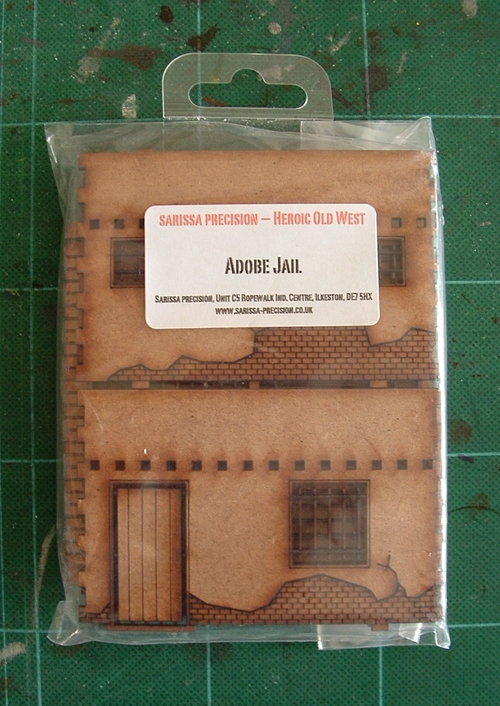
Sarissa Precision make a variety of laser cut buildings in a growing selection of ranges and scales. They started with Old West, and the jail was the one that particularly caught my eye. They have most of an Old West town already in their range (have a look at this), and the bits they were planning to finish it off were a barn/livery stable and railroad station (with cunning round water tower). I think it looks really good indeed. Of course, they say Old West, but you could use it for ACW as well, Jody was touting his for Malifaux, and you might even be able to squeeze one in a pirate game if you tried.

The buildings come in a choice of scales, which mainly means different door sizes, so you can scale the buildings to fit the look of “true” 25mm figures or the heroic 28s depending on your manufacturer of choice and basing style (the one I have here is labelled “Heroic”). That seems a pretty good idea to me, and something I’ve not seen as well developed elsewhere. Given the variance in size of models it’s a pragmatic approach that leaves gamers with enough choice to find the perfect fit for them.

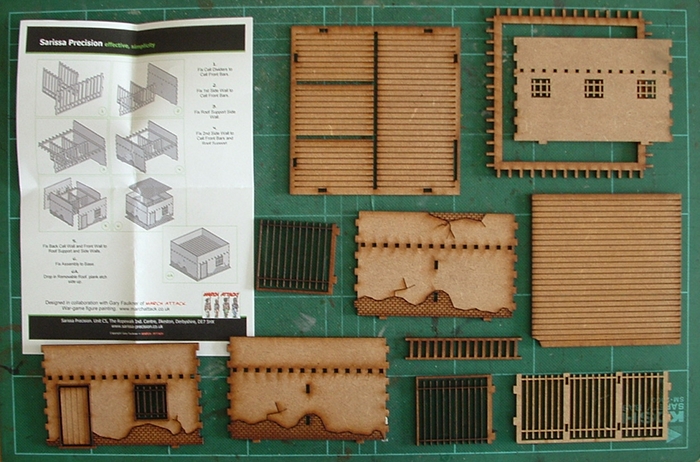
The building is like a miniature piece of flat-pack furniture, so if you’ve ever built anything from IKEA then you’re laughing. Here are all the bits laid out. I’ve left a couple upside down so you can see what they look like on both sides.

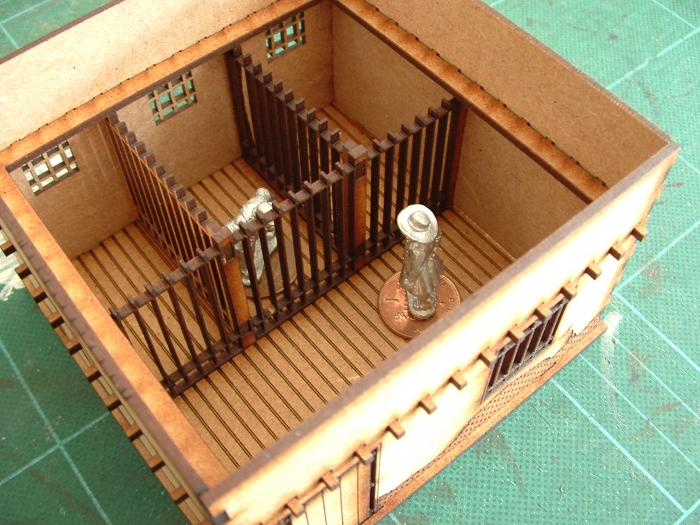
As you can see, there is an instruction sheet included. This is excellent, with very clear illustrations and a picture of the finished article on the other side. If the standard of the rest of their range matches this then it’s going to be really easy to assemble even the bigger buildings. The jail, however, is only little, and took me perhaps 3 minutes to assemble without glue or tools. Very easy indeed. You should be careful of putting too much pressure on the cell bar pieces before they are in place, though I never felt that they were going to break (I’m just advising caution). Speaking of the bars, they’re nice and delicate as you can see in this shot of Sheriff Justice P. Goodbody talking to a local troublemaker.

The roof is designed to be left loose so that it lifts off and you can get inside. The rest of the jail could be glued to make it a little more solid, although it is designed in such a way as to not need glue. The chaps I spoke to on the stand at Derby suggested that you could actually leave them unglued and then dismantle the buildings after play so that they packed away into a small space for storage or portage.

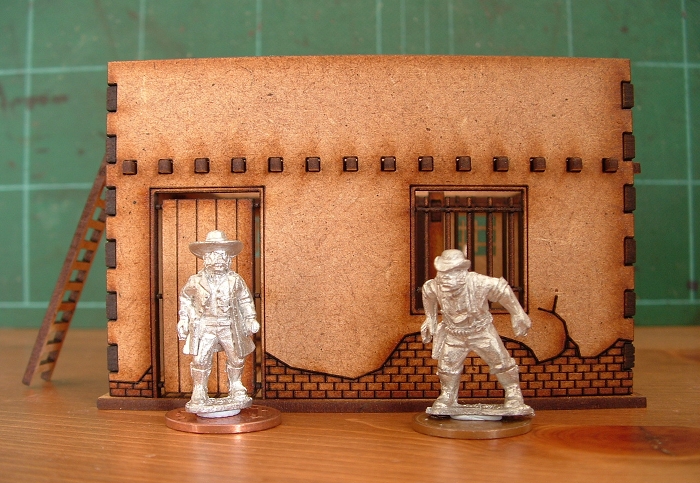
From the front you can see the relative size of the models. These are Old West Foundry models, which are a little smaller than their new ones. Still very usable pieces though, with lots of character. You can see how much difference your basing technique will have on size of model compared to the doorways. Incidentally, the doors are held in place by a handful of tags which are sturdy enough to keep them in position, but which offer the option of clipping them out if you choose. Naturally I’d want a fully functional, opening door, really, and I’ll have to decide if that’s practical. I’m sure someone will work out how to magnetize them. People seem to magnetize everything these days.

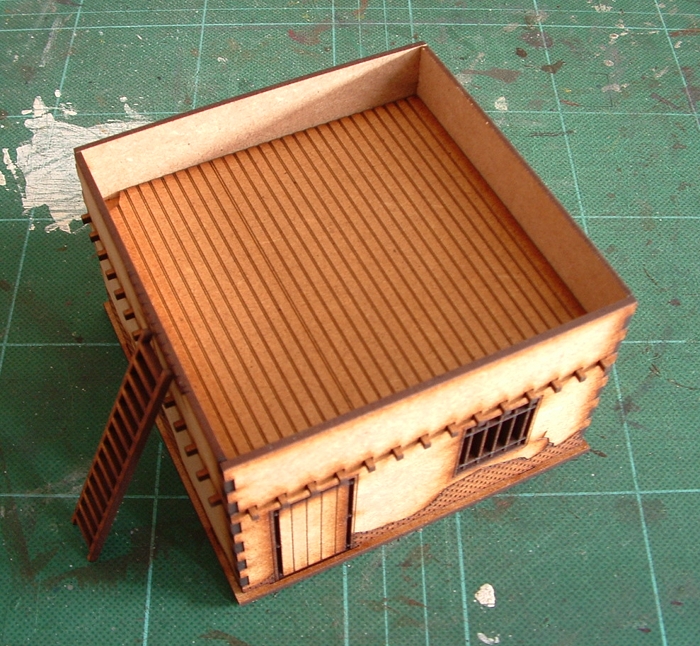
Once you’ve dropped the roof back on you can position models up there. You even have a ladder in the kit for them to get up there with. The whole building kit has been carefully thought through, and it shows.

And once they’re up there they can pull it up so the can’t be got at 🙂

Obviously these buildings are supposed to be painted, and I’ll get round to that. Not sure what the best approach is as this is my first HDF building. I don’t want to use so much water that it warps. Mind you, on the plus side, the building is pretty sturdy once it’s assembled, and if glued it will be even more so. Unless I stick it under the tap I doubt that I’ll have much problem with warpage.

I was going to sign off there, but then I heard sounds of raised voices coming from the jailhouse. It was hard to make out, though it seemed to be grim threats and pithy one-liners…

I crept closer and peered through the window. It was Sherriff Justice P. Goodbody, talking to his “guest”. There was an air of palpable tension (and clichĂ©s) in the air.

The I saw the troublemaker had a six-shooter – it was a jail break!

OK Sheriff. Go fer yer guns!


Posted in ACW, Old West, Terrain | 14 Comments

New Toys and Some Notes

Got a nice package from Forge World this morning. It was quicker than expected as I’d only ordered it on saturday and was told that the staff were mostly at the Games Day in Australia, so that’s good 🙂

Other than that, just a quick post to say that I’ve not been able to organise a Dreadfleet scrap till saturday, but that we should be able to go through a few battles then. Just what it needs: a proper thrashing. Once that’s done I can tell you what I think of it with all the ships on the high seas at once, and the game in full effect. That review should be up on saturday or sunday depending on how long it gets.

Also, a warning that I’m going to be gradually shuffling things about. The way I was intending to do reviews hasn’t turned out to be what I’ve done. The ones I’ve written (posted or otherwise) are generally very long, so I’m going to reorganise things round here to accommodate that. Instead of posting separate articles as I’d planned, I’ll post them all as blog entries and then have index pages that let you find them easier once they’ve fallen off the front page. Tags are OK, but don’t allow me to comment on the relative value of posts. I would like Quirkworthy to be usable as a reference and resource for gamers as it builds up, and don’t see why old content should die (as old blog posts tend to). That was why I was doing separate articles, but I think this new approach will work better.

Posted in Random Thoughts | 8 Comments