
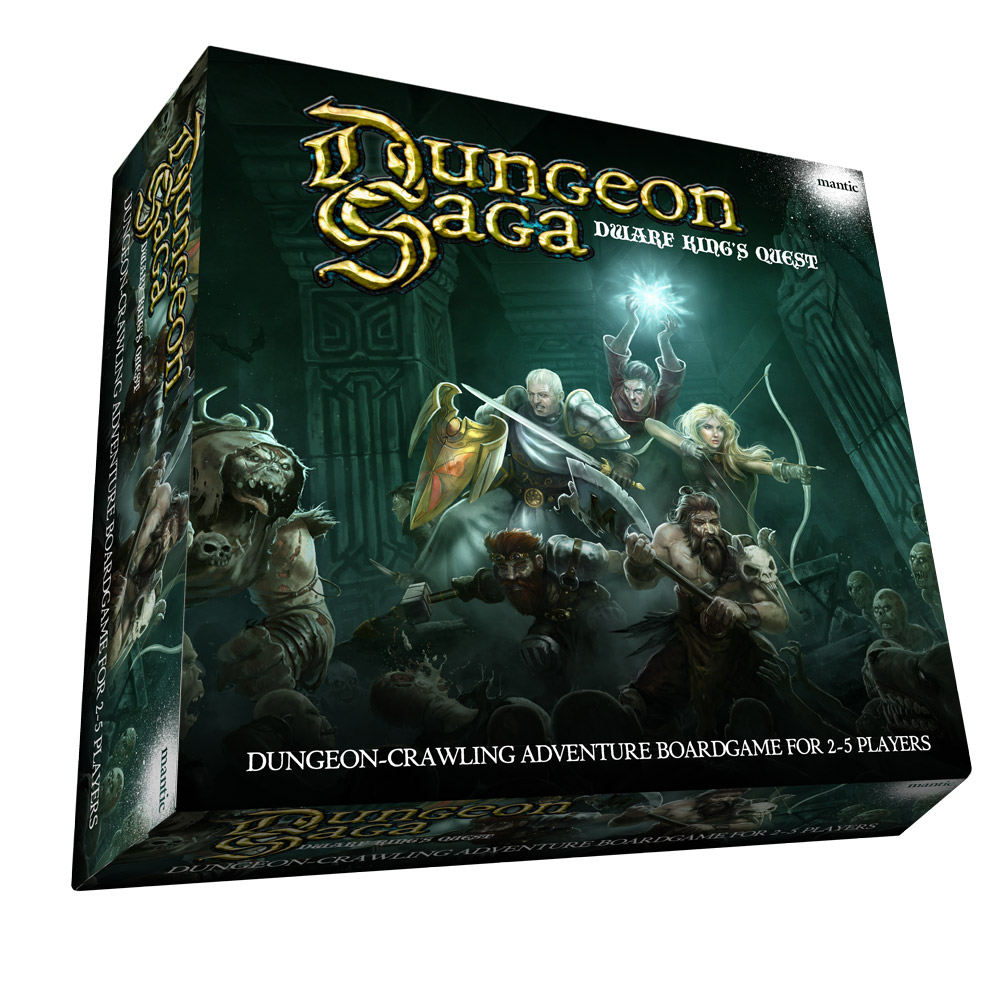
One of the most challenging areas of Dungeon Saga has been deciding where best to make the split between the core game and the Adventurer’s Companion. From the start we knew that there was going to be this division, and we agreed at the outset that the main divide would be in terms of the out-of-game options. The core game was designed to be something you could take down from the shelf, set up and play quickly without needing to make lots of choices beforehand. You just pick an adventure to play and follow the map. It’s ideal for people who don’t play often or just want something light.
But dungeon gaming could be a great deal more than this, and although it’s not what everyone wants, it’s definitely something that many do. So, while the core game is prescriptive to ensure speed and simplicity, the Adventurer’s Companion is a sandbox to play in that needs you to invest more time and creativity between games. Again, this will suit some folk perfectly, but has been sectioned off as it will just be confusing dead weight to others.
At least, that will be the retail split. I think most of the KS backers and my readership here are in the camp that wants both bells and whistles 😉
Anyway, having agreed on that split, we had to decide which elements went in each part, and that’s been very tricky. To be honest, there isn’t a right answer. So, the Adventurer’s Companion is designed in sections that are, where possible, independent of each other so that you can add as much or as little as suits you. Obviously some parts are more independent than others. For example, the experience system doesn’t make much sense without the campaign rules.
So what’s in the book?
Well, so far we have the following areas (in alphabetical order):
- Abilities: Lots more abilities to learn. These allow both Heroes and minions to explore a wide array of different career paths. There are some general rules to explain how to read the abilities and an explanation of those abilities which come in a series of ranked steps. Abilities are split into 5 main areas: combat, general, illegal, magical and musical. Some categories only have a couple of abilities in, but even a single ability can make a big difference to a Hero.
- AI rules/Solo games: rules for replacing the other side. This is the area I’m currently least happy with so I’ll explore this in another post when I’ve done some more testing and am happier with the result. Currently it works, but needs a bit more input from the remaining player(s) than I’d like.
- Bestiary: loads more creatures to populate your dungeons with. These include (where appropriate) the stuff needed to make Bosses of the appropriate race – see DIY Heroes for what this is. The bestiary is broken into families of different creatures, each of which contains several different stat lines of game values and abilities. For example, the Basilean’s include Men-At Arms, Paladins and Sisterhood. The families are: Abyssal Dwarf, Basilean, Dwarf, Elf, Goblins, Ogres, Orcs, and Undead. So far that’s a total of three dozen or so lines, a few of which you’ve seen before (in the Undead list), but most of which are new. We’ve decided to add a few more too.
- Campaigns: how to run them. The core idea is that you play a series of adventures with a Downtime turn between one and the next. Downtime turns consist of several steps such as recovering from wounds and getting gold. Did I mention there was a currency? Anyway, the main thing is choosing the location you will spend your Downtime in. You can always choose the Tavern, and deal another location card per Hero to pick from. Each location offers some benefit. Most require a dice roll; some abilities give you extra rolls; some locations might sell you extra rolls for some of the gold I mentioned. Each Hero can only go to one location each Downtime, though the Heroes can split up and go to different ones if they choose. Once you’ve resolved everyone’s locations then you spend any experience you earned on your adventure. You do this at the end because some locations can offer extra options for spending experience. What I’ve tried to do with campaigns is use features like locations to give a taste of the whole RPG thing without all the complexity.
- DIY Dungeon: this is a somewhat discursive section that goes through the steps to make your own adventures. As this is such an immensely varied process, all I can really do here is provide some guidelines for prospective Overlords (as it is they who build them). The intent here is mainly to provide some structure for you and to point out the main pitfalls to avoid. It’s actually quite a straightforward process – the complexity comes in balancing them, which is really just a case of replaying them till you’re happy.
- DIY Heroes: how to design your own hero. This simple process is a case of choosing which race, gender, profession, bonus and name you want your new character to have. Each step offers a selection to choose from. The 8 races and 9(11) professions form the bulk of this and define the majority of your Hero. Their starting stat line is made up of a baseline from the race, modified by the chosen profession. The bonus is a bit of a wild card to allow you a degree of personalisation, though the real place that new Heroes become individualised is in the experience process. Some professions require additional choices of spells or songs.
- Races: Human, Dwarf, Elf, Halfling, Naiad, Dryad, Salamander, Air Elemental.
- Professions: Barbarian, Bard, Cleric, Demon Hunter, Druid, Fighter (has 3 sub types), Paladin, Thief, Wizard.
- Environment: a few more rules to expand on the possibilities and make the dungeon more challenging. Things like magic furniture, hidden compartments, expanded rules for locks (so they can be picked as well as smashed), plus various types of trap (on the floor or the lock).
- Experience: collect glory by winning adventures (primarily – though there are a few other ways). When you have enough then you go up to the next level. Each time you go up to a new level then you get to pick a bonus of some sort. This could either be money or abilities. Usually, you’d pick abilities. The choice of abilities you have depends on your race, profession and level. Each race has a table with a single experience choice per level. This allows them to be characterised a bit. Then, each profession has two choices per level, again allowing them to be characterised. By having it broken down in this way, an Elf Thief and a Halfling Thief share two out of three choices, but each has a third which is different to retain a bit of variation. A few locations add a fourth choice to this process. It’s making these choices that really individualises your Hero. You may get a second chance to get a given ability at a later level, or you may not. And these variations are cumulative, so after a few levels and a few different choices the Heroes that both started out as basic Thieves (or whatever) could he evolved quite differently. This process is full of hard choices because there are way more cool abilities than you can get. This ensures that no single Hero can do everything on their own, meaning that there is always a reason to be adventuring as a group and playing cooperatively.
- Feats: a list of extra feats, in much the same way as the list of abilities.
- Magic: there are a few bits of general commentary for magic items and spells, but most of this is the decks of new item and spell cards. Spells are broken into families, and a spell caster will know one or more of these. You can only cast spells from families you know. The core family is petty magic, and all spell casters know that. This gives you a sort of bread and butter set of spells. The particularly thematic spells tend to fall under one or other of the families. There are currently over 60 spells and about half that in magic items.
- Random Dungeons: rules (and cards) for building random dungeons for when you’ve played all the pre-written adventures and haven’t designed your own yet. The tiles are divided into groups, each group having a small set of different layouts on cards. You randomise which sets you use and which card from each set you use. This forms your dungeon layout and is only revealed as you explore it. By breaking up the tiles/cards like this you won’t get layouts that you cannot make with the tiles you have. While you’re bumbling around in the dungeon you turn event cards to see what you find. These are generic in description as there are loads of possible types of beastie and Overlord. Speaking of which, just because it’s random doesn’t mean you don’t, or can’t (or should or shouldn’t), have an Overlord. You can if you want to, or you can tie it in with the AI rules. Anyway, the event cards define encounters in numbers of levels of creatures, and the bestiary lists the level of each type. So, you can have an encounter with 15 levels of things. As you decided at the start what type of Overlord you were up against and what models they had to hand, this is actually very quick (and obvious) to resolve on the fly.
- Songs: a few general rules for using songs (they work much like spells), plus the cards to go with them.
You noticed that I said “so far”, right? Well, I think the above covers all that was promised during the KS, but we haven’t stopped yet. Since I wrote the first draft I’ve had a couple of extra ideas I’d like to add (which aren’t in the above list), plus the guys at Mantic have got a load more cool suggestions. So this list may get bigger 🙂
Anyway, I hope this gives you a bit more of an idea what’s coming. I’ll delve into the sections in their own articles. As you can see, there’s a lot to cover, and at over 1,700 words I’ve only really scratch the surface…






 Quirkworthy