One thing about the good old days is that they weren’t all that good. At least, not if you’re talking about variety of stuff you could buy off the shelf, ready-made. These days there are many, many times more of everything available: more miniatures, more scenery, more paints, more rules, more tutorials – you name it, there’s more choice now.
However, back in those long-gone days or yore, when we hadn’t got more than a few card buildings out of old White Dwarfs to stick on the table, we had to make sure own. And, when we did, we used all manner of rubbish: insides of old radios, toilet roll holders, Pringles tubes (once they’d been invented), toothpicks, film cases, and so on. Whatever you could find that had an interesting shape.
While I’m intending to use slightly more robust materials than cereal packets for my own core construction, I thought it would be fun to go back to that nostalgic ransacking to see if I could find any interesting stuff for my Old Skool Skirmish boards.
The first victim was an old router I found. It’s not worth anything on eBay, and it’s outdated so it’s not much use elsewhere. So out came the toolkit…
Here’s what it looked like when I started.
 The dirty white outer case popped off easily enough. Can’t see a use for that. The inner box has perforated sides that look like they should have some use, so I wanted to get into that. Fiddly stuff, but it came apart in the end.
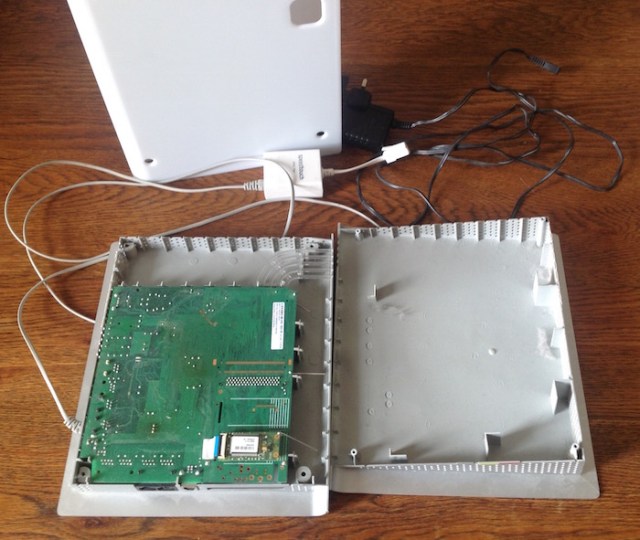 The PCB is mostly rubbish. I’ve seen them used on scenery before, and they look terrible. Just like giant PCBs, which is silly. The trick is to find something that’s got an interesting shape you wouldn’t be able to easily make, but which you can disguise in terms of scale and provenance.
 I’m liking the look of this clear plastic curvy pseudo piping. Not sure what it’s actually doing in here, though I can see it as piping on a tabletop.
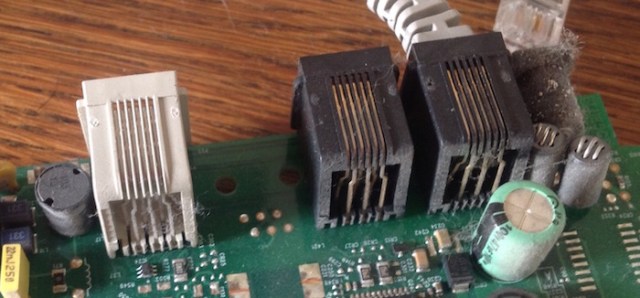
 The other bits I like are the insides of the ports. These look like they might do as air-con units, or something like that once they’ve been taken off the board.
 Then there’s the sides of the inner case, with their perforations. It’s nice and robust, so could be a wall of some sort. Might suit some part of my modernist Plaza.
 I’ve not quite finished hacking off the goodies and dumping the rubbish – I ran out of time before I had to write this. You can see where I’m going though. And this is fun too. You never know what you’re going to find when you crack something open!
Do you game over scratch built terrain made from found items, or are you a buy off the shelf kind of gamer?

 I made a few errors, and then Ben made a couple, but he was a turn ahead of me in the killing stakes, and what had started out as a game either of us might win with Omphalos collecting turned into a race to strike the mortal blow.
 Essen was an experience, and no mistake. The Spiel is vast, and sprawls over 4 public days, plus a day for professionals, and more of set-up. Something of a marathon. All good fun though, and their upcoming game (Mythic Battles: Pantheon) was very well received by both public and professionals, which always makes things easier. It goes live on Kickstarter on the 1st of Nov.
 As I mentioned
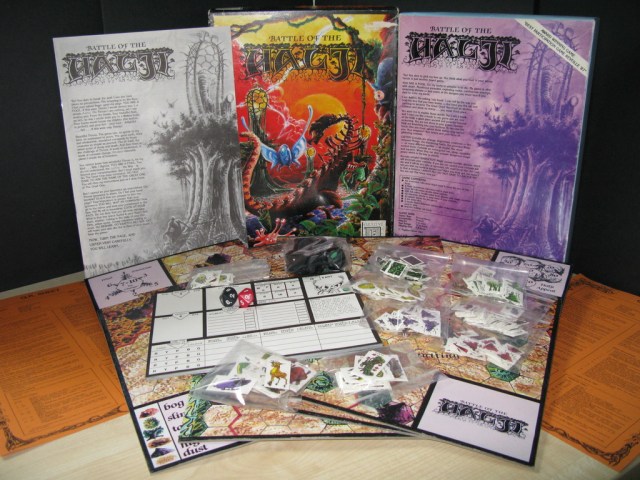
  I’ve mentioned the idea of a Battle of the Halji competition a few times as something to mark its 30th anniversary, next year. Well Chris and I (mostly Chris, actually) have finally finished getting all the files and competition rules sorted out, so the competition is live as of now.


 Quirkworthy
That’s a good question: why is there an entry fee?
Well, there are a number of answers. In no particular order…
It’s a competition rather than a raffle. As a contest of skill, it takes some time to properly judge this, and that time comes out of the only resource I have to pay my bills: time. I strongly suspect that £9 will not cover the actual costs of dealing with each entry, but the fact that it was 30 x 30p amused me because of the 30th anniversary link.
As a point of reference, I visited my mum yesterday and she sometimes enters poetry competitions. These typically cost £5 per poem (up to 40-50 lines long). Now, reading through 2 short poems is way quicker and simpler than dealing with an entire game design, so £9 does not seem unreasonable to me.
There’s also the frequent suggestion that charging for something makes people take it more seriously. I think this is probably true, and so having some sort of entry fee helps with this. It means fewer people will enter, but then this isn’t a serious money-making scheme for us; it’s a bit of fun.
The intention is that people submit whole games, not just ideas. Ideas are not something that we are not in any shortage of, thank you. I’ve already got several hundred game ideas in notebooks.
A big part of the prize is getting published, so naturally we will use the work that the winner submits. That’s the point.
The “chat with the designer” could also be referred to as a free consultation – something I normally charge companies for. If someone is interested in getting into the games industry professionally and having more games published then they probably have questions. Having spent 30 years in the business in a wide variety of roles, I often have those answers.
Note that running this competition is actually more faff and hassle for me and Chris than not doing it. We have no need to plunder your ideas, it’s just that Chris and I thought it would be fun to include other people and give someone a chance to get their name in print. If you’re not interested in this then there’s no need to take part. There’s no compulsion.